


























Views
Downloads

Essential Equal Equations Challenge Worksheet | Grade 6-8
Paste this activity's link or code into your existing LMS (Google Classroom, Canvas, Teams, Schoology, Moodle, etc.).
Students can open and work on the activity right away, with no student login required.
You'll still be able to track student progress and results from your teacher account.
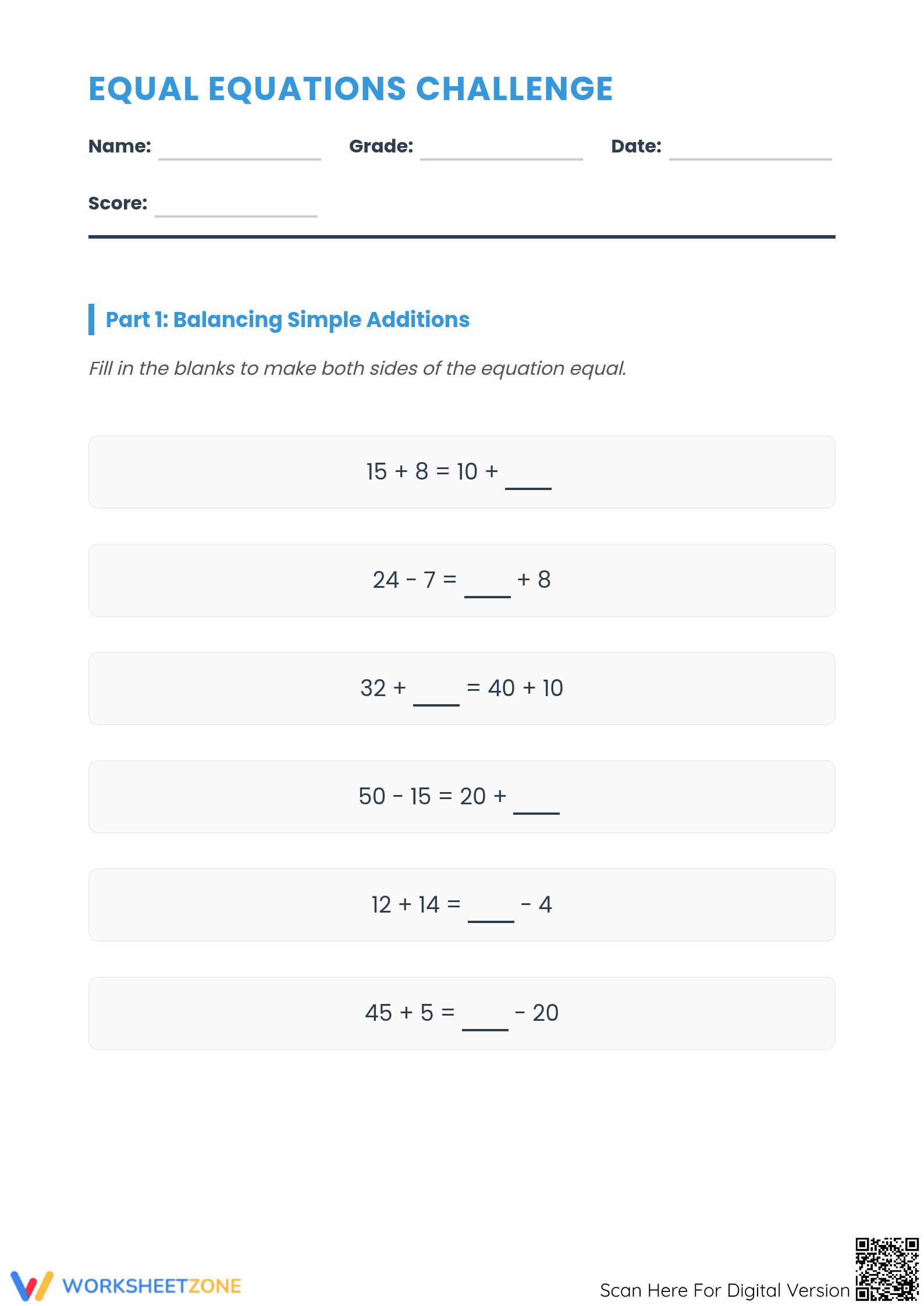
This comprehensive Grade 6-8 algebraic worksheet focuses on the fundamental concept of mathematical equality through 26 rigorous problems. Students move beyond simple calculations to develop a deep understanding of balanced expressions across all four operations. This resource ensures learners can solve for missing values in increasingly complex, multi-step equations and real-world scenarios.
At a Glance
- Grade: 6-8 · Subject: Algebra
- Standard:
CCSS.MATH.CONTENT.6.EE.B.7— Solve real-world and mathematical problems by writing and solving equations- Skill Focus: Balancing algebraic equations
- Format: 4 pages · 26 problems · Answer key included · PDF
- Best For: Middle school algebra introduction and review
- Time: 35–50 minutes
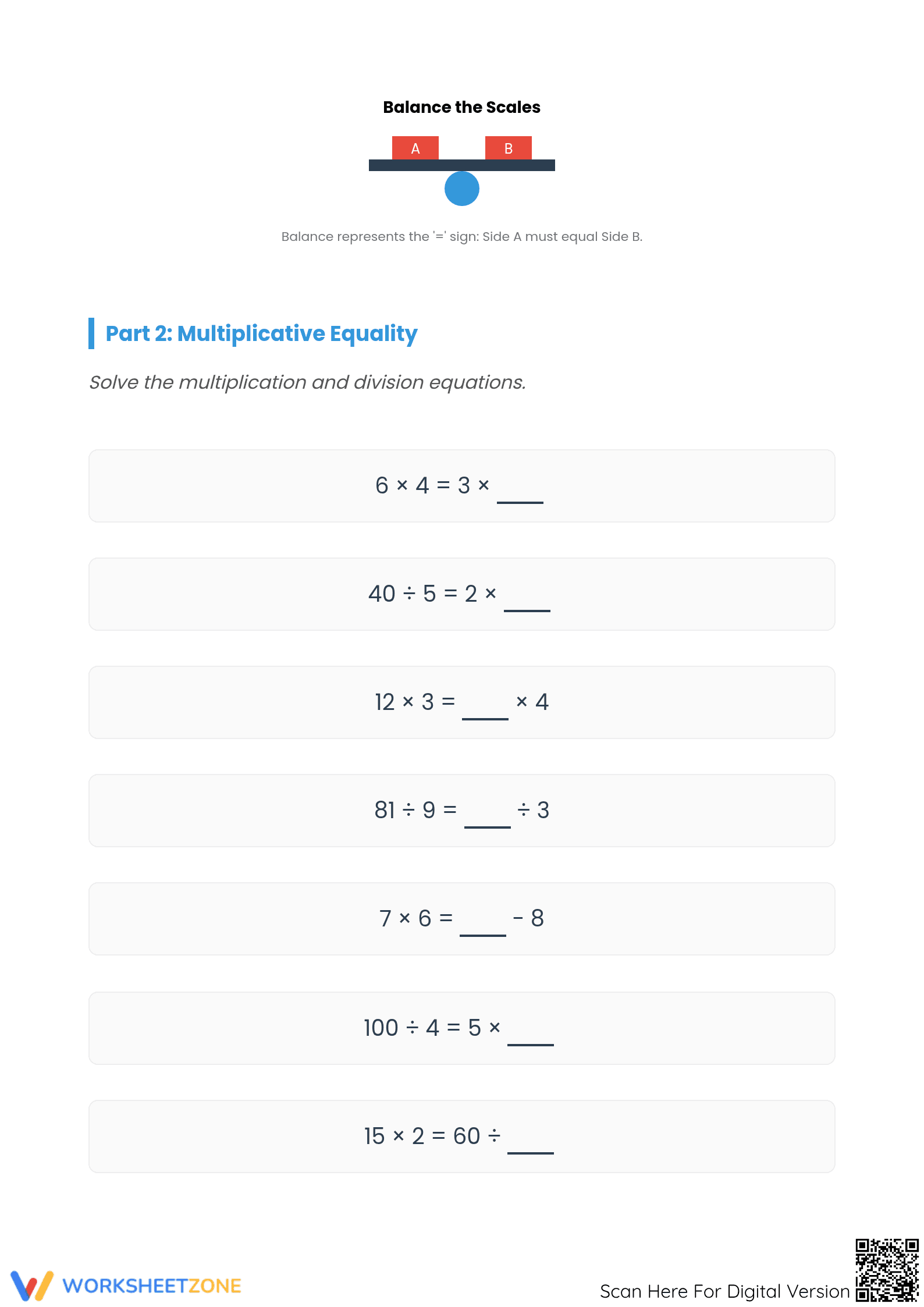
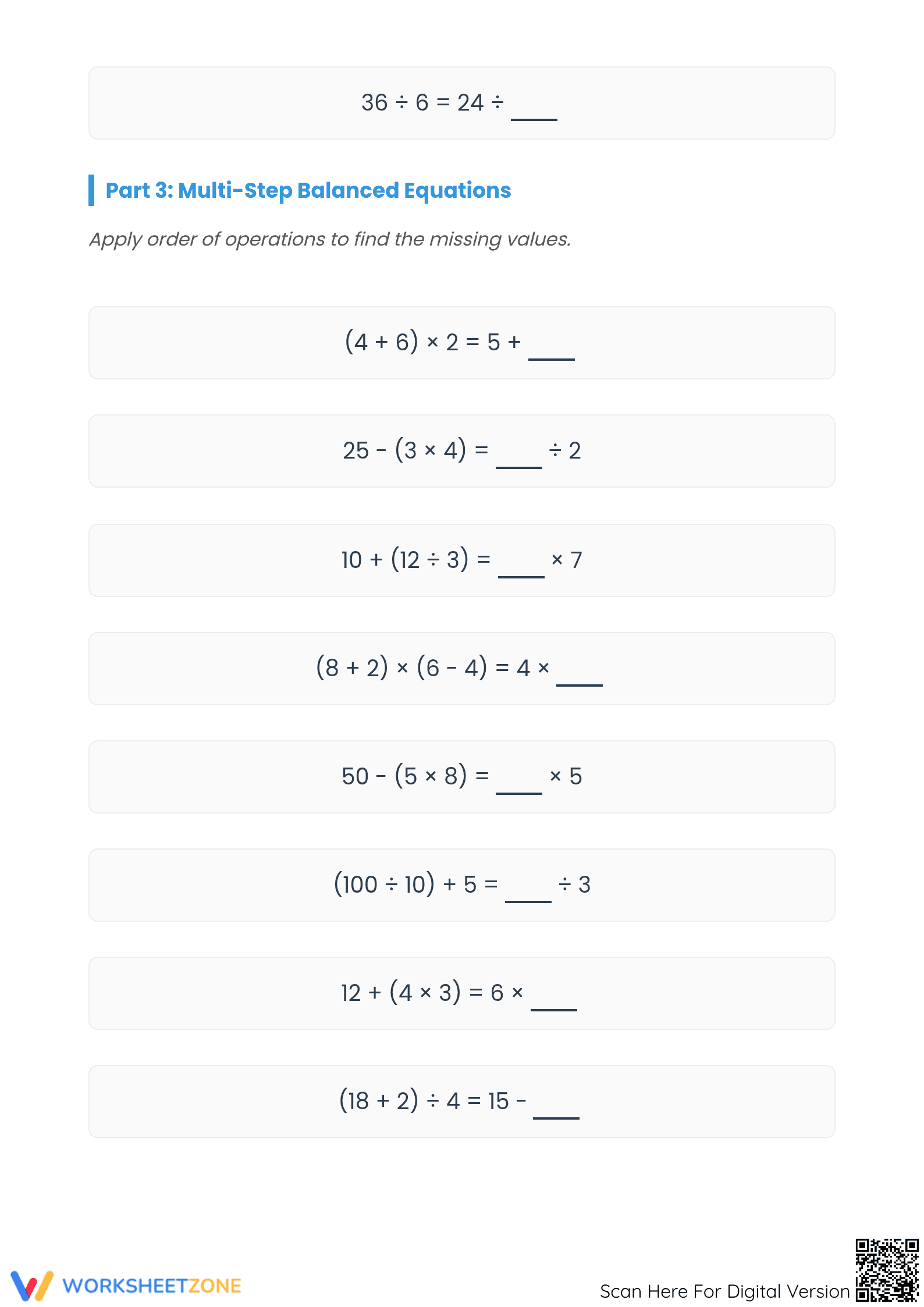
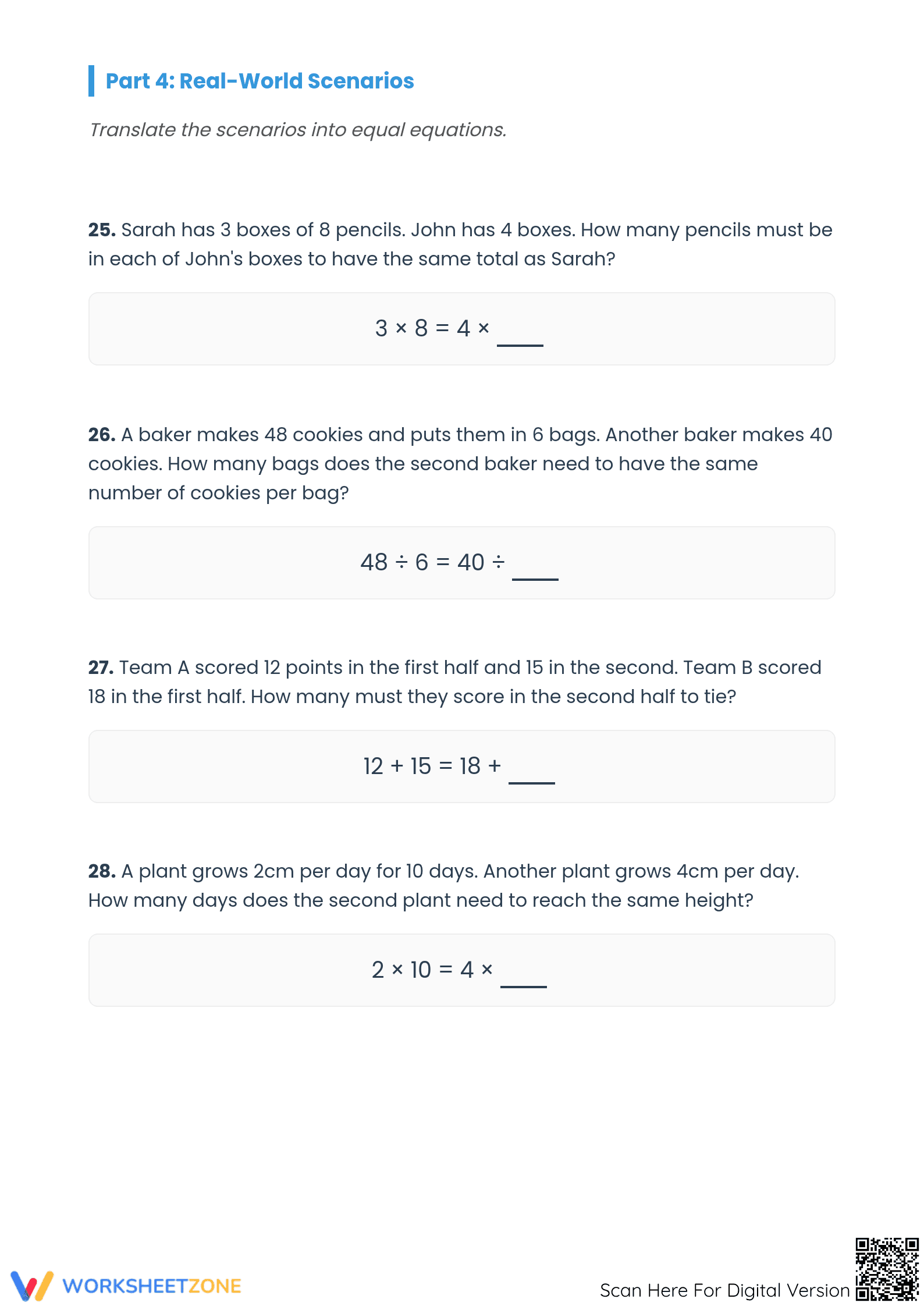
The worksheet is organized into four distinct modules that mirror the gradual release of responsibility. It spans four pages and includes 26 structured tasks, ranging from basic additive equality to complex multi-step problems involving the order of operations. A complete answer key is provided, allowing for quick grading or student self-correction. The layout uses "Balance the Scales" visual cues to reinforce the conceptual requirement that both sides of an equals sign must maintain identical values.
Skill Progression
- Guided practice: Parts 1 and 2 utilize simple arithmetic operations to establish the concept of the equals sign as a balance point rather than a command to compute.
- Supported practice: Part 3 introduces multi-step equations that require students to apply the order of operations to evaluate one side of the equation before determining the missing variable.
- Independent practice: Part 4 presents four real-world word problems where students must translate verbal scenarios into balanced algebraic expressions, demonstrating true mastery.
This sequence follows the gradual-release model, ensuring students have a solid foundation before tackling abstract applications.
Standards Alignment
This resource is primary aligned to `CCSS.MATH.CONTENT.6.EE.B.7`, which requires students to solve real-world and mathematical problems by writing and solving equations of the form x + p = q and px = q. Additionally, it supports `CCSS.MATH.CONTENT.5.OA.A.1` by requiring the correct use of parentheses in multi-step expressions. Both standard codes can be copied directly into lesson plans, IEP goals, or district curriculum mapping tools.
How to Use It
This worksheet is ideal for use during the "elaborate" phase of a 5E lesson on algebraic expressions. After direct instruction, assign the first two pages as a collaborative partner activity. Use Part 3 and 4 as a formative assessment to identify students who struggle with the transition from arithmetic to algebraic thinking. Observe students during Part 3 to see if they are correctly prioritizing operations within parentheses. Expected completion time is approximately 45 minutes.
Who It's For
Designed for middle school students in grades 6 through 8, this resource is also highly effective for 5th-grade enrichment or 9th-grade remedial support. The clear visual layout and scaffolded progression make it particularly useful for English Language Learners and students with IEPs who benefit from structured task formats. It pairs naturally with digital balance scale manipulatives or direct instruction lessons on equality properties.
The Equal Equations Challenge is a high-utility instructional tool that bridges the gap between operational fluency and algebraic reasoning. By centering the curriculum on CCSS.MATH.CONTENT.6.EE.B.7, this worksheet directly addresses the common misconception where students view the equals sign solely as an indicator for a result. This worksheet’s four-part structure ensures that learners encounter the skill in varied contexts, from pure numeric balance to complex linguistic translation, providing repeated, varied practice necessary for long-term retention of algebraic principles.


