


























1 / 2
0
Views
0
Downloads

0.0
0
Save
0 Likes
Share
Energy Release in Chemical and Biological Processes
0 Views
0 Downloads
Paste this activity's link or code into your existing LMS (Google Classroom, Canvas, Teams, Schoology, Moodle, etc.).
Students can open and work on the activity right away, with no student login required.
You'll still be able to track student progress and results from your teacher account.
Information
Description
What It Is:
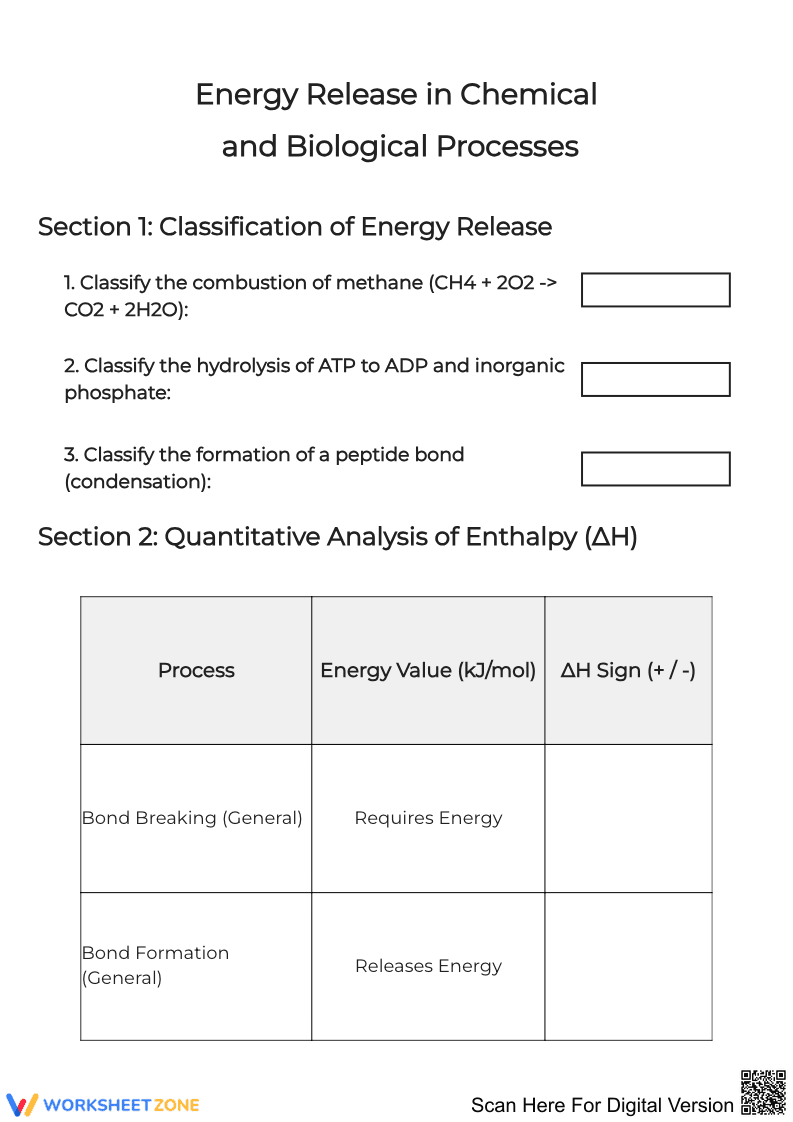
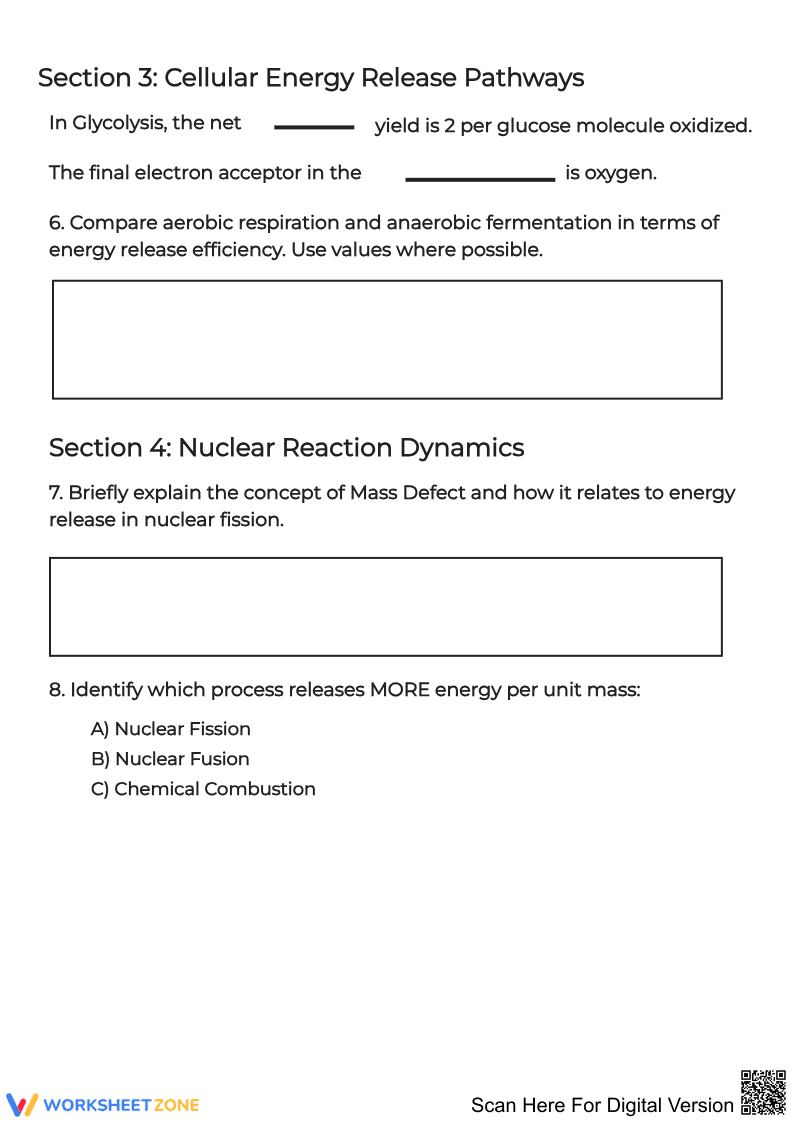
This worksheet explores energy changes in chemical and biological reactions, including combustion, ATP hydrolysis, and peptide bond formation. It also introduces enthalpy (ΔH) and the difference between bond breaking and bond formation.
Why Use It:
It helps students classify reactions as exothermic or endothermic and understand how energy is absorbed or released during bond changes. The enthalpy table reinforces the concept of ΔH signs and energy flow.
How to Use It:
• Classify each reaction as exothermic or endothermic.
• Analyze combustion, ATP hydrolysis, and condensation reactions.
• Complete the enthalpy table by identifying ΔH signs.
• Discuss why bond breaking requires energy and bond formation releases energy.
Grade Suitability:
Best suited for Grades 9–12.
• High school chemistry units on thermochemistry.
• Biology lessons on ATP and biochemical energy transfer.
Target Users:
Chemistry and biology teachers, high school students, tutors, and exam-prep learners studying thermodynamics and biochemical energy concepts.
This worksheet explores energy changes in chemical and biological reactions, including combustion, ATP hydrolysis, and peptide bond formation. It also introduces enthalpy (ΔH) and the difference between bond breaking and bond formation.
Why Use It:
It helps students classify reactions as exothermic or endothermic and understand how energy is absorbed or released during bond changes. The enthalpy table reinforces the concept of ΔH signs and energy flow.
How to Use It:
• Classify each reaction as exothermic or endothermic.
• Analyze combustion, ATP hydrolysis, and condensation reactions.
• Complete the enthalpy table by identifying ΔH signs.
• Discuss why bond breaking requires energy and bond formation releases energy.
Grade Suitability:
Best suited for Grades 9–12.
• High school chemistry units on thermochemistry.
• Biology lessons on ATP and biochemical energy transfer.
Target Users:
Chemistry and biology teachers, high school students, tutors, and exam-prep learners studying thermodynamics and biochemical energy concepts.


