


























Views
Downloads
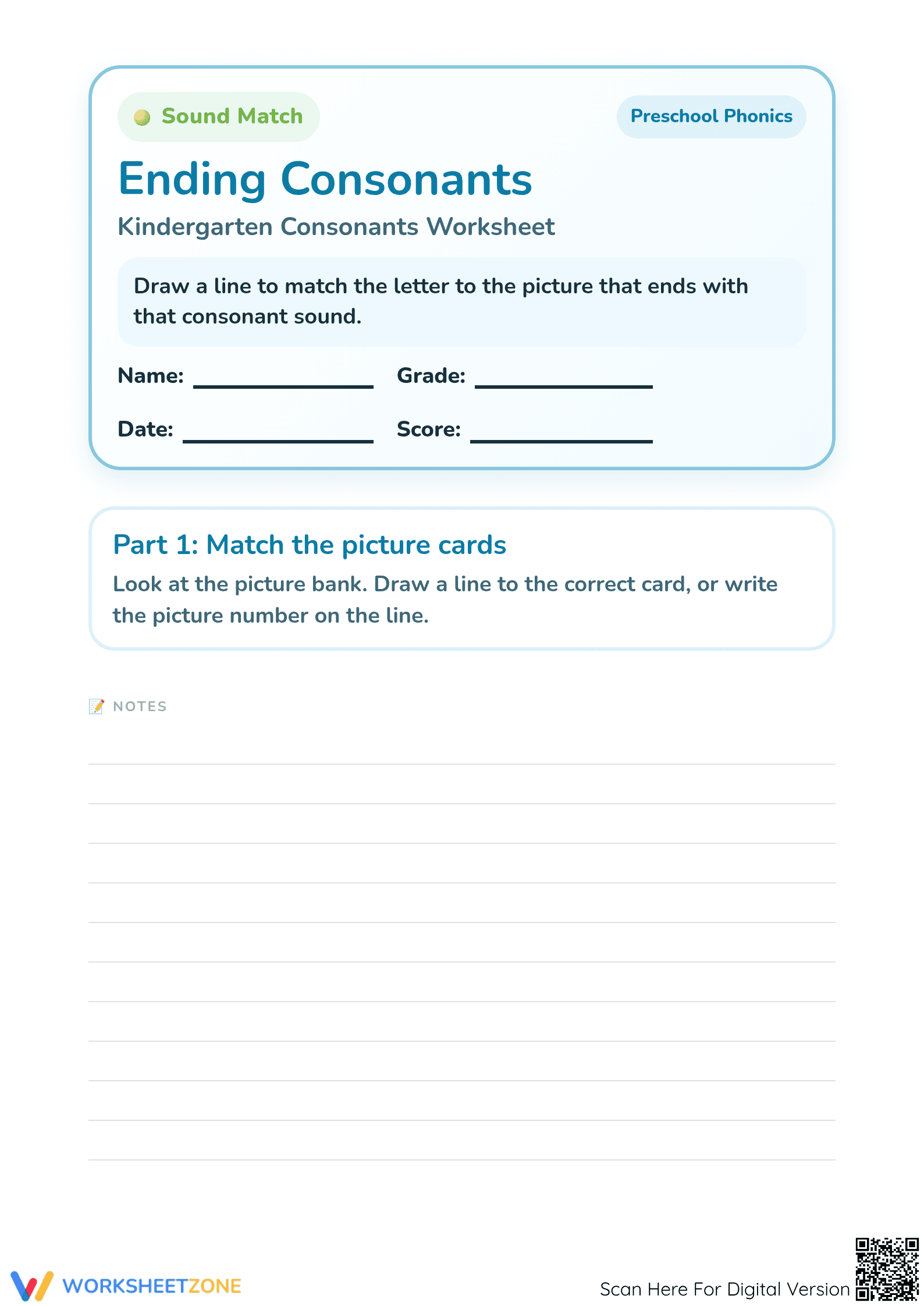

Preschool Ending Consonants — Printable No-Prep Worksheet
Paste this activity's link or code into your existing LMS (Google Classroom, Canvas, Teams, Schoology, Moodle, etc.).
Students can open and work on the activity right away, with no student login required.
You'll still be able to track student progress and results from your teacher account.
Help young learners master final phonemes with this engaging Ending Consonants worksheet. Students identify and match ending sounds for common objects like elephants and burgers, bridging the gap between spoken words and written letters. This resource provides structured practice to ensure early readers can isolate final sounds with confidence and accuracy.
At a Glance
- Grade: Kindergarten · Subject: ELA Phonics
- Standard:
RF.K.2.D— Isolate and pronounce final sounds in simple three-phoneme words- Skill Focus: Ending Consonant Identification
- Format: 3 pages · 10 problems · Answer key included · PDF
- Best For: Independent phonics centers or sub plans
- Time: 15–20 minutes
What's Inside
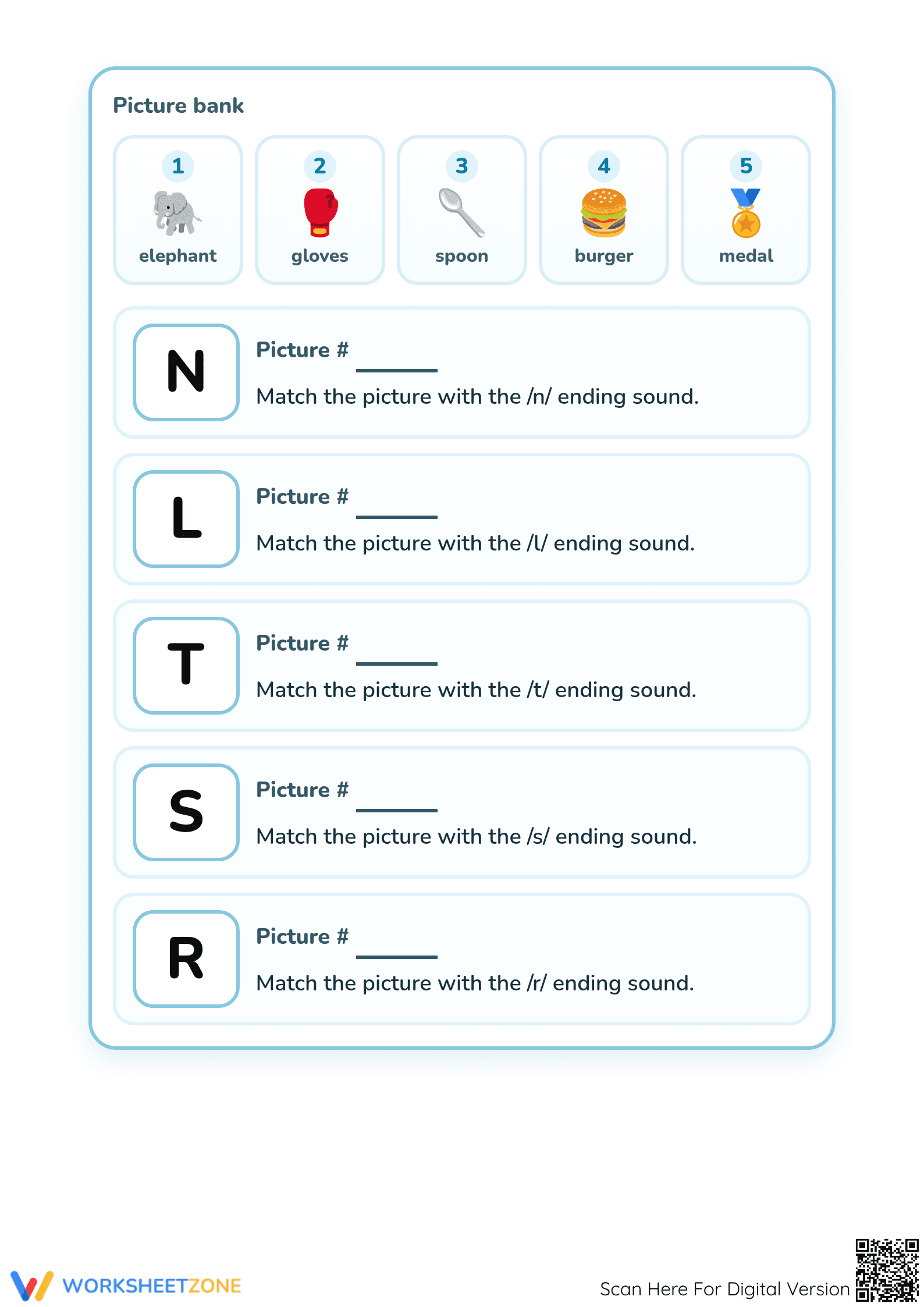
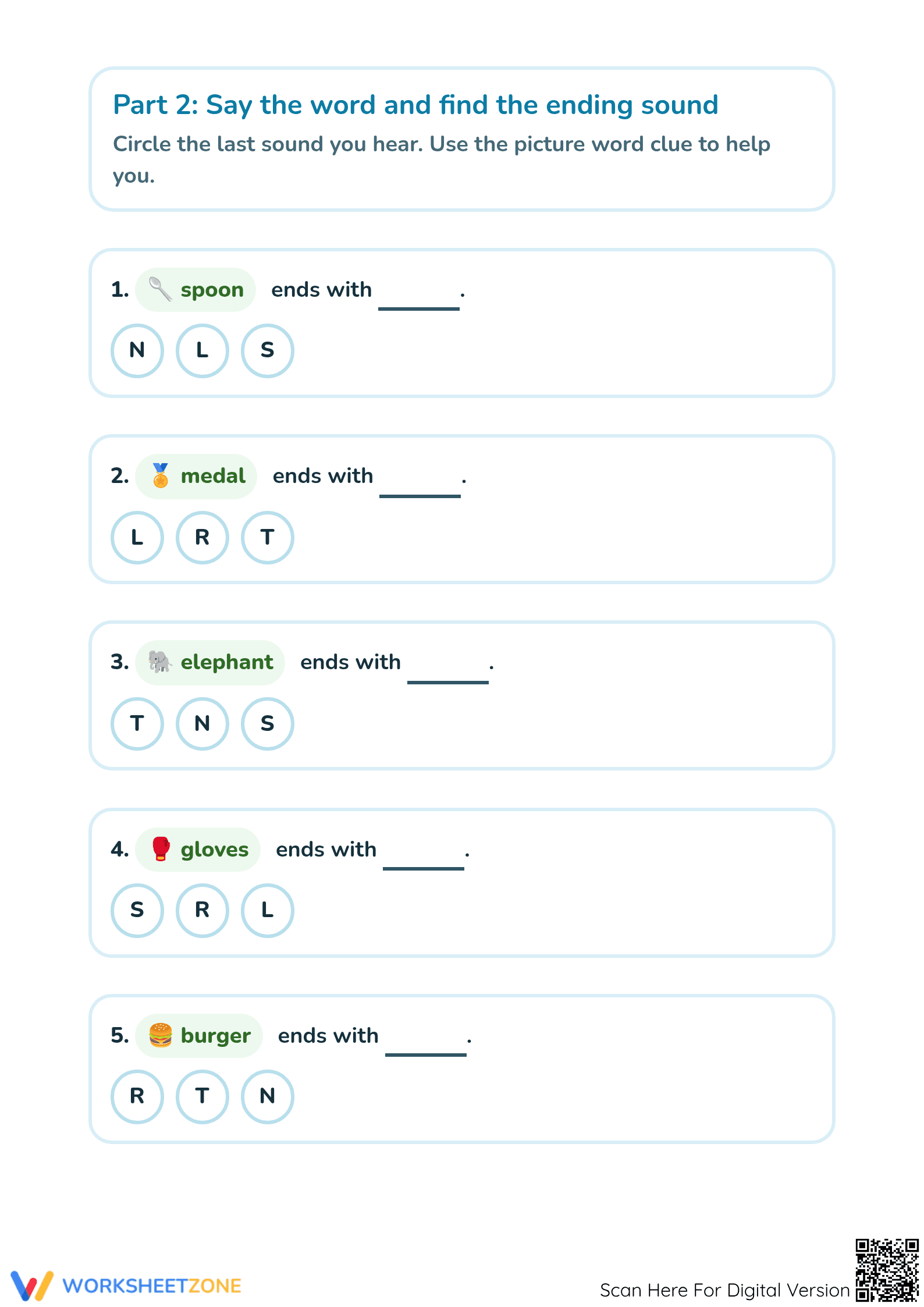
This three-page PDF features a comprehensive approach to final sound isolation. It includes a visual picture bank of five recognizable objects, a matching activity connecting letters (N, L, T, S, R) to ending sounds, and a multiple-choice section for circling the correct terminal consonant. A full answer key ensures immediate feedback for students.
Zero-Prep Workflow
The zero-prep workflow for this resource is designed for maximum efficiency. Teachers can print the activity pages in under 30 seconds, distribute them to students without additional setup, and use the included answer key for rapid review or peer-grading. Total teacher preparation time is less than 2 minutes, making it a reliable choice for busy classrooms.
Standards Alignment
This worksheet is aligned to `CCSS.ELA-LITERACY.RF.K.2.D`, which requires students to isolate and pronounce the final sounds in three-phoneme words. It also supports general phonemic awareness goals found in state frameworks like TEKS and VA SOL. Both standard codes can be copied directly into lesson plans, IEP goals, or district curriculum mapping tools.
How to Use It
Use this worksheet during the "You Do" phase of a gradual release lesson on ending sounds. It serves as an excellent formative assessment tool; observe if students struggle with the liquid consonants (/l/, /r/) versus stops (/t/) to guide small-group intervention. The expected completion time for Preschool or Kindergarten students is roughly 20 minutes.
Who It's For
This resource is specifically designed for Preschool and Kindergarten students who are beginning their phonics journey. It provides necessary scaffolding through visual cues and word labels, making it accessible for English Language Learners. Pair this worksheet with a terminal sound anchor chart or a "Final Sound Scavenger Hunt" for a complete instructional block.
Research from EdReports (2024) emphasizes that systematic phonics instruction, specifically the isolation of terminal phonemes, is a critical predictor of later reading fluency. This Grade K worksheet addresses `CCSS.ELA-LITERACY.RF.K.2.D` by providing ten targeted tasks that require students to isolate and match ending consonants. By moving from visual matching to multiple-choice identification, the resource adheres to the scaffolded learning principles outlined by Fisher & Frey (2014), which advocate for a gradual transition from guided to independent practice. Such structured activities reduce cognitive load for emerging readers while reinforcing the alphabetic principle. This worksheet ensures that students move beyond initial sounds to achieve full-word phonemic awareness, a foundational skill necessary for decoding more complex CVC and CCVC words in subsequent grades. It remains an essential tool for evidence-based ELA instruction in early childhood settings.


