


























Views
Downloads
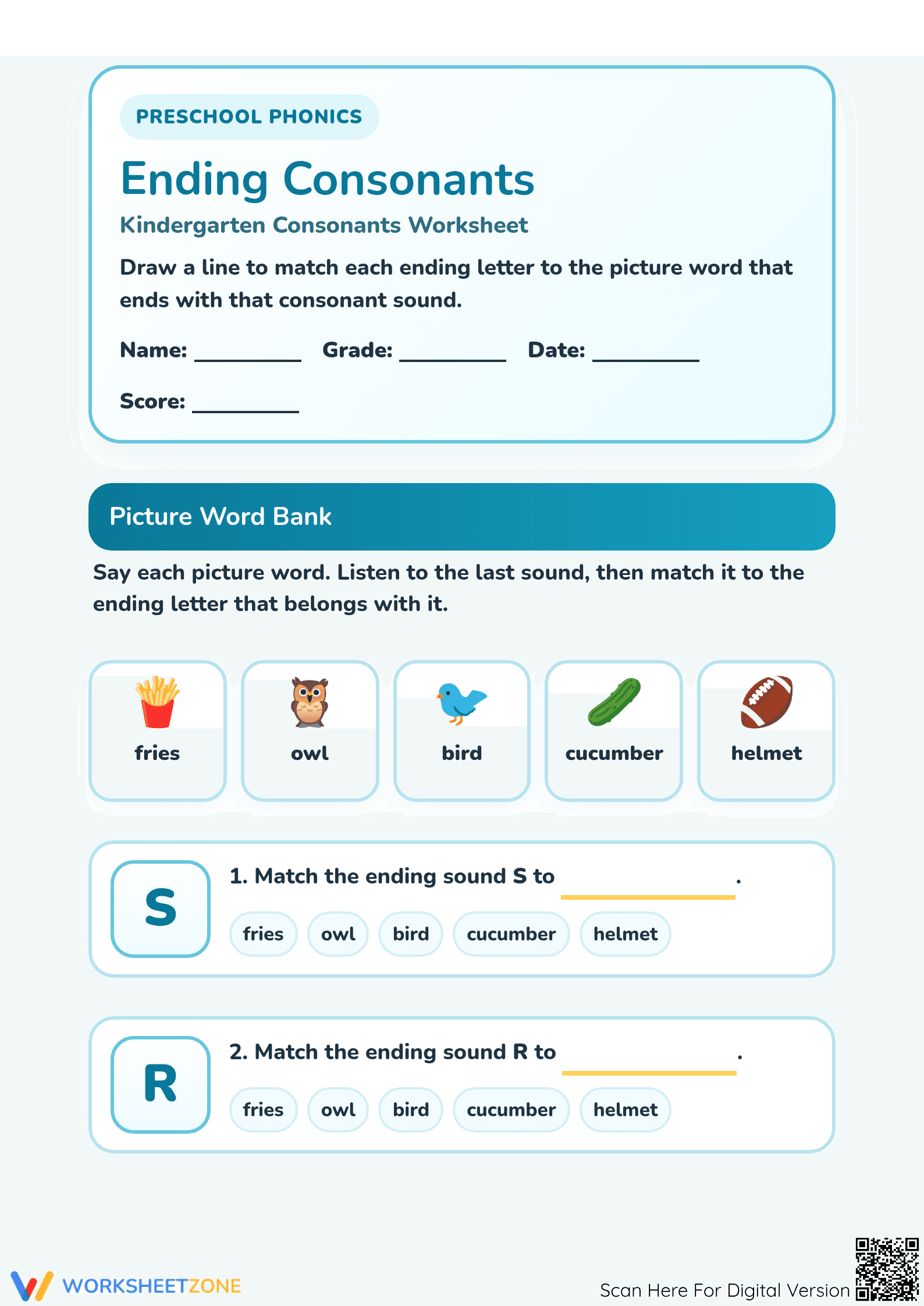


Printable Ending Consonants Worksheet | Preschool Phonics
Paste this activity's link or code into your existing LMS (Google Classroom, Canvas, Teams, Schoology, Moodle, etc.).
Students can open and work on the activity right away, with no student login required.
You'll still be able to track student progress and results from your teacher account.
This Preschool phonics worksheet helps young learners master ending consonant sounds by connecting spoken words to their final written letters. Students practice phonological awareness as they isolate the last sound in common words like owl, bird, and helmet to build a strong foundation for early reading and decoding success.
At a Glance
- Grade: Preschool · Subject: ELA Phonics
- Standard:
RF.K.2.D— Isolate and pronounce the initial, medial vowel, and final sounds in CVC words- Skill Focus: Ending Consonant Sound Matching
- Format: 2 pages · 5 problems · Answer key included · PDF
- Best For: Small group phonemic awareness practice
- Time: 10–15 minutes
What's Inside: This high-quality PDF resource includes two pages of interactive matching tasks. The first page features a vibrant Picture Word Bank with five illustrated examples (fries, owl, bird, cucumber, and helmet) to anchor the phonemic focus. The subsequent sections provide five structured matching items where students select the correct picture to correspond with final consonant letters S, R, T, L, and D. A complete answer key is included for immediate feedback.
Skill Progression
- Guided Practice: The educator leads a choral "say-and-listen" session using the Picture Word Bank to help students isolate the 5 targeted final sounds.
- Supported Practice: Students work through matching the ending sounds S and R, using visual cues from the word bank to reinforce the connection between sound and symbol.
- Independent Practice: Learners complete the remaining 3 tasks on page two, identifying final T, L, and D sounds with minimal prompting.
This sequence follows a gradual-release model, moving from teacher-led sound isolation to independent letter-sound correspondence.
Standards Alignment — This resource aligns with `CCSS.ELA-LITERACY.RF.K.2.D`: Isolate and pronounce the initial, medial vowel, and final sounds (phonemes) in three-phoneme (consonant-vowel-consonant, or CVC) words. While designed for Preschool, it targets the foundational skills necessary for Kindergarten mastery. Both standard codes can be copied directly into lesson plans, IEP goals, or district curriculum mapping tools.
How to Use It — Use this worksheet during your phonics block after introducing the concept of final sounds. It serves as an excellent formative assessment; observe if students are whispering the words to themselves to hear the "clip" of the ending consonant. Expected completion time is roughly 12 minutes, making it an ideal center activity or a quick morning work task.
Who It's For — This tool is designed for Preschool and early Kindergarten students who are beginning to recognize that words are made of individual sounds. It is particularly helpful for English Language Learners who may need extra support with final consonant clusters. Pair this with a physical letter-tile activity or an anchor chart featuring common ending letters.
The mastery of final phoneme isolation is a critical predictor of future spelling and reading fluency. According to research from Fisher & Frey (2014), the ability to isolate terminal sounds like the T in helmet or the D in bird allows students to bridge the gap between simple phonemic awareness and functional phonics. This Grade Preschool ending consonant worksheet provides 5 targeted tasks that reinforce these neural pathways through visual-auditory matching. By using consistent vocabulary in the Picture Word Bank, teachers can ensure that students focus on the phonological demand rather than struggling with unfamiliar labels. The inclusion of a standard-aligned answer key facilitates rapid assessment of phonemic gaps. This resource is essential for any early literacy curriculum aiming to meet CCSS.ELA-LITERACY.RF.K.2.D requirements through structured, research-based practice.


