


























Views
Downloads

Printable Ending Consonants Worksheet | Preschool ELA
Paste this activity's link or code into your existing LMS (Google Classroom, Canvas, Teams, Schoology, Moodle, etc.).
Students can open and work on the activity right away, with no student login required.
You'll still be able to track student progress and results from your teacher account.
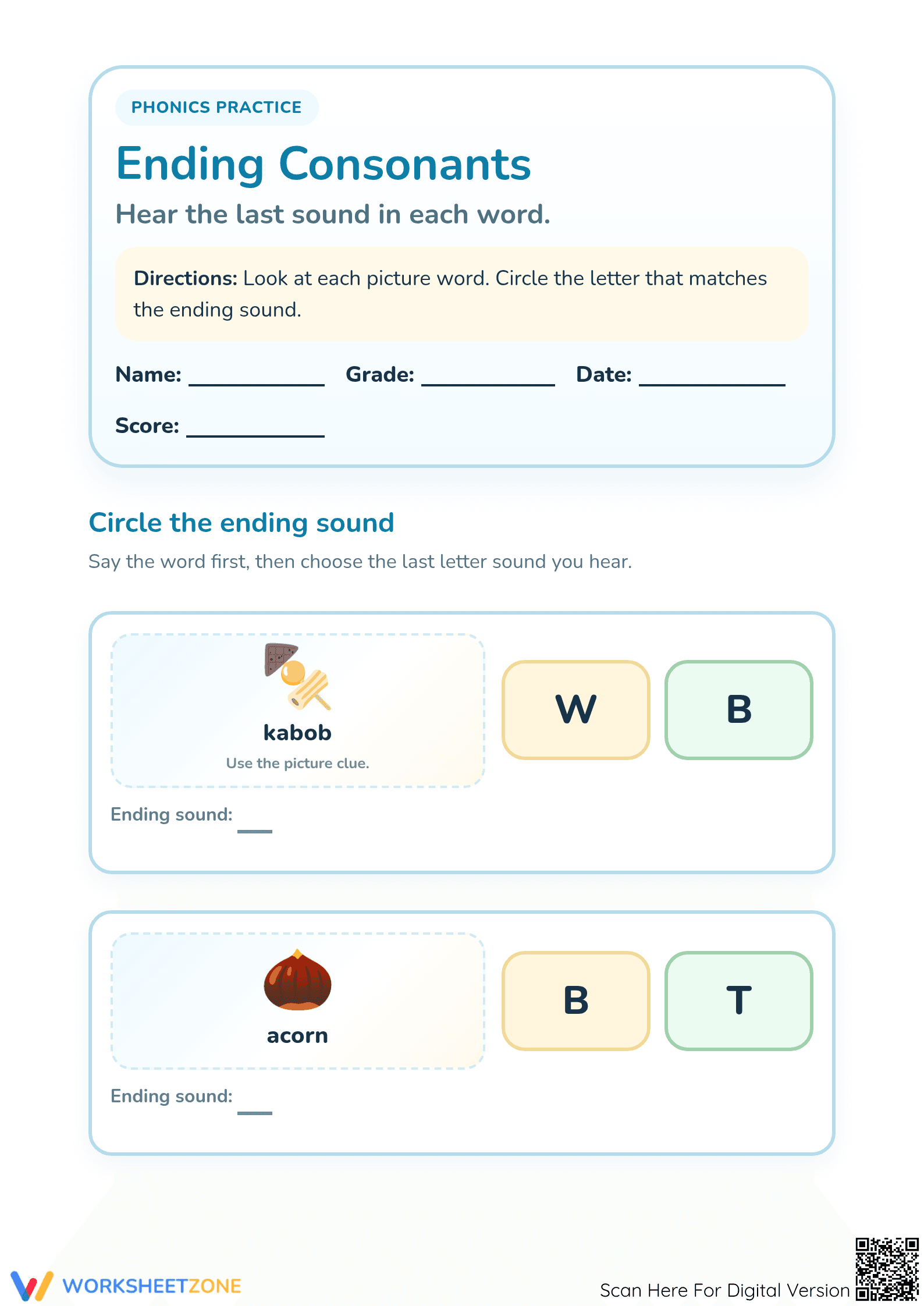
This Preschool Ending Consonants worksheet helps early learners master final sound isolation through 6 engaging picture-based tasks. By circling the correct letter for words like 'kabob' and 'acorn', students develop critical phonemic awareness required for early reading success and phonetic spelling. It serves as an ideal entry point for children just beginning to explore the phonetic structure of words.
At a Glance
- Grade: Preschool · Subject: ELA
- Standard:
RF.K.2.D— Isolate and pronounce final sounds in CVC and simple words- Skill Focus: Ending Consonant Identification
- Format: 2 pages · 6 problems · Answer key included · PDF
- Best For: Independent phonics centers and morning work
- Time: 10–15 minutes
What's Inside
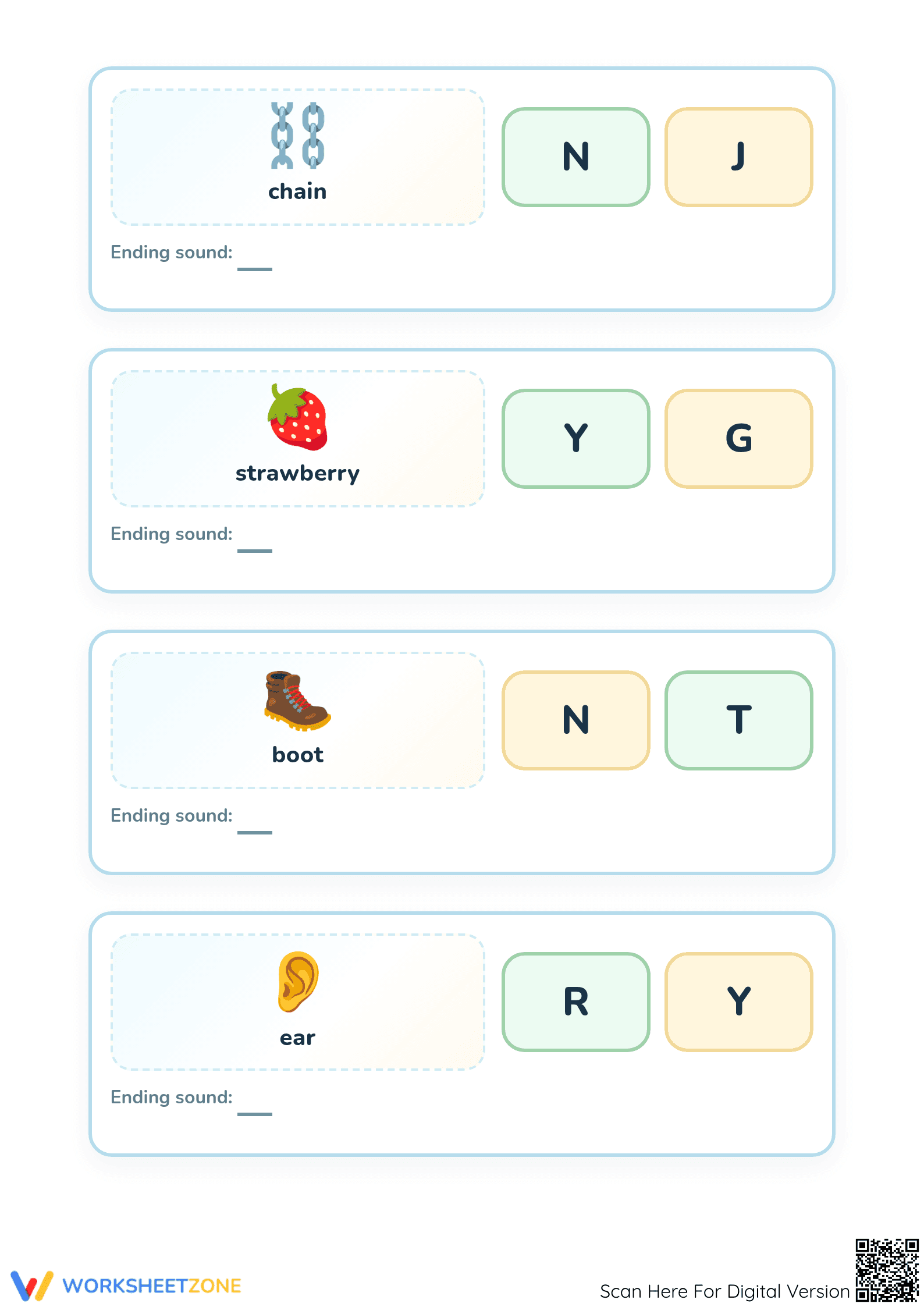
This 2-page PDF features six clear, high-quality illustrations accompanied by their written names to provide a multisensory learning experience for young children. Each task provides two distinct letter choices, allowing students to focus on phonemic discrimination without the added difficulty of open-ended writing or complex spelling requirements. A comprehensive answer key is included to facilitate rapid grading or student self-correction.
Zero-Prep Workflow
Teachers can implement this resource in under two minutes: simply Print the two pages, Distribute to students during your phonics block, and Review answers using the provided key. The intuitive layout makes it an ideal "grab-and-go" option for substitute folders or transition periods between direct instruction. No additional teacher setup or physical materials are required beyond standard writing utensils.
Standards Alignment
The primary focus is `CCSS.ELA-LITERACY.RF.K.2.D`, which requires students to isolate and pronounce the initial, medial vowel, and final sounds (phonemes) in three-phoneme (consonant-vowel-consonant, or CVC) words. This worksheet specifically targets the final phoneme, which is often the most challenging for early learners to hear. Both standard codes can be copied directly into lesson plans, IEP goals, or district curriculum mapping tools.
How to Use It
Assign this worksheet after a direct instruction lesson on final sounds. It serves as an excellent formative assessment tool; observe if students are whispering the words to themselves to hear the last sound, which indicates active phonemic processing. The completion time is expected to range between 10 and 15 minutes, making it perfect for independent desk work or literacy station rotations.
Who It's For
This resource is designed for Preschool and early Kindergarten students. It provides necessary scaffolding for learners who can identify initial sounds but struggle with the ends of words. Pair this with a physical letter-tile sorting activity or a final-sound classroom scavenger hunt for maximum impact. It is also suitable for English Language Learners (ELL) who need visual support for basic vocabulary acquisition.
Phonic awareness, specifically final sound isolation as targeted by RF.K.2.D, is a primary predictor of future reading fluency and overall literacy attainment. Research from Fisher & Frey (2014) emphasizes the vital importance of explicit guided practice and consistent visual cues in early literacy development to prevent future decoding gaps and reading frustration. This high-quality worksheet provides 6 structured opportunities for students to bridge the cognitive gap between spoken phonemes and their corresponding written symbols. By accurately isolating ending consonants in familiar, high-utility words like 'chain' and 'ear', students successfully build the complex neural pathways required for phonological processing and long-term orthographic mapping. This resource is absolutely essential for any early childhood classroom focused on rigorous, evidence-based literacy instruction and ensures that these foundational phonics skills are thoroughly mastered before students move on to more complex blending and segmenting tasks. It provides teachers with actionable data to inform future instruction.


