


























- Students will review and analyze the structure and components of a short story. At the end of the lesson, students are able to:
+ Determine the components of fiction.
+ Summarize a fictional work by plotting its story.
+ Provide evidence to back up hypotheses, conclusions, and inferences drawn from various texts.
+ Elucidate the connections between the various elements of fiction.
- How can readers decide which information from what they hear, read, and see to believe?
- How do literary and informational texts become meaningful to strategic readers?
- How does interaction with text elicit thought and response?
- What is the true purpose of this text?
- Author’s Purpose: The author’s intent either to inform or teach someone about something, to entertain people, or to persuade or convince the audience to do or not do something.
- Characterization: The method an author uses to reveal characters and their various personalities.
- Climax: The turning point in a narrative, the moment when the conflict is at its most intense. Typically, the structure of stories, novels, and plays is one of rising action, in which tension builds to the climax.
- Conflict/Problem: A struggle or clash between opposing characters, forces, or emotions.
- Literary Elements: The essential techniques used in literature (e.g., characterization, setting, plot, theme).
- Rising Action: The part of a story where the plot becomes increasingly complicated. Rising action leads up to the climax, or turning point.
- Plot: The structure of a story. The sequence in which the author arranges events in a story. The structure often includes the rising action, the climax, the falling action, and the resolution. The plot may have a protagonist who is opposed by an antagonist, creating what is called conflict.
- Resolution: The portion of a story following the climax, in which the conflict is resolved.
- Setting: The time and place in which a story unfolds.
- Summarize: To capture all the most important parts of the original text (paragraph, story, poem), but express them in a much shorter space, and—as much as possible—in the reader’s own words.
- Theme: A topic of discussion or writing; a major idea broad enough to cover the entire scope of a literary work.
- “The Dinner Party” by Mona Gardener. Saturday Review, copyright 1942, 1970. www.quia.com/files/quia/users/crott/The-Dinner-Party.doc
- “The Dinner Party” is a brief story that is easily read and has a very clear plot structure. Other selections, such as Saki’s “The Open Window” or a retelling of a myth such as “Arachne” could be substituted.
Teachers may substitute other texts to provide a range of reading and level of text complexity.
- a set of markers for each group of three to four students
- a response journal for each student
- Maintain the emphasis on the elements of fiction throughout the lesson. Evaluate students' understanding of why the events are placed in certain positions on the graph after they record the literary elements of "The Three Little Pigs" and explain the graph. Ask pupils to summarize the tale using the graph.
- Examine how well students can cite sources to back up their assumptions, conclusions, and predictions by watching them work in groups. Employ the students' reactions to "The Dinner Party" to gauge their comprehension of the connections between the plot and setting of a work of fiction. You can talk to specific students or leave comments and questions on the response to address the issues.
Explicit instruction, modeling, scaffolding, and active engagement
W: Assign students to read fiction selections and start journaling their reactions.
H: Get students interested by asking them to analyze "The Three Little Pigs'" structure.
E: Ask students to analyze a short story's literary components and then find those same components in a new narrative.
R: Have students reconsider, debate, and write their responses to the new story as you talk about it.
E: Students can assess their understanding and recollection of literary elements through group discussion of the story graph, which also offers a brief, formative overview of the same material. Students' thoughts on the story can be understood through their written responses. Students can see from the response pattern the kind of response you will be looking for in upcoming readings.
T: Students receive assistance as they progress through the process of the class discussion and analysis. Using a graphic provides a visual representation of the story structure while also simplifying the text. Give students the chance to write on their own, expressing and defending their own opinions.
O: Start with a well-known tale to go over literary components, then switch to a new one so that students can use what they've learned in a group setting. Ask students to consider and discuss the literary elements in their responses in writing.
Focus Question: What components make up fiction?
Inform students that the purpose of this unit is to look at the relationships between fiction and nonfiction writings. They will use a response journal, which they will be keeping, to write down their reflections on the reading. Remind students that a significant portion of their assessment for this unit will come from their journals.
Go through a story's components. Use a familiar story, such as "The Three Little Pigs." Ask students to identify the pigs 1, 2, and 3 as well as the wolf by writing the word characters on the board or interactive whiteboard. Add a setting (straw house, stick house, brick house), then ask students to name each one. Give students a brief rundown of the story's plot (the pigs build houses, the wolf blows down the straw house, the pigs run to the stick house, the wolf blows down the stick house, the pigs run to the brick house, the wolf tries to blow down the brick house but fails, the pigs heat a pot of water in the fireplace, the wolf climbs the chimney and falls into the boiling water pot). Ask, "What is the theme here?" (Bullying can be defeated; caution pays off.) Make sure that all of this information is accessible to students at all times.
Remind students that narratives follow a certain format. Draw the story graph below on the board or interactive whiteboard. Ask students to identify the story's primary conflict (the wolf versus the pigs) before you graph the story's structure. Write it next to the graph. Next, arrange the story's events from the peak—where the climax occurs—to the left side of the graph (rising action) (the wolf climbs the chimney and falls into the pot). For the resolution, have the plot line drop from its peak (pigs celebrate).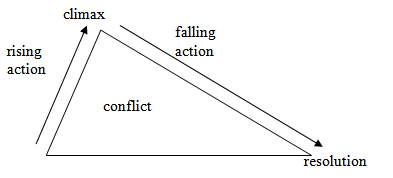
Assign students to small groups of work. Say, "We're going to read a very short story today. Since it was written over 70 years ago, some things have changed significantly." Read "The Dinner Party" aloud to the class, stopping at the scientist's realization that the snake must be under the table. Have them write a sentence predicting what they believe will happen next. After giving them a minute to write, read the story again. When you're finished, say, "Write two thought-provoking questions about the story. For instance, 'What does the story show about the view of women at the time?'". Ask a classmate to answer a question that another has asked. Continue discussing until all of the questions have been raised.
Graph the storyline of "The Dinner Party" or another story that was read aloud in class for each group. Next, ask one group to use a document camera or interactive whiteboard to present its graph. Check to see if any groups differ from one another. It is important to note that almost all of the events in the story must be represented on the graph. If some groups leave out events, consider how the story would change if those events were removed. Regarding what they wrote earlier, ask students if they know how the story will end. Gather the students' graphs after the conversation is over.
Ask students to discuss why they believe the author of the story might be the setting and why it is significant to the plot. To bolster their answers, ask them to provide instances from the tale. Assign students to start a response journal, which they will use for responses to questions in subsequent units and keep throughout the year. Instruct students to write a ten-sentence or longer response to the story that contains the following details:
the reading's title and the date
the student's perspective of the story, along with particular explanations for their feelings (e.g., the story's thought-provoking setting—a different period. The unexpected conclusion made the story humorous.)
Relationships with other books, movies, TV shows, and other media that students may have read or come across. (For instance, "Rikki Tikki Tavi," a tale about a cobra and a mongoose, or "Brave," a film about a woman's bravery.)
a set of discussion points for the class (such as Why is the story set in India? Why does the hostess at the end of the story smile, according to the author?)
Extension:
Make up a story with a very basic structure, like the one below, and have students graph the plot for students who need extra practice:
Fred couldn't wait to ride his new toboggan. He was eager for the snow to stop falling. He dashed over to his favorite hill and raced down its frosty slope, only a few feet ahead. His ever-forgetting friend Zak had stopped to rest during their walk home the previous evening, leaving his backpack filled with textbooks at the foot of the hill. The snow had now covered the backpack, posing a tiny but dangerous obstacle in Fred's toboggan's path. The collision threw Fred head-first into a nearby bank of snow. With a sigh, he got up cautiously, got himself together, shoved Zak's backpack onto the toboggan, and started walking home.
Work with students one-on-one or in small groups, using literary elements and/or story structure, to give them the chance to learn more. Choose a short, well-known tale, like "Peter Rabbit" or "Little Red Riding Hood." As they did with "The Three Little Pigs," have students follow the same steps to identify the story's elements and create a plot graph.
Pupils who are prepared to go beyond the requirements can write their own short story and plot it on a graph.

Elements of Fiction Texts (L-7-1-1)
- Students will review and analyze the structure and components of a short story. At the end of the lesson, students are able to:
+ Determine the components of fiction.
+ Summarize a fictional work by plotting its story.
+ Provide evidence to back up hypotheses, conclusions, and inferences drawn from various texts.
+ Elucidate the connections between the various elements of fiction.


