


























Views
Downloads


Printable Retell Story Worksheet | Grade 4 ELA Literature
Paste this activity's link or code into your existing LMS (Google Classroom, Canvas, Teams, Schoology, Moodle, etc.).
Students can open and work on the activity right away, with no student login required.
You'll still be able to track student progress and results from your teacher account.
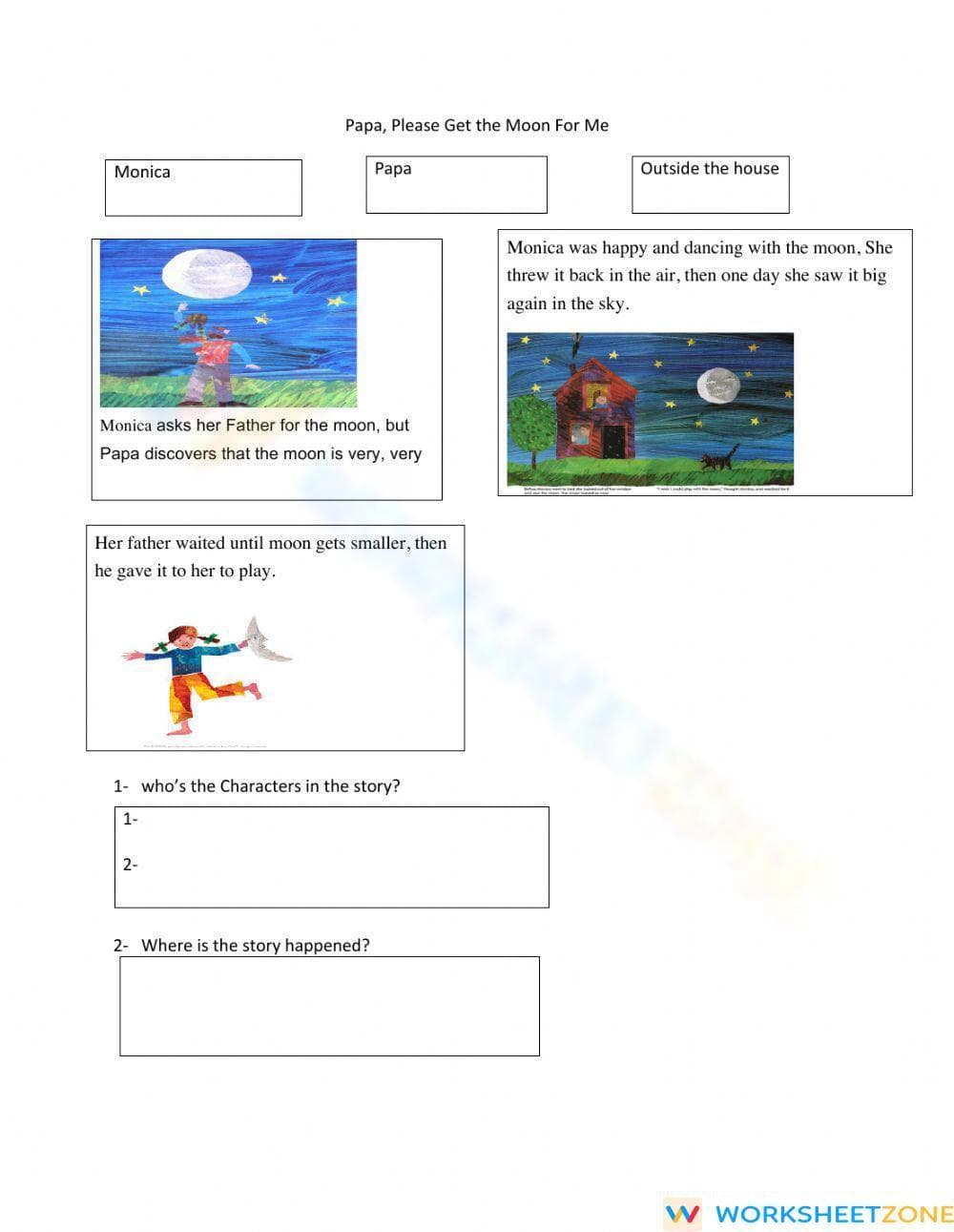
This Grade 4 story retelling worksheet helps students master the art of summarizing literature through the classic tale "Papa, Please Get the Moon For Me." By identifying key characters, settings, and plot sequences, learners develop essential comprehension skills. This printable resource ensures students can effectively recount stories and determine central messages with confidence and clarity.
At a Glance
- Grade: 4 · Subject: ELA Literature
- Standard:
CCSS.ELA-LITERACY.RL.4.2— Determine a theme and summarize the story using key details- Skill Focus: Story Retelling and Plot Sequencing
- Format: 2 pages · 5 problems · Answer key included · PDF
- Best For: Reading comprehension practice and story element review
- Time: 15–20 minutes
What's Inside
Inside this two-page PDF, teachers will find a structured approach to narrative analysis. The first page provides visual story panels with captions to scaffold the retelling process, followed by questions identifying characters and setting. The second page focuses on a beginning, middle, and end sequencing graphic organizer. A full answer key is included for efficient grading and student self-correction.
Skill Progression
- Guided Practice: Students utilize three visual story panels with captions to identify the main characters and the primary setting of the narrative.
- Supported Practice: Learners recall and record specific events that occur in the beginning and middle of the story, building chronological awareness.
- Independent Practice: Students synthesize the story's resolution on their own, demonstrating their ability to identify how the plot concludes.
This gradual-release model follows the I Do, We Do, You Do framework to ensure student mastery of narrative structures.
Standards Alignment
This resource is directly aligned to `CCSS.ELA-LITERACY.RL.4.2`, which requires students to determine a theme of a story from details in the text and summarize the text. By breaking the story into discrete components—characters, setting, and chronological sequence—the worksheet supports the foundational skills needed for complex summarization. Both standard codes can be copied directly into lesson plans, IEP goals, or district curriculum mapping tools.
How to Use It
Use this worksheet as a formative assessment after a shared reading session of the mentor text. It is ideal for checking understanding of plot structure. Teachers can observe how students transition from identifying characters to sequencing the story. Expect a completion time of 15 to 20 minutes, making it a perfect addition to literacy centers or independent work blocks.
Who It's For
This activity is designed for fourth-grade students developing narrative summary skills. It is particularly beneficial for visual learners and students requiring scaffolds in sequencing. The worksheet pairs naturally with a plot anchor chart or a read-aloud of Eric Carle’s literature to provide a cohesive and engaging instructional experience for diverse classroom populations.
According to the RAND AIRS 2024 report, structured retelling activities are critical for bridging the gap between basic decoding and deep reading comprehension. This worksheet leverages research-based strategies in plot sequencing and story element identification to help Grade 4 students meet CCSS.ELA-LITERACY.RL.4.2 requirements. By isolating the beginning, middle, and end of a narrative, learners build the cognitive frameworks necessary for more advanced literary analysis. Fisher & Frey (2014) emphasize that such scaffolds are essential for the gradual release of responsibility, moving students from dependent readers to independent thinkers. Implementing this 5-task resource provides educators with empirical evidence of student mastery in summarization, ensuring that all learners can articulate the interaction between characters and plot. This approach is consistent with NAEP standards for measuring reading proficiency through evidence-based recounting of fictional texts and narrative structures.


