


























Views
Downloads



3D Shapes & Euler’s Formula Worksheet — Grade 7 Ready
Paste this activity's link or code into your existing LMS (Google Classroom, Canvas, Teams, Schoology, Moodle, etc.).
Students can open and work on the activity right away, with no student login required.
You'll still be able to track student progress and results from your teacher account.
This comprehensive 3D geometry worksheet provides Grade 6 through 9 students with a rigorous exploration of polyhedrons and non-polyhedrons. By identifying faces, edges, and vertices, learners build the spatial reasoning necessary to master Euler’s Formula. Students will transition from basic identification to solving complex algebraic relationships, ensuring a complete understanding of three-dimensional structural properties.
At a Glance
- Grade: 6–9 · Subject: Geometry
- Standard:
CCSS.MATH.CONTENT.7.G.B.6— Solve problems involving two- and three-dimensional objects composed of triangles and prisms.- Skill Focus: 3D Shape Analysis & Euler’s Formula
- Format: 4 pages · 30 problems · Answer key included · PDF
- Best For: Middle school geometry units and theorem application
- Time: 45–60 minutes
What's Inside
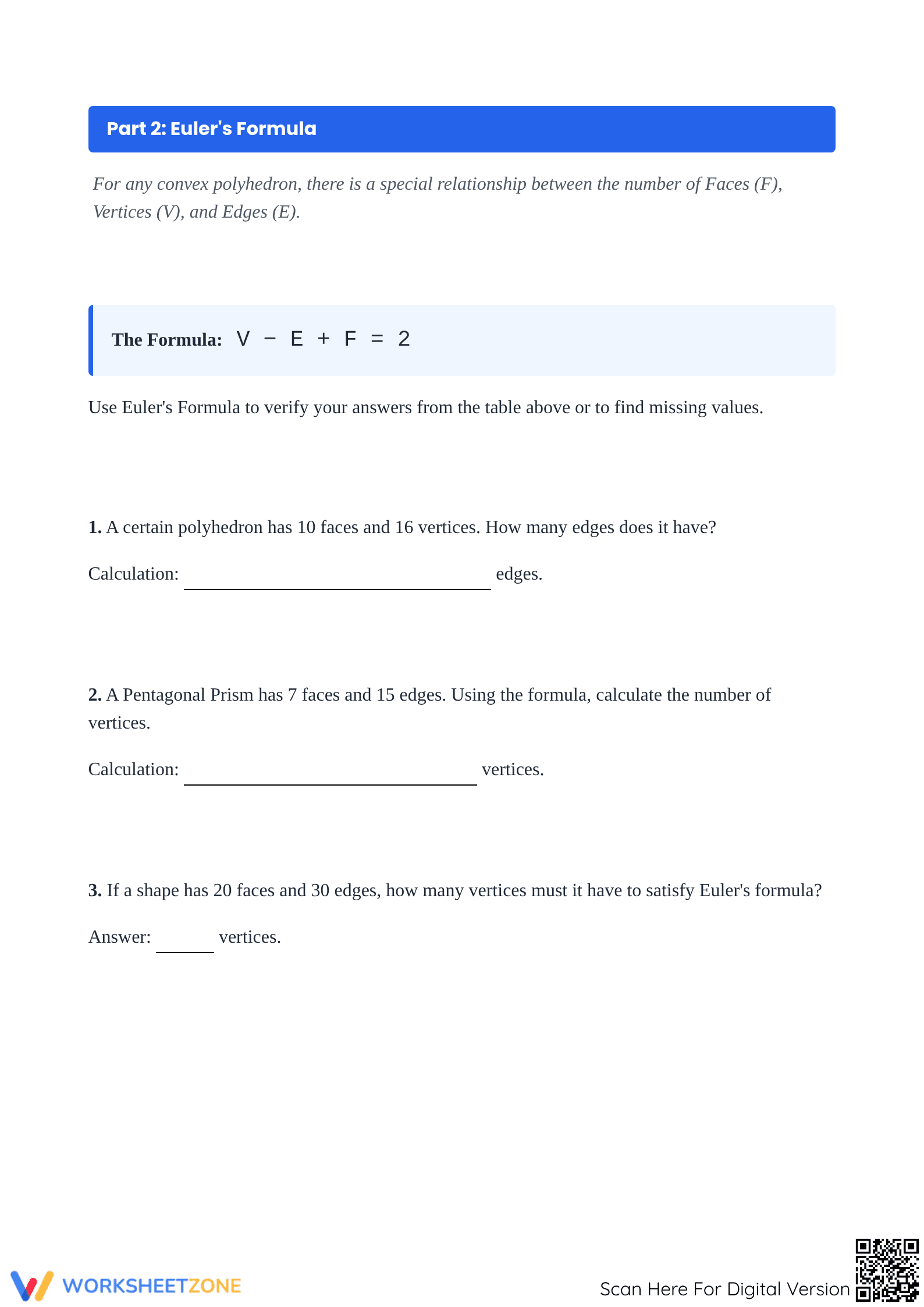
This 4-page instructional packet is divided into four distinct sections. It begins with a detailed table for polyhedrons, requiring students to count attributes of cubes and prisms. The second section introduces Euler’s Formula (V - E + F = 2) with guided calculation problems. The final pages cover curved surfaces—cylinders, cones, and spheres—and conclude with a vocabulary matching task to solidify geometric terminology.
Mastery Evidence
Every task in this worksheet maps directly to sub-skills within the geometry standard, moving from identification (DOK 1) to application (DOK 2). The inclusion of Euler’s Formula provides a quantitative check for accuracy, allowing students to self-verify their counts of faces and vertices. Teachers can use the final vocabulary section as a quick evidence check for mastery before progressing to volume calculations.
Standards Alignment
The primary alignment for this resource is CCSS.MATH.CONTENT.7.G.B.6, which requires students to solve mathematical problems involving three-dimensional objects. By analyzing the relationship between faces, edges, and vertices, students develop the foundational knowledge required for HSG.MG.A.1 in high school geometry. Both standard codes can be copied directly into lesson plans, IEP goals, or district curriculum mapping tools.
How to Use It
Assign this worksheet during the "We Do" phase of direct instruction to model the counting of hidden edges in 3D diagrams. Alternatively, use Part 2 as a formative assessment to check if students can manipulate the variables within Euler’s Formula. For a quick check, observe students during the vocabulary matching section to ensure they can distinguish between an edge and a vertex. Completion typically takes 50 minutes.
Who It's For
This resource is designed for middle and early high school students enrolled in Pre-Algebra or Geometry. It is particularly effective for visual learners who benefit from clear diagrams of prisms and pyramids. Teachers can pair this worksheet with physical 3D manipulatives or an anchor chart displaying Euler’s Formula to provide additional scaffolding for students with IEPs or English Language Learners.
According to the RAND AIRS 2024 report on mathematical literacy, the transition from two-dimensional to three-dimensional spatial reasoning is a critical milestone. This worksheet addresses this need by linking the physical attributes of polyhedrons—faces, edges, and vertices—to the mathematical consistency of Euler’s Formula. By requiring students to verify observations through algebraic calculation (V - E + F = 2), the resource reinforces the principle that geometric properties are predictable. Research from ScienceDirect TpT Analysis suggests that structured tables combined with theorem application improve retention of geometric properties significantly. Aligned to CCSS.MATH.CONTENT.7.G.B.6, this packet ensures students can accurately analyze 3D objects, a skill fundamental to advanced architecture and engineering. This evidence-based approach provides a robust framework for classroom instruction and independent practice, helping students build spatial confidence through rigorous, standards-aligned tasks.


