


























Views
Downloads

Printable Eat and Cling Rhyming Worksheet | Grade 1 ELA
Paste this activity's link or code into your existing LMS (Google Classroom, Canvas, Teams, Schoology, Moodle, etc.).
Students can open and work on the activity right away, with no student login required.
You'll still be able to track student progress and results from your teacher account.
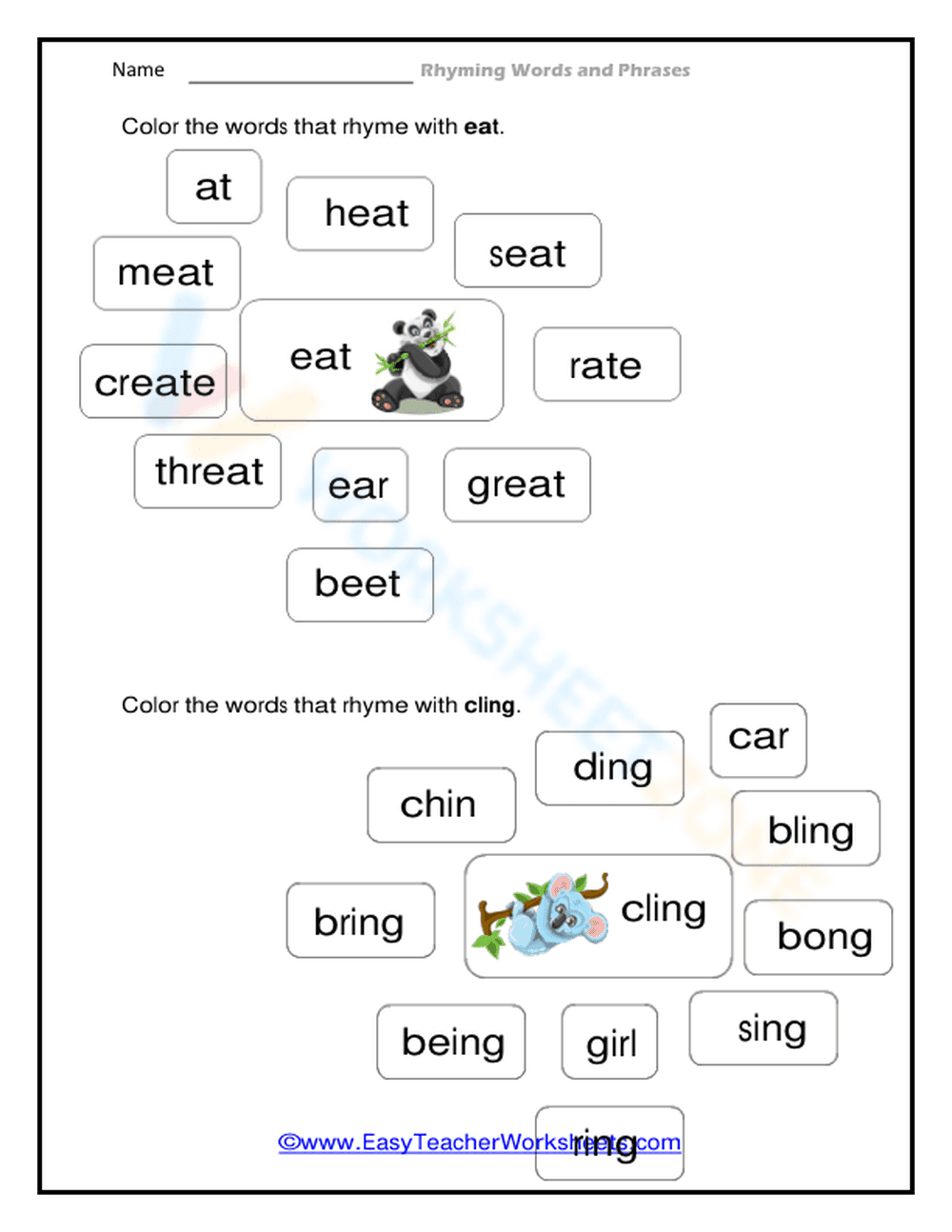
This Grade 1 rhyming worksheet helps students develop essential phonological awareness by identifying words that rhyme with "eat" and "cling." By coloring the correct bubbles, learners differentiate between similar sounds and spellings, improving their reading fluency and decoding abilities. This focused practice ensures students can recognize auditory patterns in language effectively and efficiently.
At a Glance
- Grade: 1 · Subject: ELA
- Standard:
CCSS.ELA-LITERACY.RF.1.2— Demonstrate understanding of spoken words, syllables, and sounds phonemes- Skill Focus: Rhyming Word Recognition
- Format: 1 page · 20 tasks · Answer key included · PDF
- Best For: Morning work or phonics centers
- Time: 15–20 minutes
The worksheet features two distinct sections centered around a lead word with an accompanying illustration—a panda for "eat" and a koala for "cling." Each section contains a cluster of word bubbles—ten for "eat" and ten for "cling"—offering a mix of true rhymes and phonetic distractors. The clear visual layout and coloring-based task make it engaging for young learners while maintaining a high page-count efficiency for classroom use.
The zero-prep design allows teachers to implement this activity in under two minutes. First, print the single-page PDF for your entire class. Second, distribute the worksheets and provide coloring materials, such as crayons or markers. Third, review the completed worksheets using the included answer key to quickly assess student understanding. This streamlined process makes it an ideal choice for sub plans or transition periods between daily lessons.
This resource is primarily aligned with CCSS.ELA-LITERACY.RF.1.2, which requires students to demonstrate an understanding of spoken words, syllables, and sounds. Specifically, it targets the ability to isolate and produce initial, medial vowel, and final sounds in single-syllable words. Both standard codes can be copied directly into lesson plans, IEP goals, or district curriculum mapping tools to ensure administrative compliance.
Use this worksheet as a formative assessment after a direct instruction lesson on word families. During the activity, circulate the room and observe students as they say the words aloud; if a student struggles with "threat" or "great" compared to "heat," it provides an immediate cue for a small-group intervention. The expected completion time is 15 to 20 minutes, making it perfect for independent seat work.
Designed for Grade 1 students, this worksheet also serves as an excellent enrichment activity for Kindergarteners or a remedial tool for Grade 2 learners needing additional phonics support. It pairs naturally with rhyming-focused picture books or anchor charts that display common word families like -eat and -ing to reinforce the auditory and visual connection.
The Eat and Cling rhyming worksheet leverages research-based strategies for phonological development, specifically focusing on the recognition of rhyming patterns within the CCSS.ELA-LITERACY.RF.1.2 framework. Phonemic awareness, particularly the ability to identify and generate rhymes, is a primary predictor of later reading success. According to Fisher & Frey (2014), the gradual release of responsibility in phonics instruction—moving from teacher-led auditory drills to independent visual recognition tasks like this coloring activity—helps solidify the connection between sounds and letter patterns. By requiring students to evaluate distractors such as "car" or "girl" alongside rhymes like "sing" and "ring," the worksheet encourages active cognitive processing rather than rote repetition. This approach aligns with NAEP standards for foundational literacy, ensuring that students develop the decoding skills necessary for fluent reading and comprehensive literacy achievement in the early primary grades and beyond.


