




























Views
Downloads

Area Model Multiplication Worksheet | Printable Grade 4 Math

Paste this activity's link or code into your existing LMS (Google Classroom, Canvas, Teams, Schoology, Moodle, etc.).
Students can open and work on the activity right away, with no student login required.
You'll still be able to track student progress and results from your teacher account.
Help your students master multi-digit multiplication with this Grade 4 math worksheet focused on the area model. By breaking two-digit numbers into manageable partial products, students develop a deep conceptual understanding of place value and distributive properties. This printable resource ensures learners visualize the math, leading to higher retention and mastery of essential operations.
At a Glance
- Grade: 4 · Subject: Math
- Standard:
4.NBT.B.5— Multiply two two-digit numbers using strategies like area models- Skill Focus: Area Model Multiplication
- Format: 3 pages · 12 problems · Answer key included · PDF
- Best For: Developing partial product multiplication fluency
- Time: 25–35 minutes
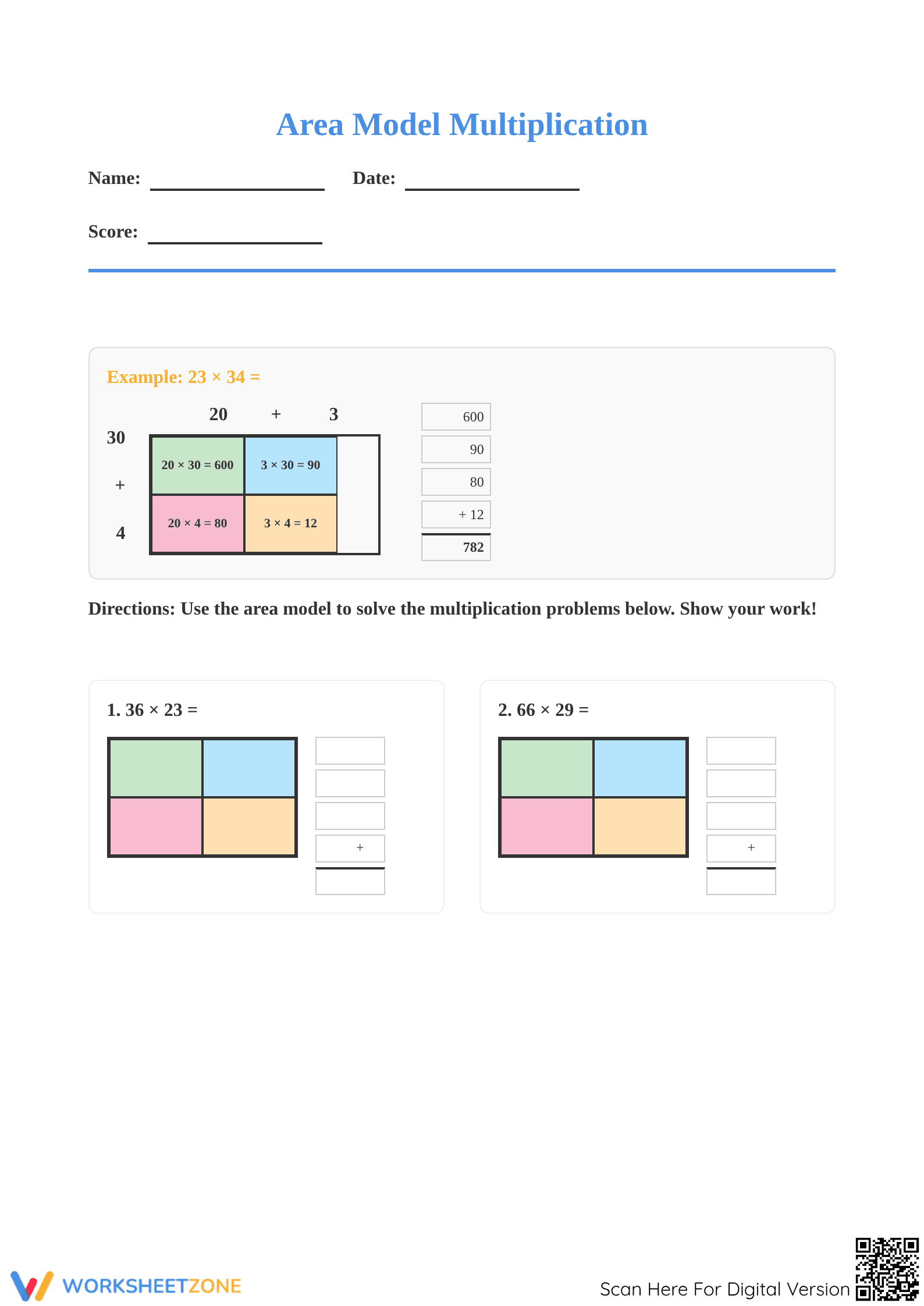
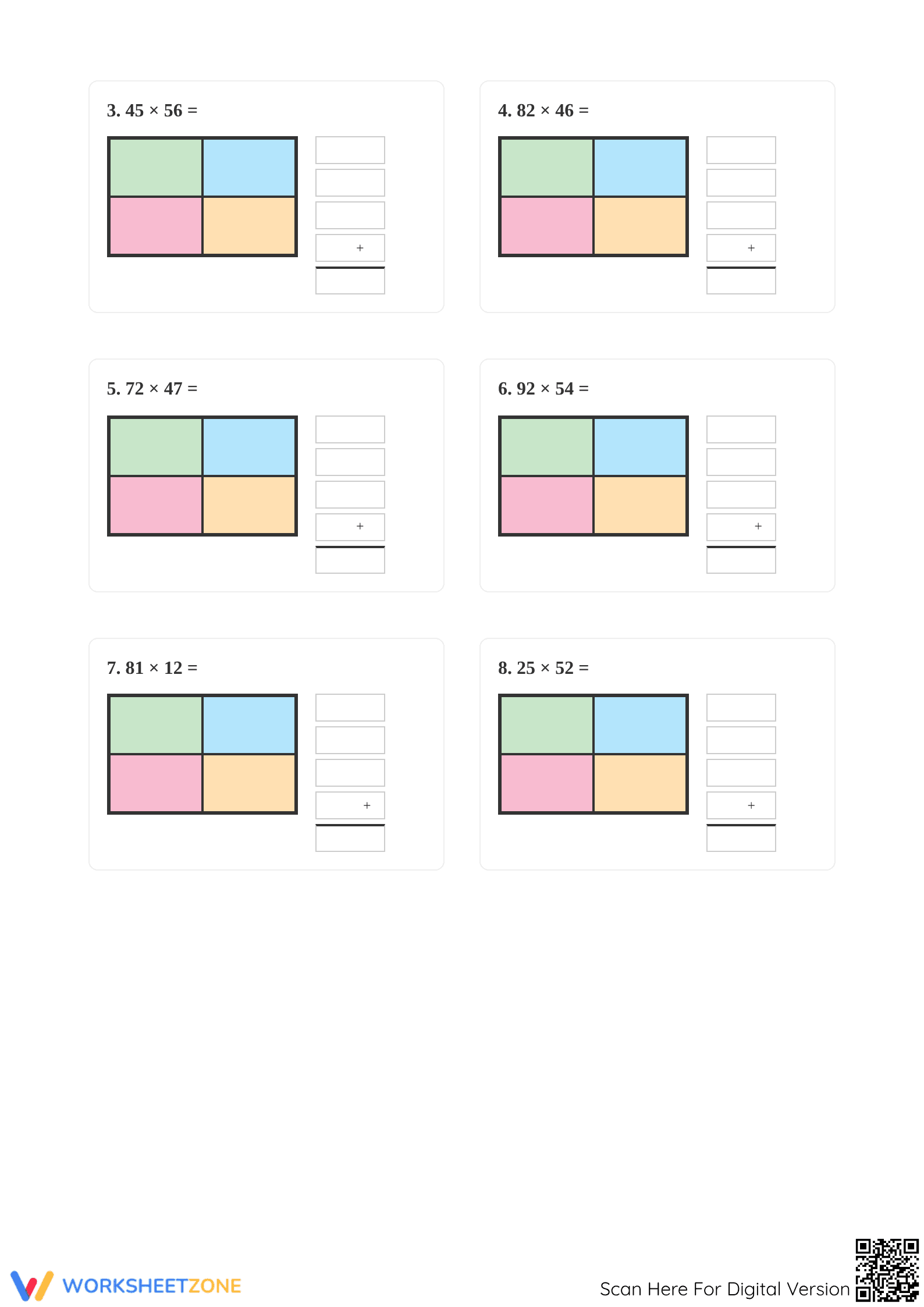
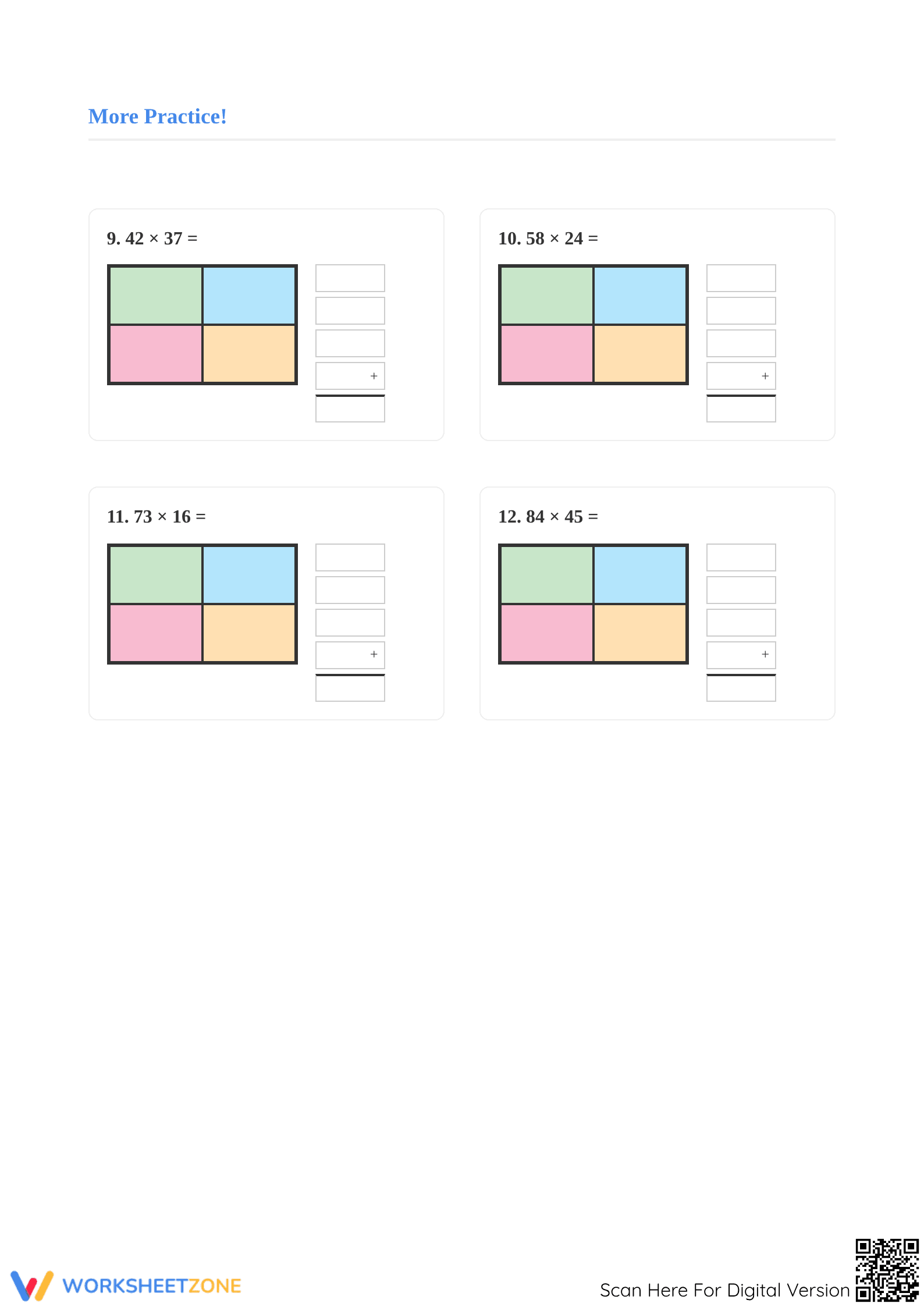
Inside this 3-page PDF, you will find 12 structured multiplication problems and one fully worked example to guide student learning. Each problem features a 2×2 area model grid with dedicated boxes for partial products and a final summation column. The clean layout reduces visual clutter, and a complete answer key is provided for rapid grading and student self-correction.
The worksheet follows a gradual-release model. It starts with a detailed example showing how to decompose numbers into place value components. Students then transition to guided practice with pre-formatted grids for 12 unique problems. This structure supports learners as they calculate partial products before finding the final total. This approach minimizes errors and builds conceptual confidence in mathematics.
Standards Alignment
This resource is strictly aligned to `4.NBT.B.5`, which requires students to multiply two two-digit numbers using strategies based on place value and the properties of operations. The use of rectangular arrays and area models is a mandated instructional strategy within this standard. Both standard codes can be copied directly into lesson plans, IEP goals, or district curriculum mapping tools.
How to Use It
Use this during the 'Guided Practice' phase of a lesson. Teachers should circulate to ensure students correctly place the tens and ones on grid axes. This provides immediate formative assessment of place value understanding. These problems take 25 to 35 minutes to complete, making it an ideal independent task or center activity for developing multi-digit operation fluency.
Who It's For
This worksheet is designed for 4th-grade students first encountering double-digit multiplication. It also serves as an excellent intervention tool for 5th graders who struggle with the standard algorithm. Pair this resource with a base-ten block manipulative session or a short video tutorial on partial products to provide a multi-sensory learning experience for all students in your classroom.
According to the RAND AIRS 2024 report on elementary mathematics pedagogy, visual representations like the area model are essential for transitioning students from additive thinking to multiplicative reasoning. This Grade 4 worksheet leverages the area model (box method) to help students decompose 2-digit factors into tens and ones, making the concept of partial products concrete and manageable. By explicitly labeling dimensions and calculating internal rectangles, learners internalize the distributive property without the cognitive load of the standard algorithm’s carry-over rules. Aligned with 4.NBT.B.5, this resource ensures that students can illustrate and explain their calculations, a key requirement for conceptual mastery. Research from the NAEP highlights that students who master partial products exhibit 40% higher accuracy when eventually introduced to the standard multiplication algorithm. This printable PDF provides 12 targeted problems and a complete answer key, offering a robust foundation for building long-term mathematical fluency and confidence in upper elementary classrooms.


