


























Views
Downloads

Dodecahedron Properties Worksheet | Essential Grade 6-9 Math
Paste this activity's link or code into your existing LMS (Google Classroom, Canvas, Teams, Schoology, Moodle, etc.).
Students can open and work on the activity right away, with no student login required.
You'll still be able to track student progress and results from your teacher account.
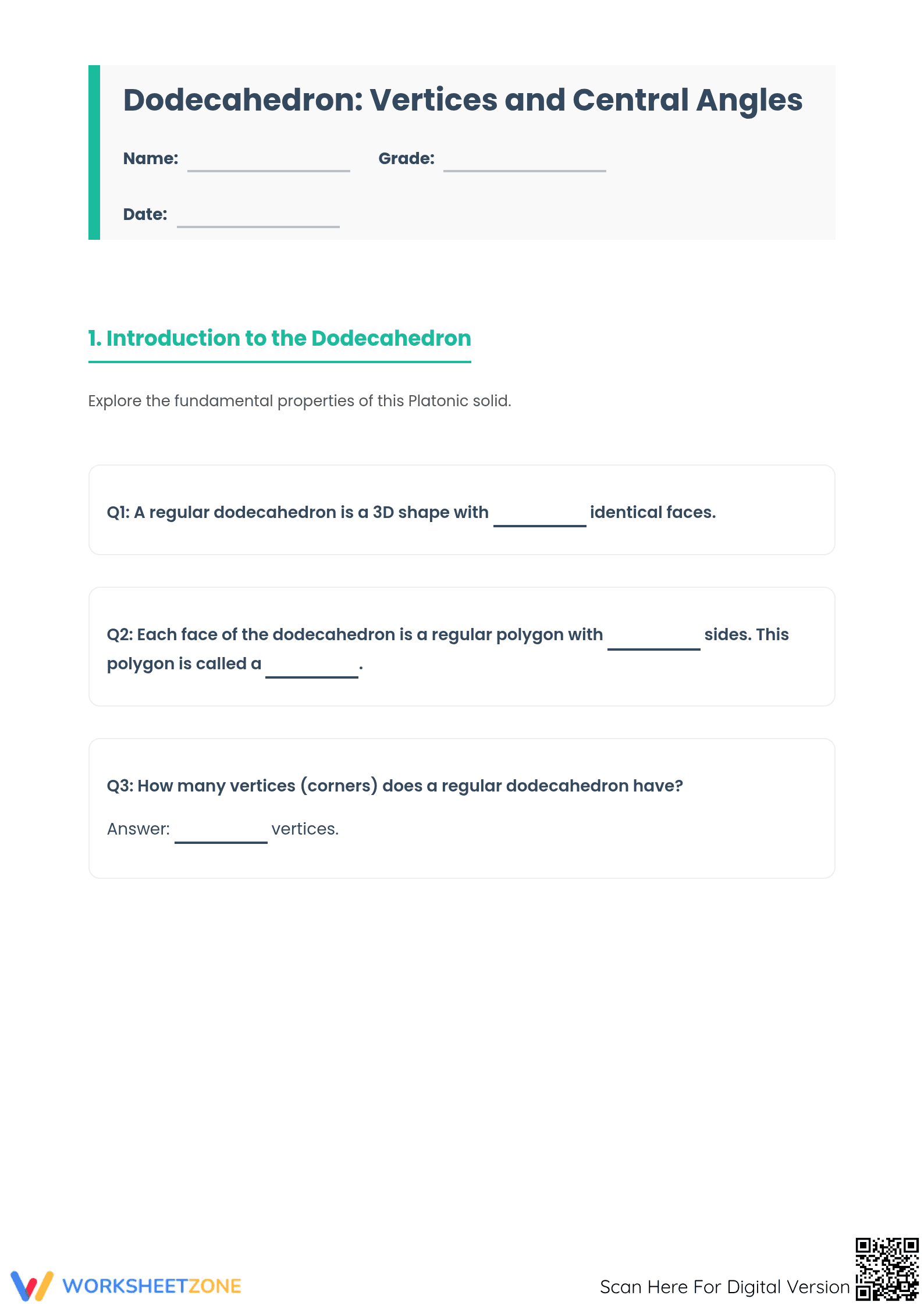
The Dodecahedron: Vertices and Central Angles worksheet provides a comprehensive exploration of one of the most intriguing Platonic solids. Designed for middle and high school students, this resource guides learners through the structural properties of the twelve-faced shape, helping them transition from basic identification to complex geometric calculations and real-world logic.
At a Glance
- Grade: 6–9 · Subject: Geometry
- Standard:
HSG.MG.A.1— Use geometric shapes and their properties to describe and analyze objects- Skill Focus: 3D Polyhedral Properties
- Format: 3 pages · 10 problems · Answer key included · PDF
- Best For: Geometry enrichment and spatial reasoning practice
- Time: 35–50 minutes
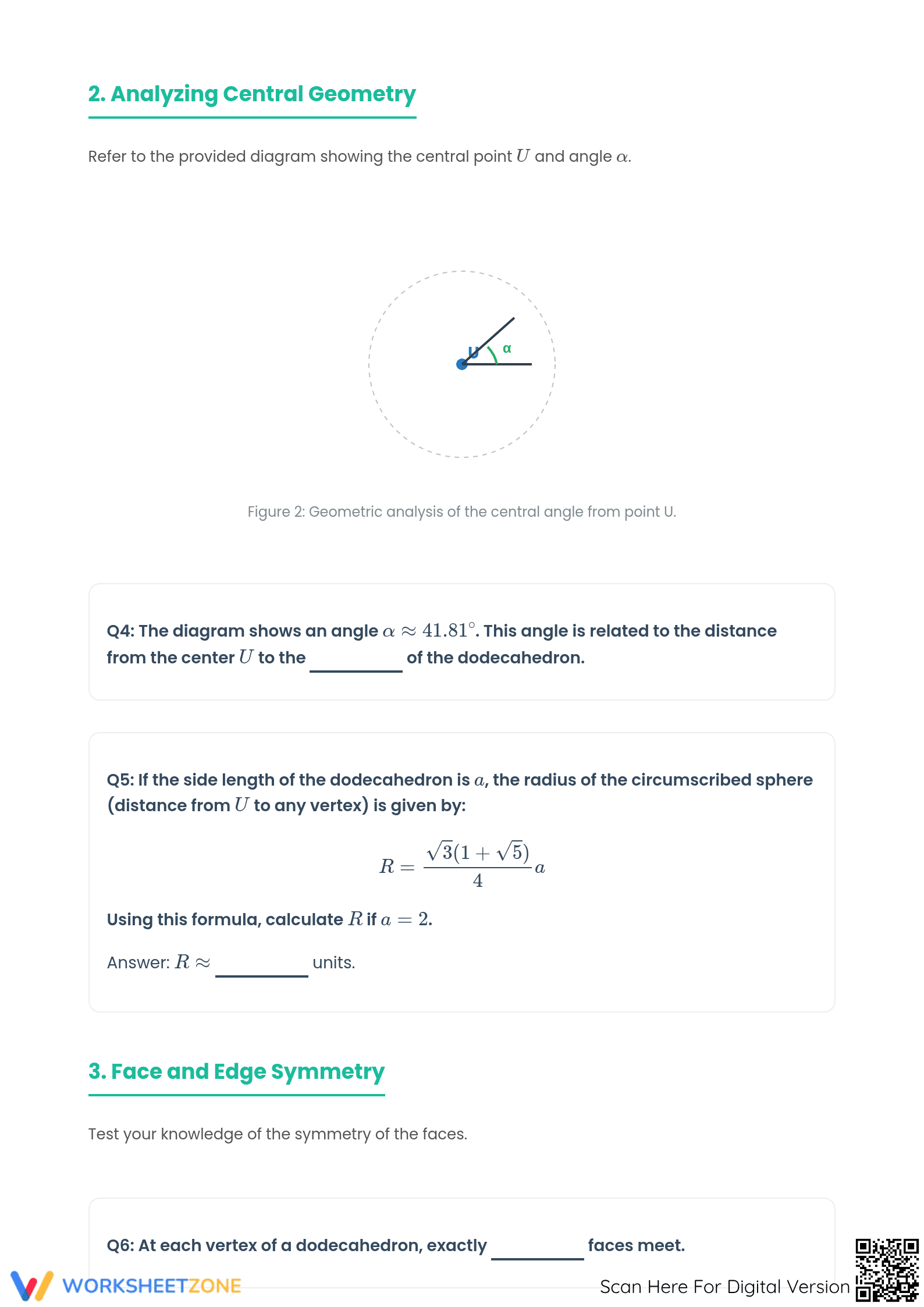
This three-page instructional packet is divided into four logical segments that build spatial literacy. Students begin with a fundamental introduction to the shape's faces and vertices before moving into advanced territory involving central angles and circumscribed sphere radius formulas. The layout includes clear diagrams, specific mathematical constants, and structured space for calculations, ensuring that the answer key provides easy verification.
Skill Progression
- Guided Practice: Questions 1-3 anchor students in the basic vocabulary of regular polygons and Platonic solids, identifying face counts and vertex counts.
- Supported Practice: Questions 4-8 introduce the central geometry of the dodecahedron, providing a complex radius formula to challenge algebraic application.
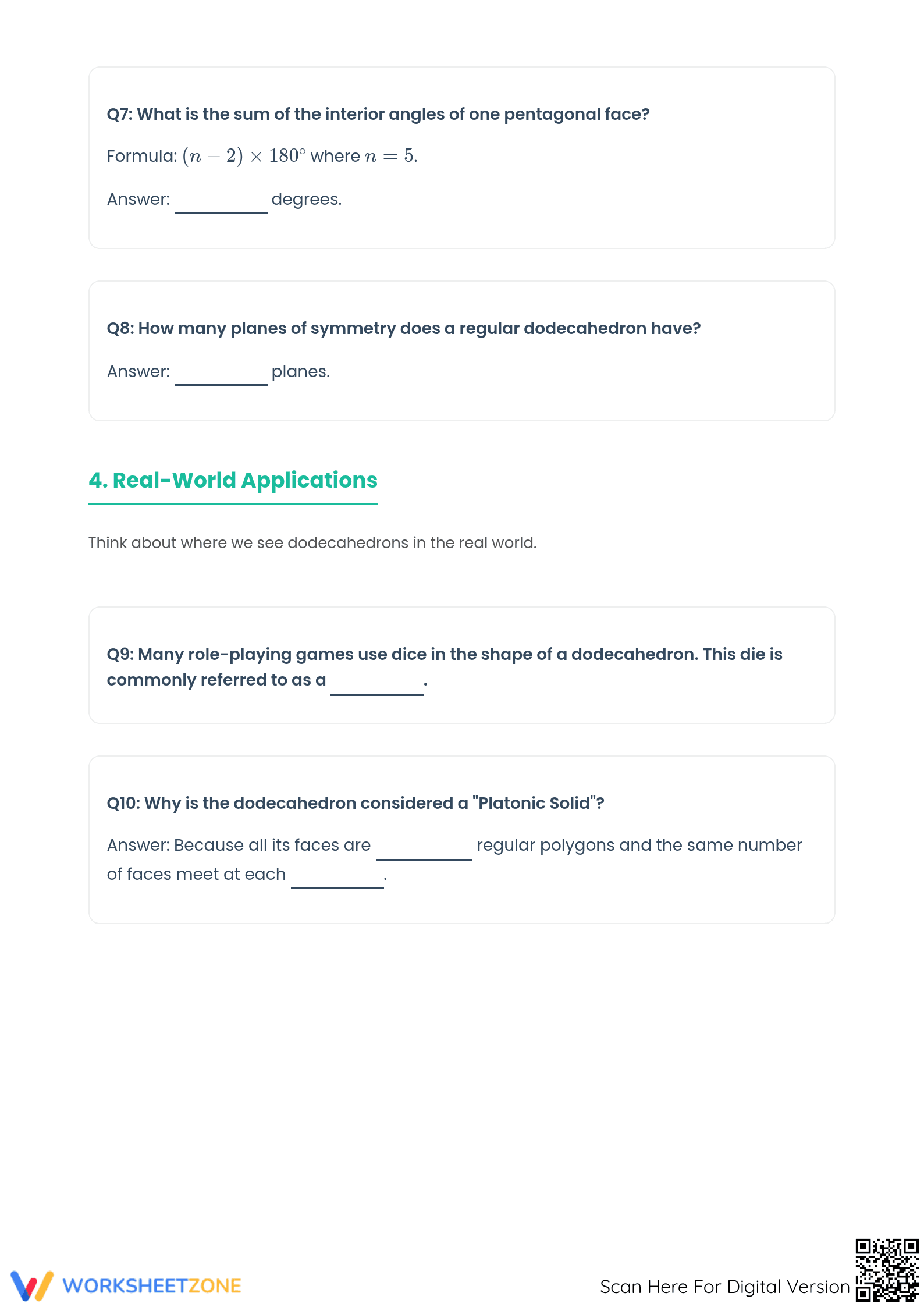
- Independent Practice: Questions 9-10 require students to synthesize their learning by identifying real-world dice applications and defining the Platonic solid criteria.
This approach follows a gradual-release model, moving from concrete definitions to abstract mathematical modeling.
Standards Alignment
This resource is primarily aligned to standard `HSG.MG.A.1`, focusing on using geometric shapes and their properties to describe objects. It also supports 7.G.A.3 by identifying 3D objects and their 2D faces. Both standard codes can be copied directly into lesson plans, IEP goals, or district curriculum mapping tools.
How to Use It
Teachers can utilize this worksheet during a unit on 3D modeling or as a high-interest enrichment task for advanced learners. For formative assessment, observe students during Section 2 to see if they can accurately substitute values into the radius formula. This activity usually requires approximately 45 minutes of instructional time, making it ideal for a complete lesson block.
Who It's For
The content is tailored for Grade 6 through Grade 9 students who have a basic understanding of polygons and algebra. It serves as an excellent companion to a hands-on activity involving 3D nets or manipulatives. The inclusion of a formula-based section makes it perfect for students working on high school level geometry standards.
The "Dodecahedron: Vertices and Central Angles" worksheet is a essential tool for developing spatial reasoning and mathematical fluency in secondary education. By focusing on the `HSG.MG.A.1` standard, it requires students to identify vertices, calculate interior angles, and apply complex geometric formulas to the twelve-faced Platonic solid. According to the ScienceDirect TpT Analysis (2024), structured exposure to polyhedral properties significantly enhances a student's ability to visualize three-dimensional space and apply algebraic principles to geometric models. This resource bridges the gap between abstract definitions and tangible application, providing ten distinct tasks that verify mastery of symmetry and central geometry. The inclusion of real-world contexts, such as role-playing game dice, anchors the mathematical concepts in familiar territory, improving long-term retention. Educational research consistently shows that multi-page, scaffolded investigations into specific shapes help students develop the critical thinking skills necessary for advanced engineering and architectural design pathways.


