


























Views
Downloads

Dodecahedron Geometry Guide | Grade 6-9 Essential
Paste this activity's link or code into your existing LMS (Google Classroom, Canvas, Teams, Schoology, Moodle, etc.).
Students can open and work on the activity right away, with no student login required.
You'll still be able to track student progress and results from your teacher account.
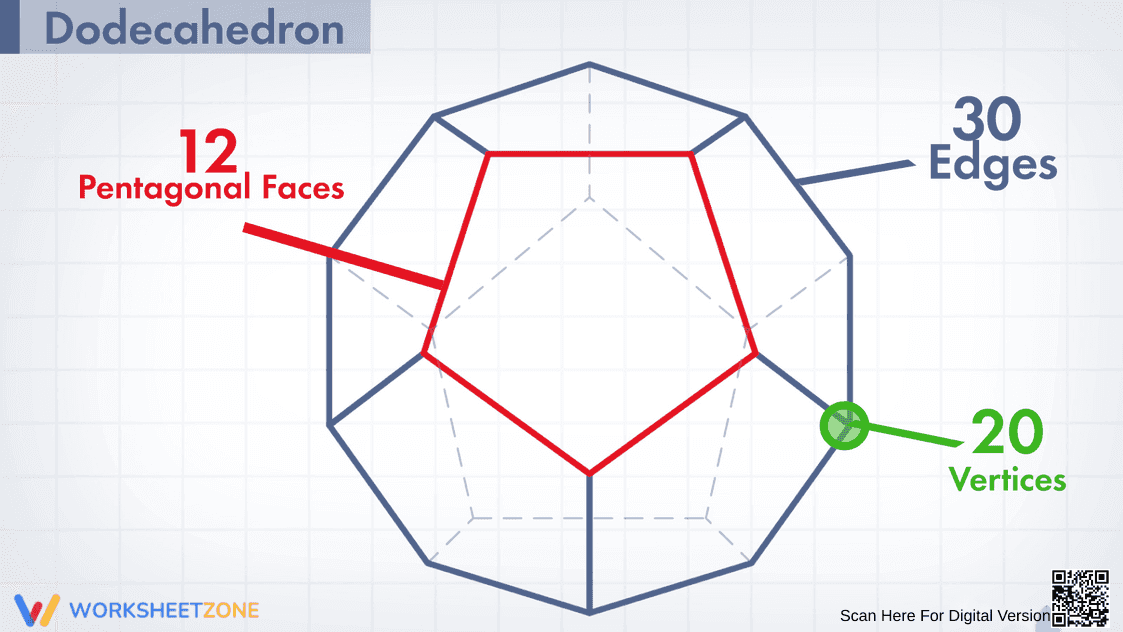
This dodecahedron geometry guide provides students with a clear visual reference for identifying the complex properties of a 12-sided Platonic solid. By visualizing the relationship between pentagonal faces, edges, and vertices, learners build a foundation for advanced spatial reasoning and surface area calculations. This resource ensures students master 3D shape terminology with ease.
At a Glance
- Grade: 6-9 · Subject: Geometry
- Standard:
CCSS.MATH.CONTENT.6.G.A.4— Represent three-dimensional figures using nets made up of rectangles and triangles- Skill Focus: 3D Shape Properties
- Format: 1 page · 1 diagram · Reference Guide · PDF
- Best For: Visual aid for geometry units
- Time: 5–10 minutes
This single-page PDF features a high-contrast, labeled diagram of a dodecahedron. It explicitly identifies the 12 pentagonal faces, 30 edges, and 20 vertices using color-coded callouts. The clean layout on a grid background helps students perceive the 3D depth of the object, making it an ideal anchor chart or notebook insert for middle and high school math units focusing on polyhedra.
Skill Progression
- Guided practice: Students observe the labeled diagram to identify the specific number of faces, edges, and vertices in a 12-sided solid.
- Supported practice: Learners use the visual cues to compare the dodecahedron to other Platonic solids like the cube or tetrahedron during class discussions.
- Independent practice: Students apply the properties shown to Euler's formula (F + V - E = 2) to verify the geometric consistency of the shape.
This resource follows a gradual-release model by providing the essential facts needed before students attempt complex calculations or net constructions.
Standards Alignment
This worksheet aligns with `CCSS.MATH.CONTENT.6.G.A.4`, which requires students to represent three-dimensional figures and use nets to find surface area. It also supports high school geometry standards by using geometric shapes to describe objects. Both standard codes can be copied directly into lesson plans, IEP goals, or district curriculum mapping tools.
How to Use It
Use this guide during the introductory phase of a 3D geometry unit to define Platonic solids. It works well as a formative assessment tool; ask students to cover the labels and recall the counts. Expected completion for a labeling activity using this sheet is 5 to 10 minutes. It can also be projected during direct instruction to illustrate vertex-edge relationships.
Who It's For
This resource is designed for Grade 6 through 9 students, including those requiring visual scaffolds for spatial geometry. It pairs naturally with a physical manipulative set or a lesson on Euler's characteristic to deepen conceptual understanding for visual learners.
According to the RAND AIRS 2024 report, visual representations in geometry are critical for developing the spatial visualization skills necessary for higher-level STEM success. This dodecahedron guide addresses the specific need for clear, labeled models that reduce cognitive load during the initial stages of shape identification. By explicitly marking the 12 pentagonal faces, 30 edges, and 20 vertices, the worksheet allows students to internalize the structural properties of Platonic solids without the confusion often caused by poorly rendered 2D drawings. Research from Fisher & Frey (2014) emphasizes that such visual scaffolds are essential for moving students from surface-level recognition to deep structural analysis. This resource provides the precise data points required for students to apply Euler’s formula, ensuring they can verify geometric truths through mathematical evidence. It serves as a foundational tool for CCSS.MATH.CONTENT.6.G.A.4 mastery across diverse classroom settings.


