


























Views
Downloads



Essential Dodecagon Properties Worksheet | Grade 7-10 Math
Paste this activity's link or code into your existing LMS (Google Classroom, Canvas, Teams, Schoology, Moodle, etc.).
Students can open and work on the activity right away, with no student login required.
You'll still be able to track student progress and results from your teacher account.
Master the unique properties of the 12-sided dodecagon with this comprehensive geometry practice set. Students will calculate interior angle sums and solve for diagonals using standard formulas. By completing these 8 targeted tasks, learners develop a deep understanding of regular polygon characteristics. This resource transforms abstract geometry into concrete, solvable problems for middle and high school students.
At a Glance
- Grade: 7–10 · Subject: Geometry
- Standard:
HSG-MG.A.1— Use geometric shapes and their properties to describe objects- Skill Focus: Regular Dodecagon Properties
- Format: 3 pages · 8 problems · Answer key included · PDF
- Best For: Geometry unit practice and formative assessment
- Time: 25–35 minutes
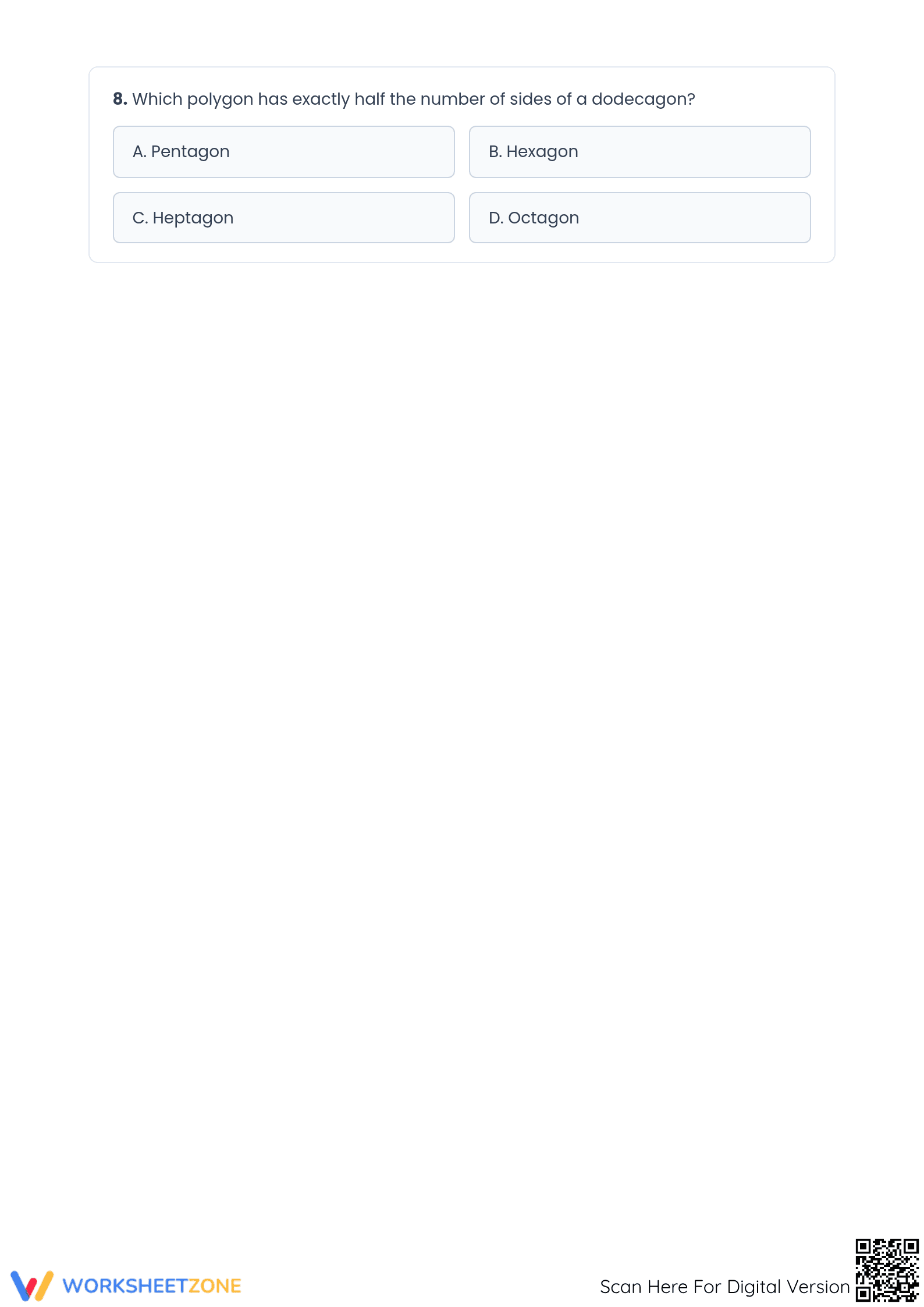
This 3-page instructional resource is meticulously organized to support various learning styles. Inside, you will find a clear diagram of a regular dodecagon as a visual reference, followed by a series of structured property questions. The first page focuses on definitions, while the second page introduces the sum of interior angles formula and diagonal calculations. The final section includes multiple-choice items that assess perimeter logic and side-count comparisons. A full answer key is provided for immediate feedback or grading.
The worksheet follows a deliberate sequence to ensure student success. First, Guided Practice introduces the dodecagon's definition and Greek prefix through 2 fill-in-the-blank questions. Next, Supported Practice presents 3 formula-driven problems where students calculate angles and diagonals using provided hints. Finally, Independent Practice offers 3 multiple-choice challenges testing side-length logic. This gradual-release model moves students from recall to the application of geometric theorems.
Standards Alignment
This resource is primarily aligned to CCSS.MATH.CONTENT.HSG.MG.A.1, focusing on using geometric shapes and their properties to describe objects. It also supports CCSS.MATH.CONTENT.7.G.B.6 by requiring students to solve real-world and mathematical problems involving the properties of two-dimensional objects. Both standard codes can be copied directly into lesson plans, IEP goals, or district curriculum mapping tools.
How to Use It
Integrate this worksheet during the 'You Do' phase of your geometry lesson on polygon angles. For formative assessment, observe students during Question 5 to see if they can apply the diagonal formula correctly. This worksheet is also ideal as independent practice or a comprehensive homework assignment. Expected completion time is approximately 30 minutes for most students.
Who It's For
This practice set is designed for Grade 7 through 10 students in Geometry courses. It is effective for learners who benefit from visual aids and formula hints to master polygonal properties. To extend the lesson, pair this worksheet with a coordinate plane activity where students plot vertices. This reinforces both algebraic calculation and spatial graphing skills.
According to the RAND AIRS 2024 report on secondary mathematics education, spatial reasoning and the ability to generalize geometric properties are critical predictors of success in higher-level calculus and engineering courses. This dodecagon worksheet directly addresses these competencies by requiring students to apply the (n-2) x 180 formula and diagonal calculations to a complex 12-sided polygon. By moving from basic property identification to multi-step perimeter and angle calculations, the resource supports the cognitive shift from concrete to abstract mathematical reasoning. The CCSS.MATH.CONTENT.HSG.MG.A.1 standard emphasizes the application of geometric concepts in modeling situations, and this practice set ensures that students possess the foundational accuracy needed for such complex tasks. Research indicates that structured, repetitive practice with high-order polygons helps solidify the relationship between side counts and interior angle sums. This self-contained module provides the necessary scaffolding to bridge the gap between simple triangle properties and advanced polygonal geometry.


