




























Views
Downloads
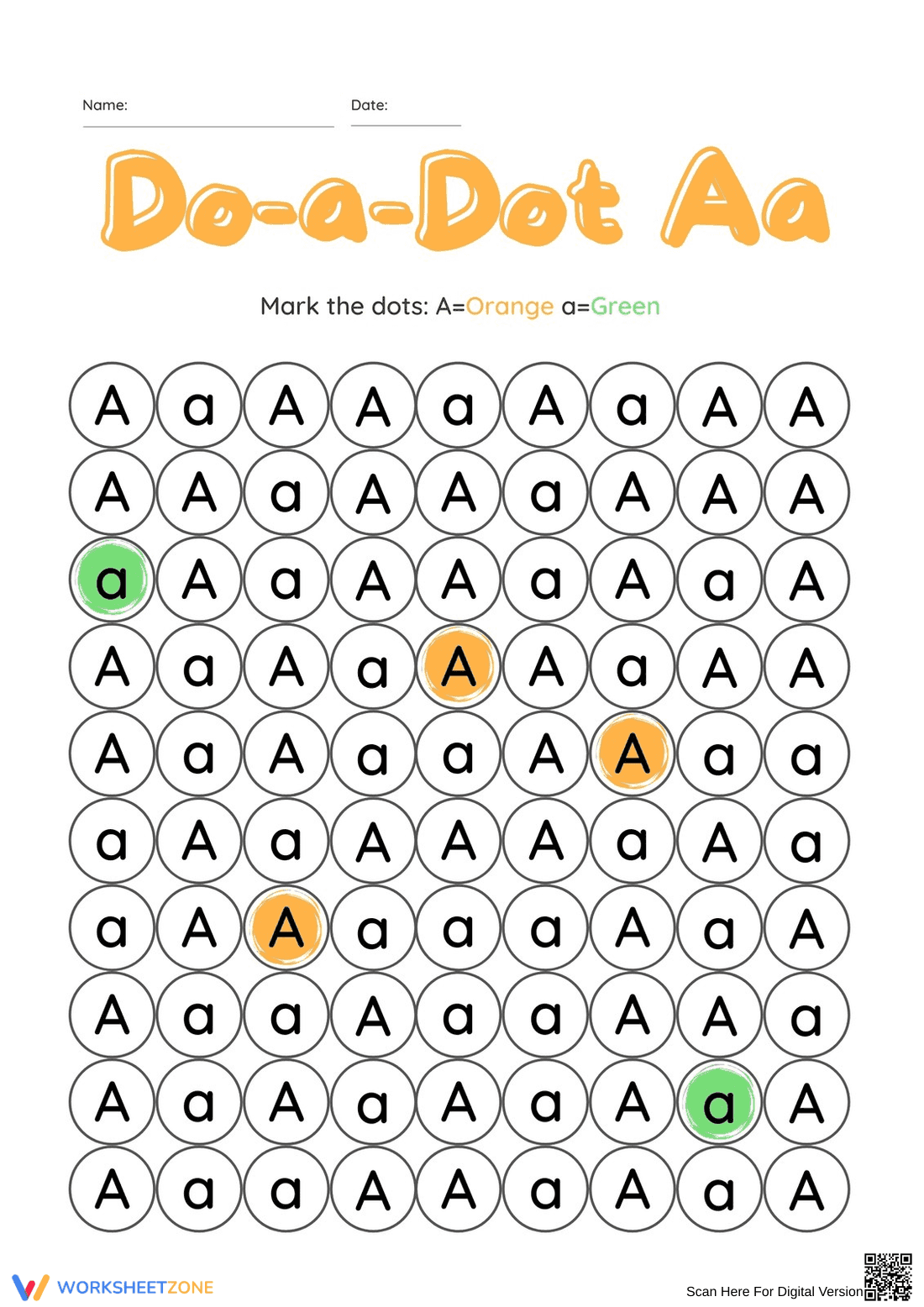

Printable Do-a-Dot Letters Worksheet | Kindergarten ELA

Paste this activity's link or code into your existing LMS (Google Classroom, Canvas, Teams, Schoology, Moodle, etc.).
Students can open and work on the activity right away, with no student login required.
You'll still be able to track student progress and results from your teacher account.
This Kindergarten letter recognition worksheet helps students distinguish between uppercase and lowercase 'A' through an engaging tactile activity. By using dot markers or crayons, learners build visual discrimination skills and fine motor control simultaneously. It provides a clear, focused environment for mastering the first letter of the alphabet with immediate visual feedback.
At a Glance
- Grade: Kindergarten · Subject: ELA
- Standard:
CCSS.ELA-LITERACY.RF.K.1.D— Recognize and name all upper- and lowercase letters of the alphabet- Skill Focus: Letter Aa Recognition
- Format: 1 page · 90 problems · Answer key included · PDF
- Best For: Morning work or literacy centers
- Time: 10–15 minutes
This single-page PDF features a high-density grid containing 90 individual letter circles. The layout includes a clear color-coding key at the top, instructing students to mark uppercase 'A' in orange and lowercase 'a' in green. The clean design minimizes distractions, while the large dot format is specifically optimized for bingo daubers or standard markers.
The zero-prep workflow is designed for busy educators. First, print the single-page PDF (30 seconds). Second, distribute the sheets along with orange and green markers to your literacy center (1 minute). Third, review student progress by checking for color consistency across the grid (30 seconds). This resource is an ideal emergency sub plan component.
This resource aligns with `CCSS.ELA-LITERACY.RF.K.1.D`, which requires students to recognize and name all upper- and lowercase letters of the alphabet. By isolating the letter 'A', students develop the foundational phonemic awareness and orthographic mapping skills necessary for early reading success. Both standard codes can be copied directly into lesson plans, IEP goals, or district curriculum mapping tools.
Use this worksheet during the "You Do" phase of a gradual release lesson on the alphabet. It serves as an excellent formative assessment tool; teachers can quickly scan the room to see if students are correctly identifying the case based on the colors used. It is also effective for small-group intervention for students struggling with visual discrimination.
This activity is designed for Kindergarten students, though it is highly effective for Pre-K learners and English Language Learners (ELLs) who need repetitive practice with English orthography. It pairs naturally with an alphabet anchor chart or a read-aloud focused on the letter 'A' to reinforce the letter-sound relationship.
According to the RAND AIRS 2024 report, tactile engagement in early literacy significantly improves retention of letter shapes among emergent readers. This worksheet utilizes a high-repetition model, providing 90 distinct opportunities for students to practice visual discrimination between uppercase and lowercase forms. Research by Fisher & Frey (2014) emphasizes that such focused, low-stakes practice allows students to build the automaticity required for fluent decoding later in their academic careers. By integrating color-coding with letter identification, the resource addresses multiple learning modalities, ensuring that students with varying fine motor abilities can participate successfully. The inclusion of CCSS.ELA-LITERACY.RF.K.1.D ensures that the activity remains grounded in rigorous academic expectations while maintaining an age-appropriate, play-based feel. This balance of engagement and alignment is critical for sustaining student interest during foundational literacy blocks.


