




























Views
Downloads

Printable Dichotomous Key Worksheet | Grade 5 Science

Paste this activity's link or code into your existing LMS (Google Classroom, Canvas, Teams, Schoology, Moodle, etc.).
Students can open and work on the activity right away, with no student login required.
You'll still be able to track student progress and results from your teacher account.
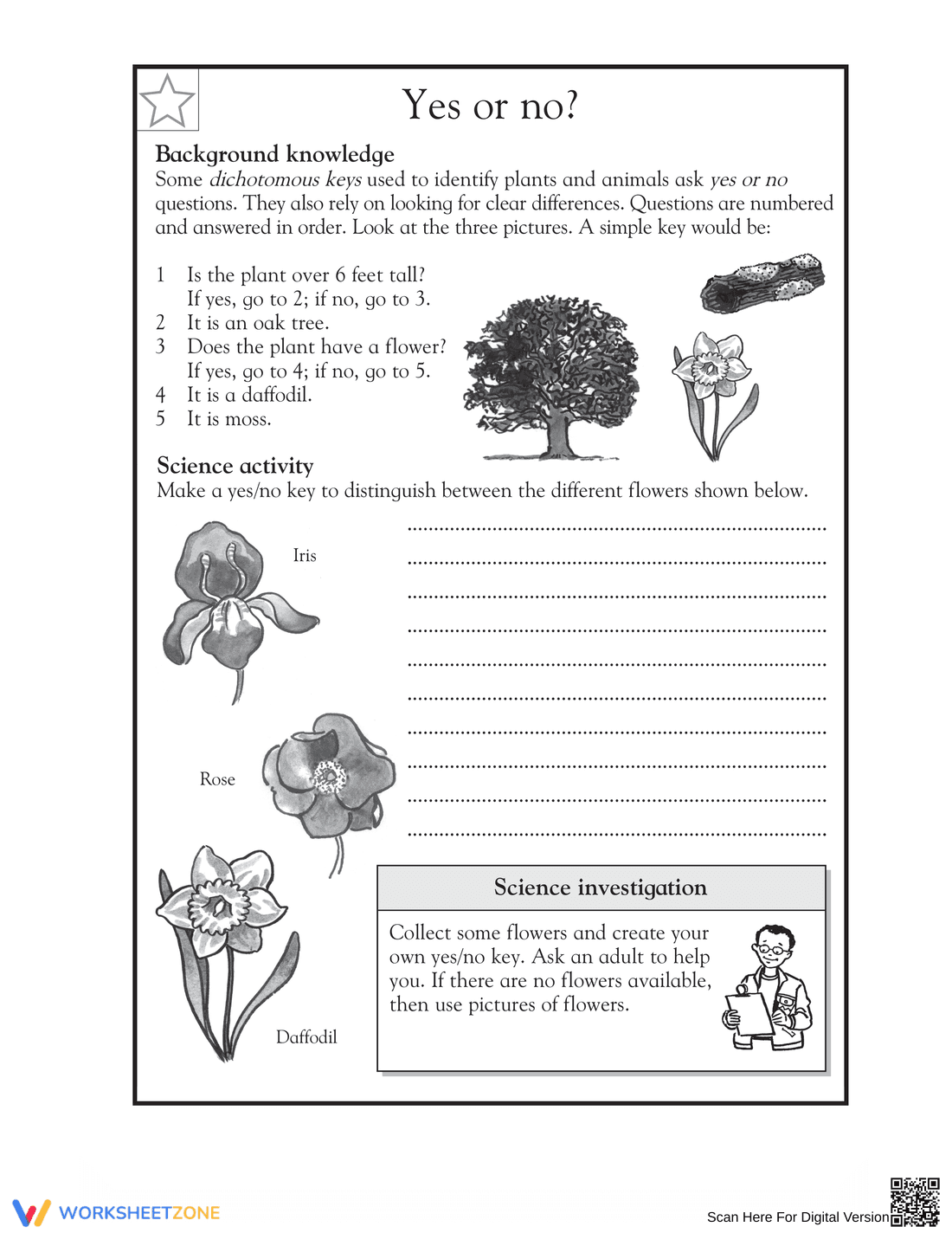
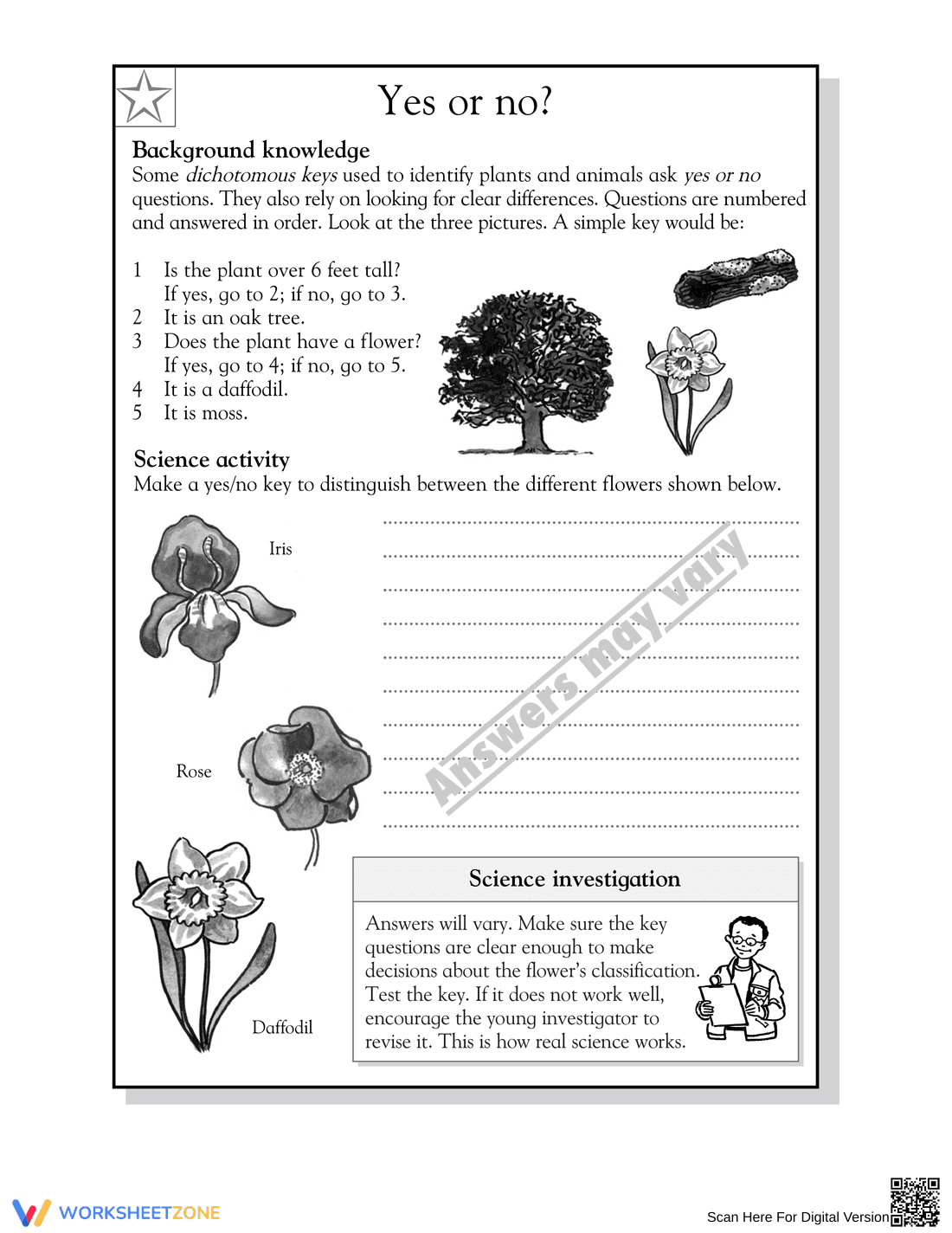
This Grade 5 science worksheet empowers students to master the art of biological classification by constructing a functional dichotomous key. By analyzing the physical traits of an iris, rose, and daffodil, learners develop critical thinking skills necessary for scientific inquiry. Students transition from understanding background knowledge to independent application, ensuring they can distinguish living things based on observable differences.
At a Glance
- Grade: 5 · Subject: Living Things
- Standard:
5-LS1-1— Distinguish living things based on observable physical traits and characteristics- Skill Focus: Dichotomous key construction
- Format: 1 page · 2 tasks · Answer key included · PDF
- Best For: Science centers and independent practice
- Time: 20–30 minutes
This one-page resource features a comprehensive "Background Knowledge" section that introduces the concept of yes/no branching keys using a tree, flower, and moss as examples. The primary "Science Activity" provides clear illustrations of an iris, rose, and daffodil, with structured writing lines for students to draft their own identification questions. Additionally, a "Science Investigation" extension encourages hands-on learning by asking students to collect local specimens and create a unique classification system.
Zero-Prep Workflow
The zero-prep design makes this worksheet an ideal choice for busy educators and substitute plans. Teachers can follow a simple three-step workflow to implement this lesson effectively:
- Print (1 minute): Generate copies for the class or science center.
- Distribute (1 minute): Hand out the sheets; the background section eliminates the need for an introductory lecture.
- Review (3 minutes): Use the answer key to facilitate a quick check or allow for peer grading.
Standards Alignment
This resource aligns primarily with 5-LS1-1, focusing on the classification of organisms based on their physical structures and requirements. By creating a dichotomous key, students engage in the scientific practice of developing and using models to describe the natural world. This standard code can be copied directly into lesson plans, IEP goals, or district curriculum mapping tools.
How to Use It
Use this worksheet as a formative assessment during a unit on plant biology or ecosystems. It is best implemented after direct instruction on plant anatomy, allowing students to apply their knowledge of petals, stems, and heights to a logical framework. Educators can observe how students prioritize traits to gauge their understanding of hierarchical classification. Completion typically ranges from 20 to 30 minutes depending on the depth of the investigation extension.
Who It's For
Designed for fifth-grade students, this worksheet is also suitable for fourth-grade enrichment or sixth-grade review. It includes sentence starters via the background example to support English Language Learners and students with IEPs. For a complete lesson experience, pair this worksheet with a botanical passage or a classroom anchor chart on plant structures to provide additional linguistic and visual support.
According to the RAND AIRS 2024 analysis, scaffolded classification tasks improve a student's ability to process complex biological data. This worksheet addresses the 5-LS1-1 standard by requiring students to distinguish living things through a logical branching system, a skill fundamental to taxonomy. By engaging with both a provided model and an independent construction task, learners build the cognitive pathways necessary for higher-order scientific reasoning. The immediate background knowledge ensures that the instructional moment is maximized without teacher preparation delays. Research from ScienceDirect TpT Analysis suggests that high-quality, print-and-go resources like this one enhance classroom efficiency by allowing educators to focus on individual feedback rather than administrative setup. This resource provides a proven framework for Grade 5 learners to access complex scientific concepts through structured, observable evidence.


