


























In this lesson, students will:
- use a variety of methods to study distance.
- decide when it is appropriate to use exact vs estimated solutions.
- use distance to solve real-world problems.
- How are relationships represented mathematically?
- How are expressions, equations, and inequalities used to quantify, solve, model, and/or analyze mathematical problems?
- How can mathematics help us communicate more effectively?
- How may patterns be used to describe mathematical relationships?
- How can mathematics help to quantify, compare, depict, and model numbers?
- What does it mean to analyze and estimate numerical quantities?
- What makes a tool and/or strategy suitable for a certain task?
- What domains does distance arise in the study of mathematics?
- How does distance relate to other mathematical topics?
- Absolute Value: The value of a number without its sign, e.g., the absolute value of –5 is 5.
- Composite Figure: In geometry, two or more figures, typically polygons, adjoined such that the total area is equal to the sum of each figure.
- Coordinate Plane: A system of points called ordered pairs whereby each point may be located by the distance from two perpendicular lines called axes. The horizontal is the x-axis and the vertical axis is called the y-axis.
- Distance Formula: The formula that reveals distance as a function of rate and time (e.g., ).
- Length of a Segment: The distance between the endpoints of a line segment.
- Proportion: A statement of equality between two ratios.
- Pythagorean Theorem: The theorem that relates the legs of a right triangle and its hypotenuse by stating a² + b² = c²
- Rulers with customary and metric scales
- Flexible tape measure in customary and metric scales
- Lesson 1 Exit Ticket (M-8-5-1_Lesson 1 Exit Ticket and KEY)
- Measurement handout (M-8-5-1_Measurement)
- Assess each proportion in relation to the appropriate allocation of related portions prior to evaluating the computation's accuracy. Ratio equivalencies are only true when the numerator and denominator have the proper relationships.
- Take note of how accurately each ratio was represented by the students throughout the lesson's review and during the class discussion.
- Analyze the values of ordered pairs' addition and subtraction using a coordinate grid. Keep in mind the differences between distance and direction (left to right for positive, and right to left for negative). The distance between (0, 1) and (−10, 1), for instance, has an absolute value of 10.
Explicit Instruction, Modeling, Scaffolding, Active Engagement
W: Students investigate distance through a range of methods and visualizations, making connections between the topic and other mathematical subjects. Students also use this knowledge to solve practical issues.
H: By providing an overview of distance and showcasing a range of approaches to it, the lesson's opening "hooks" students. An abstract method for conceptualizing positive and negative directions as well as distance is also covered in the first section of the session.
E: A combination of tangible and abstract issues and approaches are used in this course.
R: Students get many chances to edit, go over, consider, and reconsider their work thanks to the interactive exercises. Throughout the class, there are additional discussion chances for the students.
E: Through the formulation of problems and involvement in a range of remote activities, students engage in self-evaluation and self-reflection.
T: Students of different learning styles and comprehension levels are supported by the incorporation of both independent and group activities. Students can receive individualized support by using specific examples as needed.
O: Through a combination of abstract and concrete problems and presentations, the lesson encourages and directs students to think abstractly and draw connections and applications.
Part 1: Distance and Perimeter
Tell students, "We can talk about the length of a segment, the distance between Point A and Point B, the total distance around an object (perimeter), the distance between coordinates on a coordinate plane, the distance as a function of the product of rate and time, or the height of an object when we are discussing the topic of distance."
"We can utilize distance to calculate the perimeter of a shape or item or to find a missing height or length. Many techniques are available to us for determining such distances."
"Do we consider in terms of positive and negative distance when we discuss distance? If yes, provide an instance."
Say, "For example, Sarah turned around at a stop sign and took three steps back. How far did she walk? In what way would we represent that distance? We would display the steps as −3 to indicate the negative direction. However, she only walked 3 steps. She did not take negative steps. We understand that there is no negative distance in a common sense context. As a result, |-3| = 3, which expresses the true distance, is 3. Here, we are briefly discussing the idea of absolute value. In simple terms, the equation states that the absolute value of -3 is 3."
"Now, imagine she takes 5 steps forward. How far did she walk? In what way would we represent that distance? We would express the stages as +5 to indicate the positive direction. She took 5 steps. The distance can therefore be expressed as |5| = 5 using the absolute value definition as show above. The absolute value of 5 is 5."
“Where does she stand if she goes forward 5 steps from the point of 3 steps behind the stop sign? In other words, what is it? The answer is 2. Now, how many total steps did she take? We can determine the answer to that question by using the absolute values of the two numbers. For example, |-3| + |5| = 3 + 5 = 8 . She therefore took 8 steps in total.”
When presenting the above statements to the class, use an image to visually represent the concept. Draw a number line with the stop sign at zero and Sarah walking 3 steps behind (-3), 3 steps past (+3). This will show students where the 3 − (−3) = 6 comes from visually. Remind students that when subtracting, the answer should be absolute value because distance is always positive, as previously explained.
"Observe that the + and − distances correspond to the right and left positions on an x-axis or a number line, respectively. Now that you have an understanding of direction of a distance, therefore, let's proceed to measure distance using a ruler."
"We can draw a line segment of a specific length using a ruler. With a ruler, we can determine a line segment's length. Let's do both."
“Suppose we want to draw a line segment of length 2.375 inches. We must establish the number of intervals we have between each successive inch. We find that we have 8 intervals. Thus, the ruler is marked in eighths, with each interval representing \(1 \over 8\) inch.”
"What do we need to decide now? We need to convert 2.375 to a fraction. What is 2.375 as a fraction?" (\(2 {3 \over 8} \))
"So, we will draw a line from 0 inches to 2 inches, and keep going until we reach the third \(1 \over 8\) mark after the 2."
Ask them to sketch this while they follow along with you on paper. "Now let's measure the given line segment."
Give the Measurement activity sheet (M-8-5-1_Measurement) to the students, along with a pre-drawn line segment at \(4 {7 \over 10} \) cm.
"Observe that both lines on the activity sheet are larger than the actual measurement scale to make them easy to see and read."
This activity's instructions are designed to emphasize the partitions of the two measurement scales rather than the absolute distances they represent. In the inch scale, the partitions are in sixteenths, and in the centimeter/millimeter scale, the partitions are in tenths.
Use the guidelines below to verbally take students through the process of measuring with centimeters. "Let's place the straightedge directly under the line segment. We must line up the left side of the line segment with 0 cm on the straightedge. We can see that the line segment is longer than 4 cm. The interval between successive centimeters is \(1 \over 10\). Our segment goes seven one-tenths past 4 cm, or \(7 \over 10\) past 4 cm. Thus, the segment's length is \(4 {7 \over 10} \) cm. This measurement is also 4.7 cm, which is equal to 4 centimeters and 7 millimeters."
Explain to students that each centimeter is divided into 10 millimeters.
"Note that decimal measurements for feet and inches are also common, but they can cause problems and must be recorded appropriately to avoid confusion. For example, while writing 3.5 ft, you might think of it as 3 feet 5 inches. However, it is actually 3 feet 6 inches, because 0.5 or one-half of one foot equals 6 inches."
"Likewise, 3.6 feet does not equal 3 feet 6 inches! It is actually 3 ft 7.2 inches because 0.6 of a foot is more than half a foot, indicating that it is greater than 6 inches. To determine the precise number of inches we have, multiply .6 by 12 (the number of inches in one foot). Examples like this demonstrate why it is much more common to see metric measurement in decimal form than customary measurements expressed as fractions."
“Suppose we are not only interested in just the length of a line segment. Instead, we want to find the total distance around a shape, also known as its perimeter. Let's calculate the perimeter of the following shape.”
"The perimeter is the total distance around a triangle. Thus, the perimeter is 7 + 4 + 9, or 20."
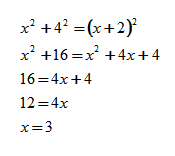
"What if we looked at perimeter in a real-world scenario? Assume Michael must build a border around a rectangular garden. The width can only be 4 feet, with a maximum perimeter of 26 feet. What border length must Michael use?" (9 ft)
Steps to solve this problem:
Activity—Perimeter
Part 1: Draw a rectangle, square, and pentagon. Label each side length with the values of your choice. Show how to find and record the perimeter.
Part 2: Create a word problem that describes the real-world need for perimeter measurement. Demonstrate how to find the perimeter or distance, and then record the perimeter/distance.
Perimeter of Compound Figures
Explain to students, "Given the following compound figure, find the total distance around the figure." (42 cm)
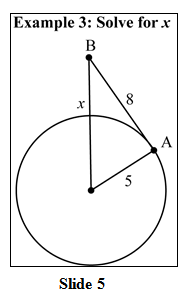
"Notice that we did not count the length of the bottom of the triangle, since it is adjoined to the rectangle."
"What if we had a circle? Suppose I stake a peg in a football field with a long rope attached. I then extend the rope and mark a spot with a paint gun. I continue to stretch the rope, mark spots, and move around in a circular motion. When I'm finished, I'll have a bunch of markers that form a circle, with my center at the staked peg. Now, what if I want to know the distance around the circle or the distance I just walked? How could I find that distance? What is another term for the distance around a circle?"
Allow students time to consider various measuring alternatives. (Some would suggest stretching a measuring tape around the circle. Others might consider drawing a square around the circle, calculating its perimeter, then measuring the distance around the circle.)
"The distance around a circle, or the perimeter of a circle, is known as the circumference. Circumference can be calculated using the following formula:
C = 2πr, where π is considered to be around 3.14, d is the circle's diameter, and r is the radius of the circle."
"Suppose our circle had a diameter of 24 feet. Substituting into our formula we have:"
C = 24π
≈ 75.56
Note: Remind students that 24p and p24 are the same because of the commutative property of multiplication.
"Therefore, we could say that 75.36 feet was the distance around the circle."
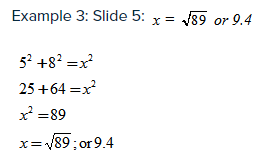
Divide students into groups of three or four. Students will use a tape measure to determine how close they can get to pi. Measure the circumference (distance around the circle) and diameter of three different circles on the floor (in centimeters). To calculate each pi value, use the circumference formula. Due to potential creases in the tape measure, students will most likely receive three estimations of the value of pi. Each group will report on the three values of pi, noting the one closest to 3.14. Copy or print the chart below so that student groups can record their results and calculations:
Tell students, "We are frequently asked to identify the percent of a distance or calculate the distance for a certain percentage. Let's investigate this topic within the context of the circumference of a circle. We shall look at the topic from two perspectives."
"First, we'll calculate the percent of a distance. Assume we are walking on a circular track. We walked 189 meters along a 400-meter round track. What percentage of the circle's perimeter or circumference have we walked? We would formulate the following question:
189 meters is what percent of 400 meters?
We can turn this question into an equation by writing:
189 = 400x
x ≈ 0.47
As a result, we have walked approximately 47% of the way around the circular track (0.47 * 100 converts the decimal to the percent). This proportion seems reasonable, given 189 is less than but close to 200." Note: Point out to students that most circular running tracks that surround playing fields are not strictly circular, but composite figures. They are normally made up of two semicircles, each with a radius of around 36.4 meters. They are connected by an 85-meter straight line on each side.
"Second, let's calculate the distance for a given percent. Assume our circle has a circumference of 16π, which is roughly 50.27. What is 60% of the circumference, or distance around the circle?" (approximately 30.16)
"Therefore, if we trace 60% of the circle's perimeter, we will cover 30.16 units. Keep in mind that while using percents, we must use the decimal version of the percent. This is calculated by moving the decimal place two spaces to the left or dividing 100, so 60% is 0.60 as a decimal."
(0.60)(50.27) ≈ 30.16
"A group of university students is given the following space for their fundraising booth." Draw approximate places for the following four ordered pairs on the board: "The coordinates of the four vertices of the rectangle are: A (−10, 20), B (10, 20), C (10, −20), and D (−10, −20)." (Distance from A to B = 20; Distance from B to C = 40; Distance from C to D = 20; Distance from D to A = 40).
"If the units are feet, what is the perimeter of the space they are given?" Allow students time to discuss.
"We need to find the horizontal distance from either Point A to Point B or Point D to Point C, and the vertical distance from either Point A to Point D or Point B to Point C."
"Let's find the horizontal distance between Point A and Point B. As previously discussed, distance is positive, as indicated by its absolute value. We will calculate the absolute value of the difference in x-coordinates between each point. Thus, the length of their space can be expressed as:
l = |-10 - 10|
l = |-20| = 20
"Now, let's find the vertical distance from Point A to Point D."
"To determine the width of the space, we will calculate the absolute value of the difference in the y-coordinates of each point. Thus, the width of their space can be expressed as:
w = |20 - (-20)|
w =|40|
w = 40
The total distance around the given space, or perimeter, can be calculated by adding 20 + 20 + 40 + 40, for a total of 120. The perimeter of the space is 120 feet."
Explain to students, "Suppose you are given the following choices and accompanying diagram:"
The parking lot in the city mall is being reconstructed. The construction manager must use 428 feet as the width for the front lot of the mall. If the diagram depicts two distinct widths (with the lot beginning at different distances from the drive), which width should he/she choose?
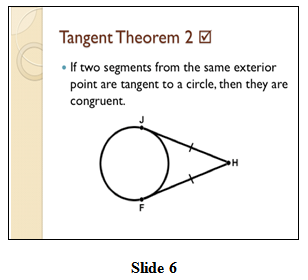
Students should understand that, Width Choice A is the ideal width, since the distance can be calculated as follows:
|561 - 133| = |428| = 428
and
|491 - 86| = |405| = 405
When the graph's points are compared to the estimated values, it becomes clear that they are approximations.
Create a real-world situation in which a person must select the best path based on a desirable/preferred distance. Include an appropriate diagram, created on a coordinate grid, to demonstrate the lengths or distances. Show how to solve the problem, state your answer, and provide supporting explanations.
"Sometimes we are given only two sides of a right triangle and must determine the length of the third side. How would we go about determining the missing side length of a right triangle?
"We may apply the Pythagorean theorem. According to the Pythagorean Theorem, the sum of the squares of two legs is equal to the square of the hypotenuse. Written in equation form, we have:
a² + b² = c²
where a and b are legs, and c is the hypotenuse.”
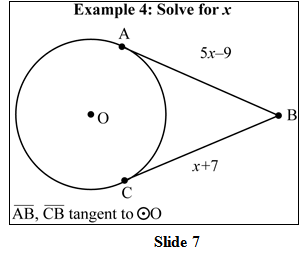
“Let’s see an example. Suppose you are given:
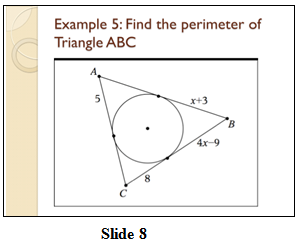
Since we want to find the length of the hypotenuse in this example, we will solve for c.
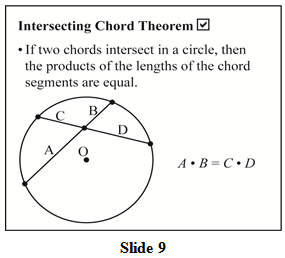
As a result, c is roughly 3.61 cm."
“Now let's look at another example. This is actually a rather common triangle. In this example, we will be provided the lengths of one leg and the hypotenuse. It is important to note that the right angle must be identified in order to determine which side is the hypotenuse and which are the two legs.”
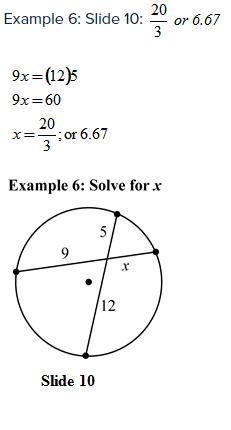
"To get the length of the missing leg, we simply substitute the lengths that we already know into the Pythagorean Theorem formula:
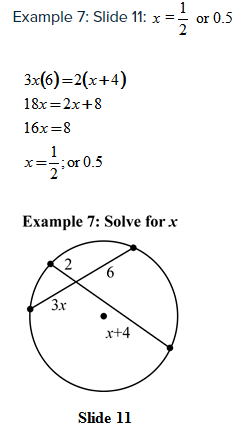
Therefore, the length of the missing leg is 4 inches."
"Now, let's take a look at a real-world problem:" Read the problem aloud and draw a diagram on the board.
Monique is currently looking for an apartment. She has picked two apartment complexes to view. She has two options for getting from Apartment 1 to Apartment 2: walk 0.8 miles north and then 0.6 miles east, or cut through a park. Determine the distance she would travel if she cut across the park. Will that path be shorter or longer than the route that goes directly north and then east? If so, how much shorter or longer?
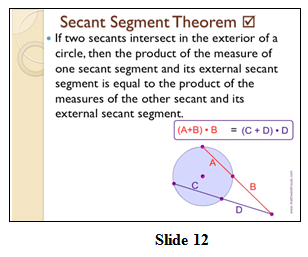
“The hypotenuse represents the indirect path. Therefore, we will substitute the values of our legs into the formula for the Pythagorean Theorem.”
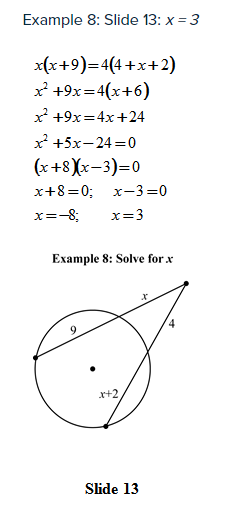
"The path across the park is 1 mile in length. The path's distance is equal to the sum of 0.8 and 0.6, which equals 1.4 miles. As a result, the path through the park is 0.4 miles shorter than the path that runs immediately north and then east."
"Now, assume we need to find distances on a coordinate grid. In the example, the distances form a right triangle, allowing us to find the missing distance using either the Pythagorean Theorem or the distance equation. We'll look at both. It should be noted that the distance equation can be used to calculate the distance between any two coordinate pairs, whether or not there are multiple line segments. We're only continuing our discussion of the Pythagorean Theorem."
"Consider a triangle whose vertices are (20, 56), (20, 32), and (38, 32). Do you recall how we may calculate horizontal and vertical distances?" (Subtract the coordinates.)
“To get the horizontal distance between (20, 32) and (38, 32), we compute 38 - 20, which equals 18. To calculate the vertical distance between (20, 32) and (20, 56), we subtract 32 from 56, which is 24.”
"We can now use those two measurements and the Pythagorean Theorem to get the length of the hypotenuse:
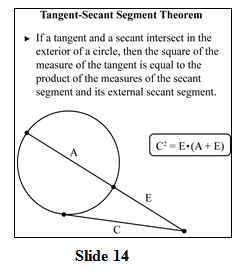
Consequently, the length of the hypotenuse is 30."
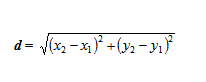
"Let's now calculate the distance between coordinates (20, 56) and (38, 32) using the distance formula. Is there anyone who knows how this formula will look?" (the Pythagorean Theorem)
"Use the following formula to determine the distance between two points:
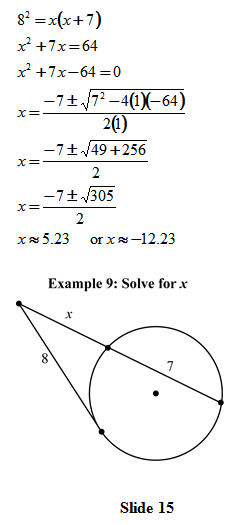
Substituting in our values, we have:
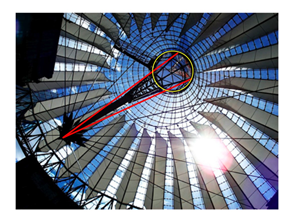
Simplifying gives:
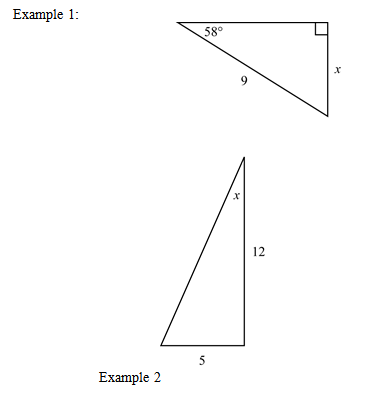
Once again, we determine that the distance of the hypotenuse is 30."
Tell students, “Using what you've learned about distances, the Pythagorean Theorem, and the formula for calculating the distance between any two points, create a short, animated PowerPoint to demonstrate a real-world problem. The PowerPoint presentation must feature at least one animated illustration. For example, while looking at triangles in a bridge's architectural plan, you could demonstrate how the appropriate lengths are computed. In this case, the Pythagorean Theorem is most appropriate.”
Part 2: Other Applications and Reasoning
Distance using Rate (d = rt)
"We can also use the term distance when discussing the concept of distance traveled. Assume we have the following problem.
Hannah drives for 4 hours at 65 miles per hour. How far did she drive?"
Ask,
"How do we solve this problem? (Multiply 4 by 65).
Do you agree that we are seeking for the distance traveled?"
Allow students to ponder their ideas. Some may go straight to the distance formula, while others may understand the solution is to multiply the hours by the rate. “We need to multiply the number of hours she drives by the rate at which she drives. Because we're talking about the number of miles driven in one hour, our rate is a unit rate.”
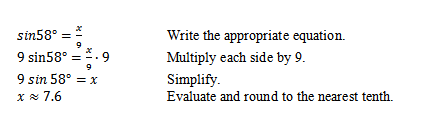
"We have the following after dividing by hours as the common denominator, t:"
= 65 • 4 mi
= 260 mi
Assign this task to students to create. "Create a science-based word problem using the ideas of distance, time, and rate. Display your work, solve it, and be ready to share the solution with the class."
Give students time to explore a distance/rate idea that is scientific in nature.
Proportion
Tell students: "Proportions can be utilized to identify missing lengths or heights. Remember that a proportion is an equation that equalizes two ratios."
"Foresters use proportional reasoning throughout their careers, as they must determine the heights of trees." Ask,
“How would you use a proportion to find the height of a tree?” (find the length of its shadow to solve a proportion.)
"What would you use?" (tape measure)
"What measurements would be included in the proportion?" (the length of an object with known height and the length of its shadow)
"Suppose you go out into the field, with only yourself and a measuring tape." Allow students time to discuss and conclude that the individual's height, the length of his/her shadow, and the length of the tree's shadow are all necessary for the setup.
Divide students into groups of three or four. If possible, outside in a tree-filled environment, have students actually perform an experiment to measure the height of a tree. If it is not practicable, modify the activity to include determining the height of another item, such as a building, pole, tower, etc.
Once students have completed the task, have each group present the results of their experiment. Discuss any questions, issues, or suggestions you may have. Provide the following sample problem to include in their notes:
Assume Amanda is 5.5 feet tall. She throws a 7.5-foot shadow. She must find the height of a tree that throws an 18-foot shadow. How would she approach solving this problem?
Tell students: "Amanda would set up a proportion in either of two ways. First, she might compare the height-to-shadow ratios. Second, she could compare the height and shadow ratios. Looking at the equations will make things clearer."
"If she compares the ratios of heights to shadows, she will set up a proportion as:"
\(5.5 \over 7.5\) = \(x \over 18\)
“Solving for x, she will get:”
7.5x = 99
x = 13.2
"Let's now try it the other way. We'll establish a proportion by comparing her height with the height of the tree and her shadow length with the shadow length of the tree. The proportion is set up as follows:"
\(5.5 \over x\) = \(7.5 \over 18\)
(7.5)(x) = (5.5)(18)
7.5x = 99
“Solving for x, she will get x = 13.2.”
"Either way, she may say that the tree's height is around 13 feet." Allow students time after reviewing the example problem to apply similar techniques to their own problems in the activity.
"Under the general ideas of proportional reasoning and missing lengths, we can look at the topic of determining reasonableness of a length of a figure, given the measurements of another similar figure, and the measurement of at least one side of the figure in question."
“Let's examine two similar triangles:”
The side lengths of Triangle 1 are a = 9.2, b = 4.4, and c = 6.1 units.
The side lengths of Triangle 2 are unknown d and e, and f = 12.2 units.
Side a corresponds to side d; side b corresponds to side e; and side c corresponds to side f.
"Would an 18-unit estimate for side d be reasonable? Why, or why not?"
Students should be encouraged to mentally calculate proportions and visualize the relationships between the similar triangles. It should be noted that the second triangle looks to have side lengths double those of the other triangle. As a result, if side an in one triangle corresponds to side d in another, it is reasonable to expect d to be about 18, because 9.2(2) = 18.4.
For review, organize a class discussion about the components of the activities that were most helpful to students. What connections did they make throughout this lesson? Possible questions to get the discussion started are:
1. Is there any connection between the distance formula (coordinates) and the Pythagorean Theorem?
2. Where else in real life could you apply these types of distances?
3. Which topics do you see yourself using the most?
Students must complete the Lesson 1 Exit Ticket (M-8-5-1_Lesson 1 Exit Ticket and KEY).
Extension:
Encourage students to go deeper into one of the activities/explorations. Have them work specifically with a circle's circumference and pi. For example, given that all circles are similar to each other in the same way that all squares are, what is the relationship between the following two circles:
Circle X has a radius of 5 units.
Circle Y has a radius of 20 units.
How much longer is the circumference of Circle Y than Circle X? (4 times, as 5 × 4 = 20)
Give students problems to practice and apply the concepts from Lesson 1 independently or as homework.

Distance (M-8-5-1)
In this lesson, students will:
- use a variety of methods to study distance.
- decide when it is appropriate to use exact vs estimated solutions.
- use distance to solve real-world problems.


