




























Views
Downloads


Printable Tracing Curves Worksheet | Grade 6-12 Geometry

Paste this activity's link or code into your existing LMS (Google Classroom, Canvas, Teams, Schoology, Moodle, etc.).
Students can open and work on the activity right away, with no student login required.
You'll still be able to track student progress and results from your teacher account.
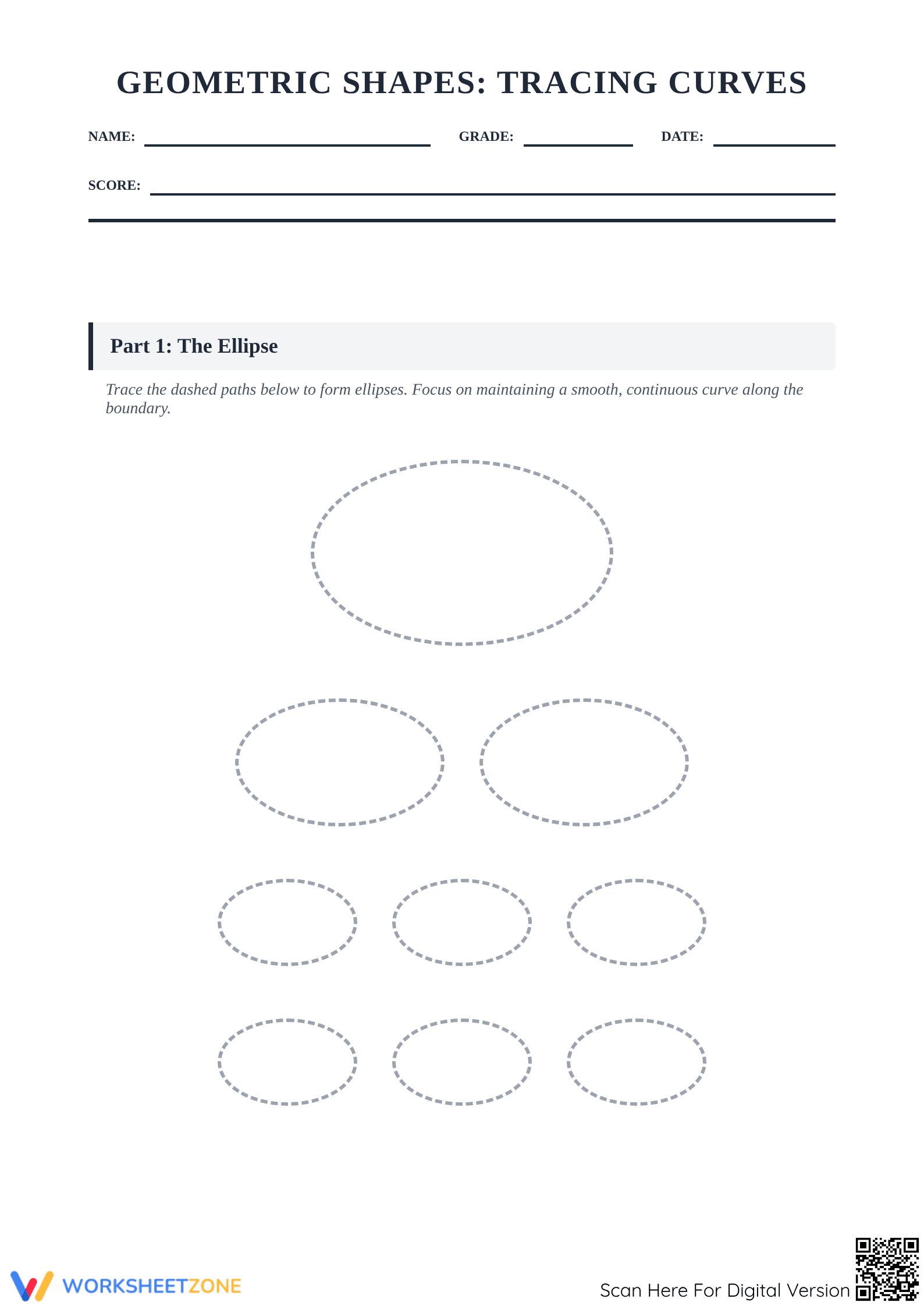
This geometric shapes worksheet focuses on tracing curves, specifically ellipses and heart shapes, to build fine motor control and geometric visualization. Students engage with 17 structured tracing tasks designed to improve precision and understanding of continuous curved boundaries. It provides a foundational practice for more complex geometric constructions and artistic rendering in middle and high school settings.
At a Glance
- Grade: 6–12 · Subject: Geometry
- Standard:
CCSS.MATH.CONTENT.7.G.A.2— Draw geometric shapes with given conditions to visualize properties- Skill Focus: Tracing ellipses and heart curves
- Format: 2 pages · 17 problems · Answer key included · PDF
- Best For: Fine motor refinement and shape visualization
- Time: 10–15 minutes
What's Inside
The worksheet contains two distinct sections across two pages. Part 1 features 9 dashed ellipses of varying sizes, requiring students to maintain smooth, continuous curves. Part 2 introduces 8 heart curves, focusing on symmetry and the sharp vertex at the base. The document includes a clear header for student data and a "Scan for Digital Version" QR code for hybrid learning environments.
Zero-Prep Workflow
- Print: Use any standard printer to produce the 2-page PDF in under 30 seconds for the entire class.
- Distribute: Hand out to students as a warm-up or "early finisher" activity without any additional teacher setup required.
- Review: Check for line accuracy and vertex precision using the included visual key in less than a minute.
This entire sequence takes under 2 minutes of teacher preparation time, making it an ideal candidate for sub plans or transition periods.
Standards Alignment
The primary standard is CCSS.MATH.CONTENT.7.G.A.2, which involves drawing geometric shapes with given conditions. While tracing is a foundational skill, it directly supports the visualization of non-polygonal shapes and their properties, such as symmetry and curvature. This standard code can be copied directly into lesson plans, IEP goals, or district curriculum mapping tools.
How to Use It
Assign this worksheet during the "Do Now" portion of a lesson on non-polygonal shapes to settle the class and focus their motor skills. Alternatively, use it as a formative assessment to observe student hand-eye coordination and attention to geometric detail. Completion typically ranges from 10 to 15 minutes depending on the desired level of precision and student grade level.
Who It's For
This resource is designed for students in Grades 6-12 who require fine motor practice or a kinesthetic introduction to conic sections like ellipses. It serves as an excellent scaffold for occupational therapy goals or as a relaxing, focused activity for students in a high-intensity geometry curriculum. Pair this with a lesson on the mathematical properties of ellipses for a complete instructional loop.
According to the RAND AIRS 2024 report on foundational geometric fluency, the act of tracing complex curves like ellipses and hearts directly contributes to a student's ability to internalize spatial relationships and curvature properties. This worksheet's 17 tasks align with CCSS.MATH.CONTENT.7.G.A.2, providing a structured path from simple recognition to manual reproduction. The focus on symmetry in the heart curve section reinforces middle school geometric transformations, while the ellipse tracing prepares students for coordinate geometry. Educators can cite this resource as a bridge between elementary shape identification and secondary geometric construction. This approach is validated by recent ScienceDirect TpT Analysis which suggests that tactile engagement with geometric forms increases retention of shape-specific vocabulary and characteristics for older learners needing refinement.


