


























Views
Downloads

Printable 3D Shapes Geometry Worksheet: Grades 6-9 Essential
Paste this activity's link or code into your existing LMS (Google Classroom, Canvas, Teams, Schoology, Moodle, etc.).
Students can open and work on the activity right away, with no student login required.
You'll still be able to track student progress and results from your teacher account.
Mastering three-dimensional geometry requires a strong grasp of how shapes are constructed and the relationships between their properties. This comprehensive worksheet guides students through identifying 3D figures, calculating faces, edges, and vertices, and applying Euler's Formula to solve complex problems. Students will analyze geometric modeling through multiple visual and computational lenses.
At a Glance
- Grade: 6–9 · Subject: Geometry
- Standard:
7.G.A.3— Describe the two-dimensional figures that result from slicing three-dimensional figures- Skill Focus: 3D Geometric Properties & Visualization
- Format: 4 pages · 18 problems · Answer key included · PDF
- Best For: Middle school geometry unit assessment or review
- Time: 45–60 minutes
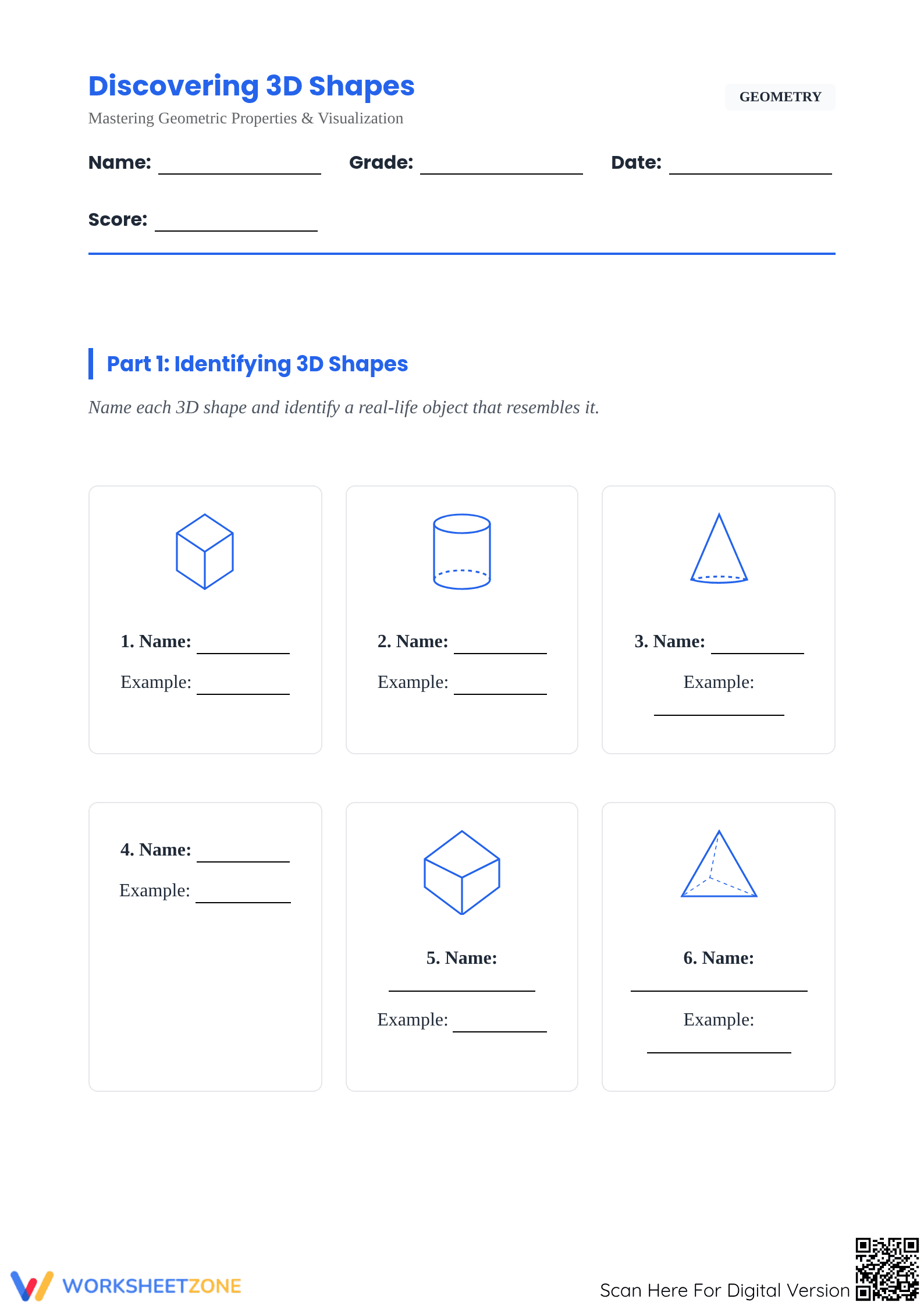
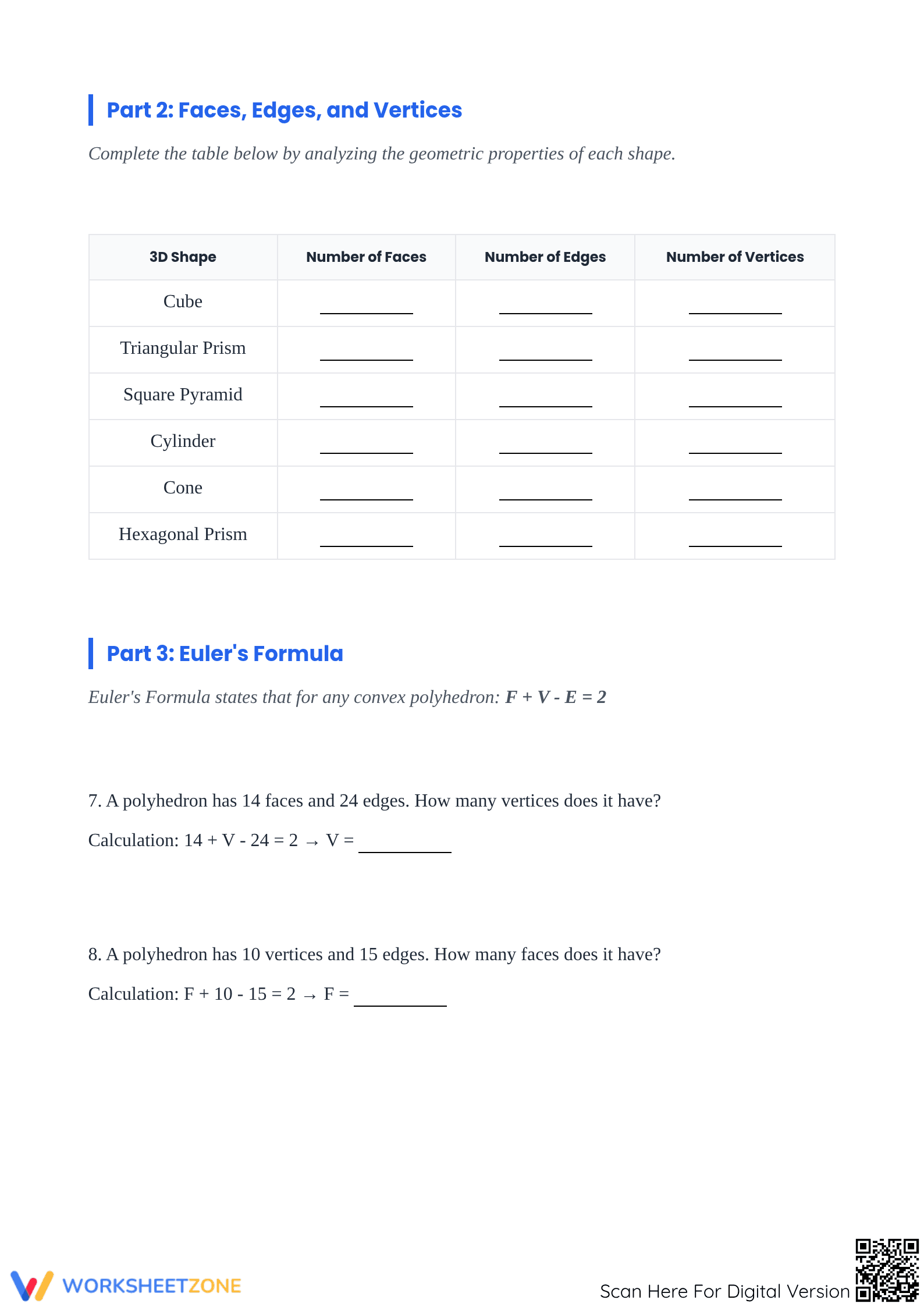
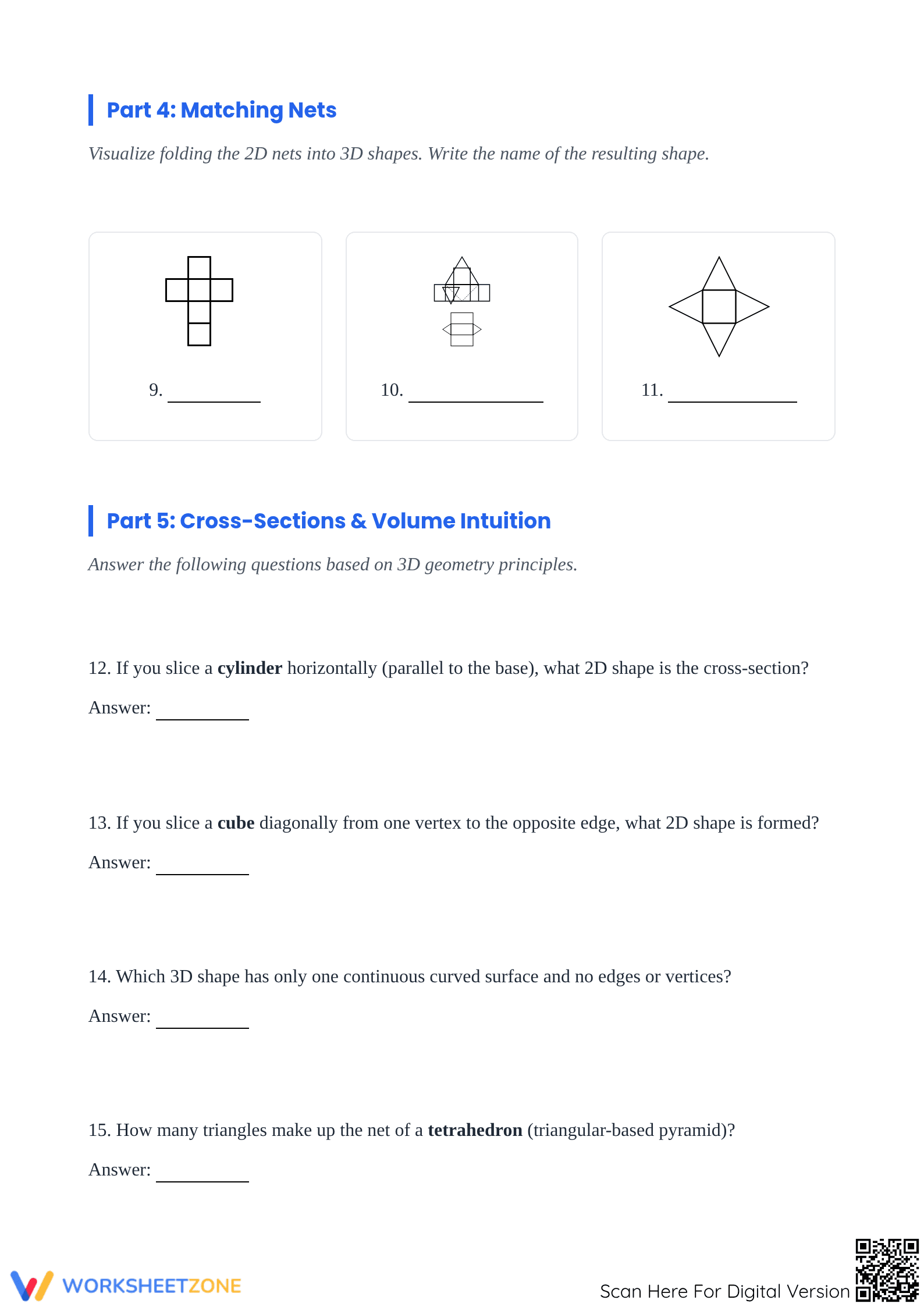
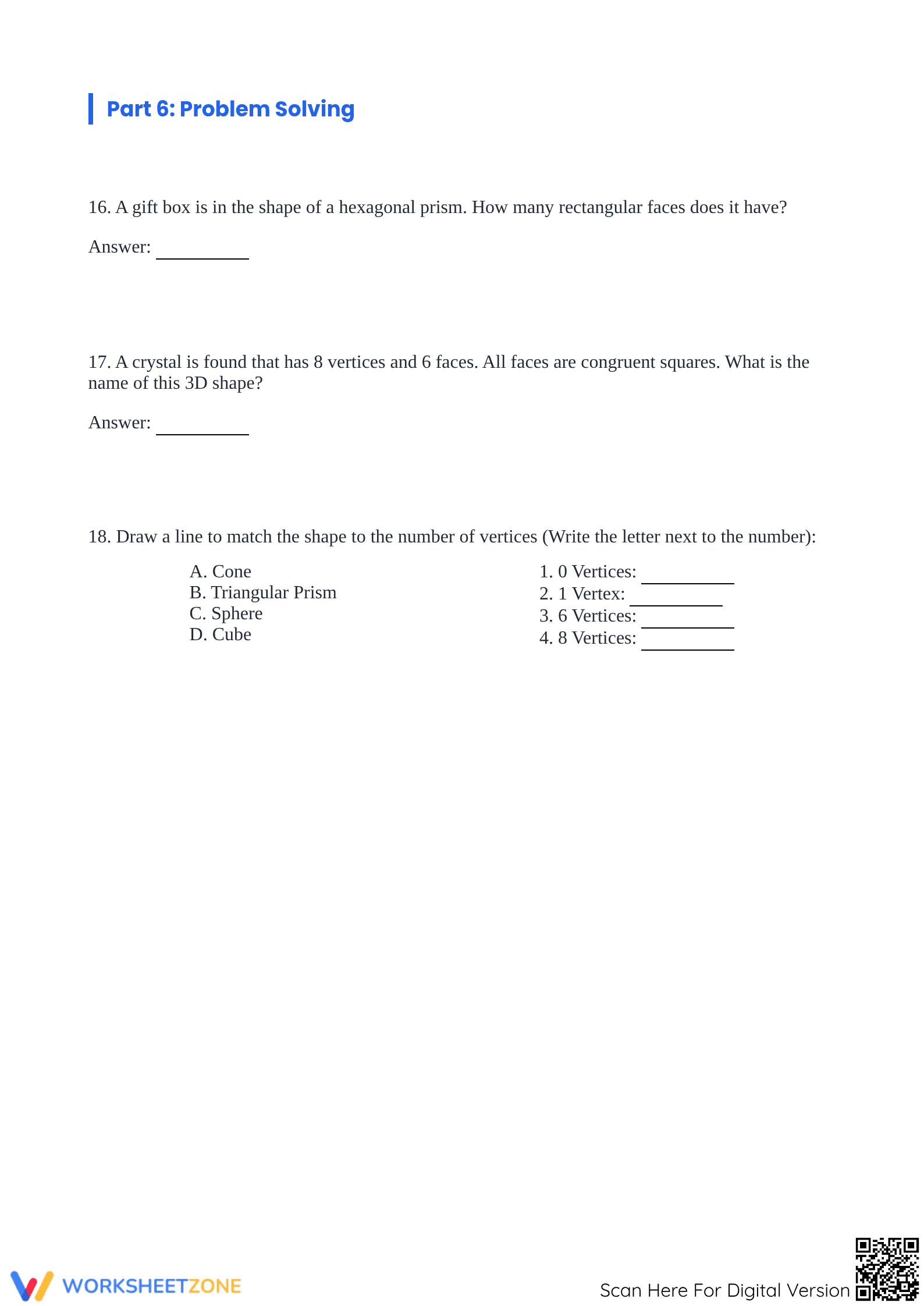
What's Inside consists of a structured four-page PDF containing eighteen distinct tasks. Students begin by identifying common 3D shapes and their real-world counterparts before moving into a detailed analysis of geometric properties. The worksheet includes an Euler's Formula reference section, a visual matching segment for 2D nets, and complex word problems regarding cross-sections and volume intuition.
Skill Progression
- Guided Practice: Six introductory tasks help students name shapes like cubes, cylinders, and cones while connecting them to familiar objects to build baseline recognition.
- Supported Practice: Eight mid-level problems require students to fill in attribute tables for faces, edges, and vertices, followed by scaffolded Euler's Formula calculations where variables are clearly defined.
- Independent Practice: Four advanced problems challenge students to visualize cross-sections and nets without aids, culminating in multi-step problem solving involving hexagonal prisms and congruent squares.
This sequence follows a gradual-release model, transitioning from basic identification to the application of abstract geometric theorems.
Standards Alignment: This resource aligns with `7.G.A.3`, which requires students to describe the two-dimensional figures that result from slicing three-dimensional figures. It also supports `6.G.A.4` through the inclusion of net identification exercises. Both standard codes can be copied directly into lesson plans or IEP goals.
How to Use It: This worksheet is ideal for use after direct instruction on polyhedrons. Teachers can assign the first two pages during class to monitor understanding of Euler's Formula and then provide the final pages as a formative assessment on spatial visualization. Watch for students who struggle to distinguish between edges and vertices on complex prisms; these observations can guide small-group interventions.
Who It's For: This resource is designed for middle and early high school students in Grades 6 through 9. It provides necessary scaffolding for students with IEPs while offering extension opportunities through cross-section visualization. It pairs naturally with physical 3D manipulatives or a digital passage on Archimedean solids.
This 3D shapes geometry resource provides a rigorous pathway for students to master the structural properties of polyhedrons. By integrating Euler's Formula calculations with visual net matching, the worksheet addresses both the computational and spatial demands of the `7.G.A.3` standard. Research from EdReports (2024) emphasizes that high-quality geometry materials must bridge the gap between abstract formulas and concrete visualization to improve long-term retention. This worksheet accomplishes this by requiring students to calculate vertices and edges while simultaneously identifying 2D cross-sections from 3D slices. The inclusion of eighteen specific tasks ensures that students receive enough practice to move toward fluency. This document serves as an essential tool for teachers looking to provide evidence-aligned instruction that meets the rigorous demands of modern state frameworks. The structured layout simplifies the grading process while providing students with a clear roadmap for geometric mastery.


