


























Views
Downloads


Essential Euler Characteristic Worksheet | Grades 6-9 Math
Paste this activity's link or code into your existing LMS (Google Classroom, Canvas, Teams, Schoology, Moodle, etc.).
Students can open and work on the activity right away, with no student login required.
You'll still be able to track student progress and results from your teacher account.
This comprehensive discovery task guides students through the fundamental components of planar graphs: vertices, edges, and regions. By counting these elements across various shapes, learners empirically derive the Euler Characteristic formula. This 4-page resource transforms abstract graph theory into a concrete, hands-on investigation that builds essential spatial reasoning and algebraic modeling skills for middle and high schoolers.
At a Glance
- Grade: 6-9 · Subject: Geometry
- Standard:
HSG-MG.A.1— Use geometric shapes and their properties to describe objects and model relationships- Skill Focus: Euler Characteristic and Planar Graph Analysis
- Format: 4 pages · 8 problems · Answer key included · PDF
- Best For: Geometry enrichment and discovery-based modeling
- Time: 35–50 minutes
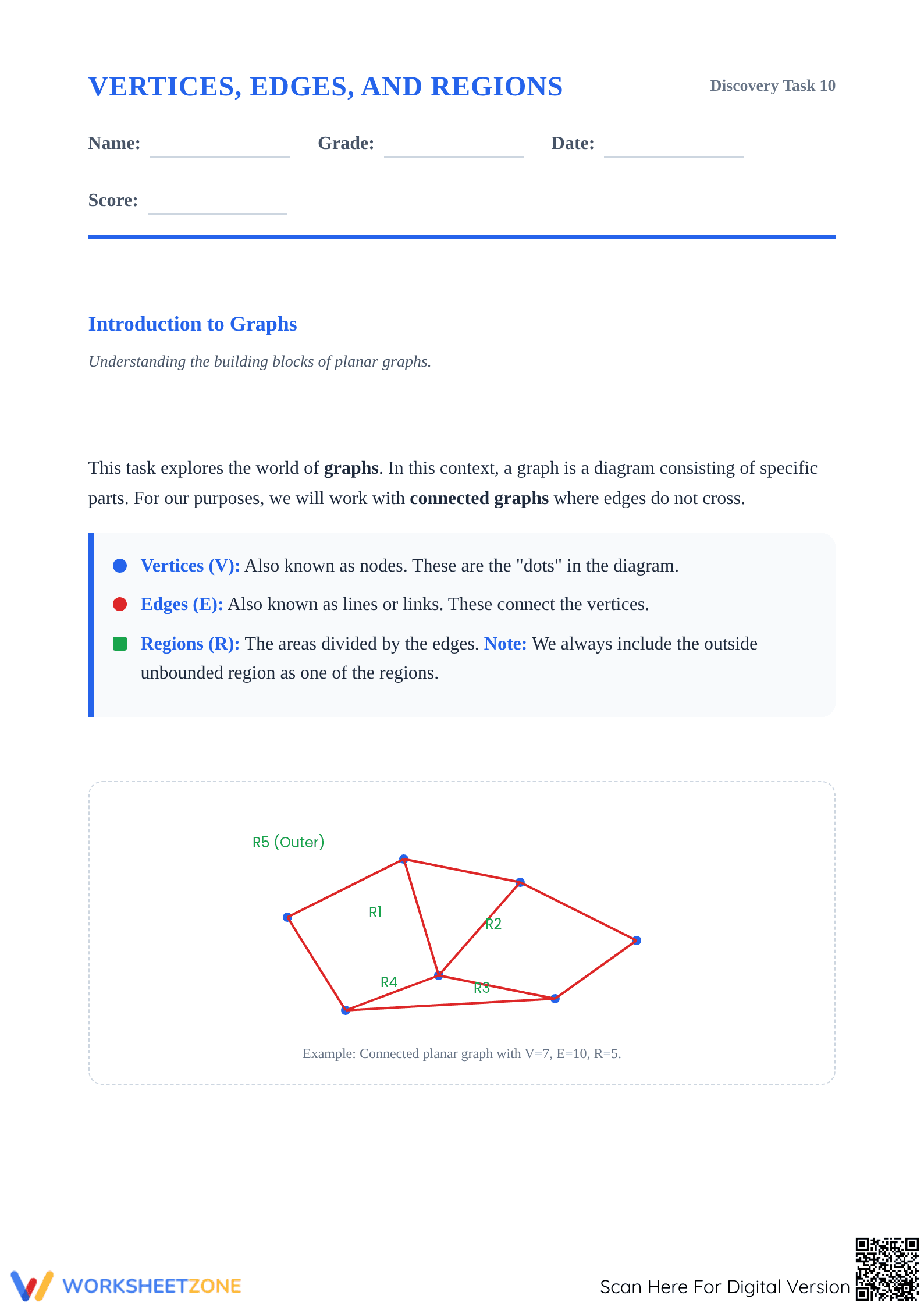
Inside this 4-page PDF, you will find a structured progression from definitions to independent application. Page one provides clear visual anchors for nodes (vertices), links (edges), and divided areas (regions), including the often-overlooked unbounded outer region. Subsequent pages feature a data collection table for six distinct graphs, a formula derivation workspace, and a high-level challenge task for complex modeling.
Mastery Evidence
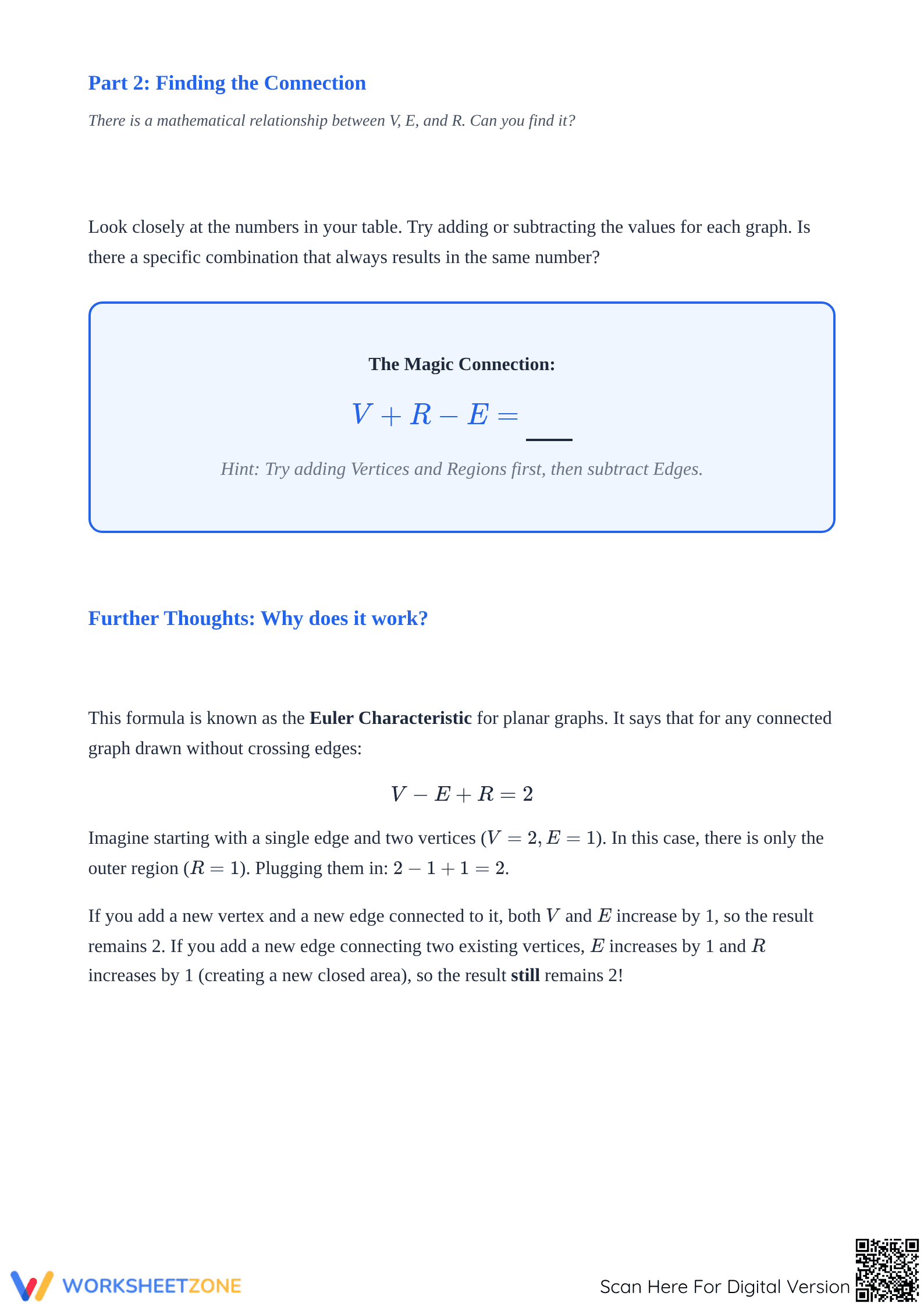
Students provide evidence of mastery through a scaffolded data table. They quantify properties for six graphs, ensuring they generalize the relationship across complexity levels. The progression moves from simple shapes to networks, verifying understanding of planar constraints. Completion of the "Magic Connection" serves as a formative benchmark before the final open-ended challenge drawing.
Standards Alignment
Aligned to HSG-MG.A.1, students use geometric properties to model relationships within planar graphs. It also supports 7.G.A.2 exploration. Both standard codes can be copied directly into lesson plans, IEP goals, or district curriculum mapping tools to document rigorous alignment with college-and-career readiness benchmarks.
How to Use It
Use this discovery lesson during polygon units or for enrichment. Introduce terms on page one, then have students complete the data table in pairs. As a formative tip, check if students count the unbounded outer region; if they miss it, use the worked example to redirect focus to the definition of a region.
Who It's For
Designed for Grade 6-9 general education, honors geometry, or pre-algebra tracks. It offers natural differentiation; struggling students use colored labels for visual support, while advanced learners can extend the formula to 3D polyhedra. Pair this with a physical string-and-pin modeling activity to maximize student engagement.
The application of discovery-based learning in geometry, as demonstrated in this Euler Characteristic task, aligns with educational research indicating that student-derived formulas lead to significantly higher long-term retention compared to rote memorization. According to a ScienceDirect TpT Analysis (2024), mathematical modeling tasks that bridge the gap between concrete counting and abstract algebraic relationships improve spatial visualization abilities in adolescent learners. This worksheet specifically addresses the HSG-MG.A.1 standard by requiring students to analyze the topological properties of vertices, edges, and regions. By guiding students to identify the constant relationship V - E + R = 2, the resource fosters a deeper understanding of planar graph theory and its practical applications. Such structured investigations provide the necessary scaffolding for students to move from basic geometric identification to higher-order mathematical synthesis, ensuring they are prepared for the rigors of advanced high school geometry and college-level discrete mathematics.


