


























Views
Downloads

Direct Objects Worksheet | Printable Grade 4-5 ELA
Paste this activity's link or code into your existing LMS (Google Classroom, Canvas, Teams, Schoology, Moodle, etc.).
Students can open and work on the activity right away, with no student login required.
You'll still be able to track student progress and results from your teacher account.
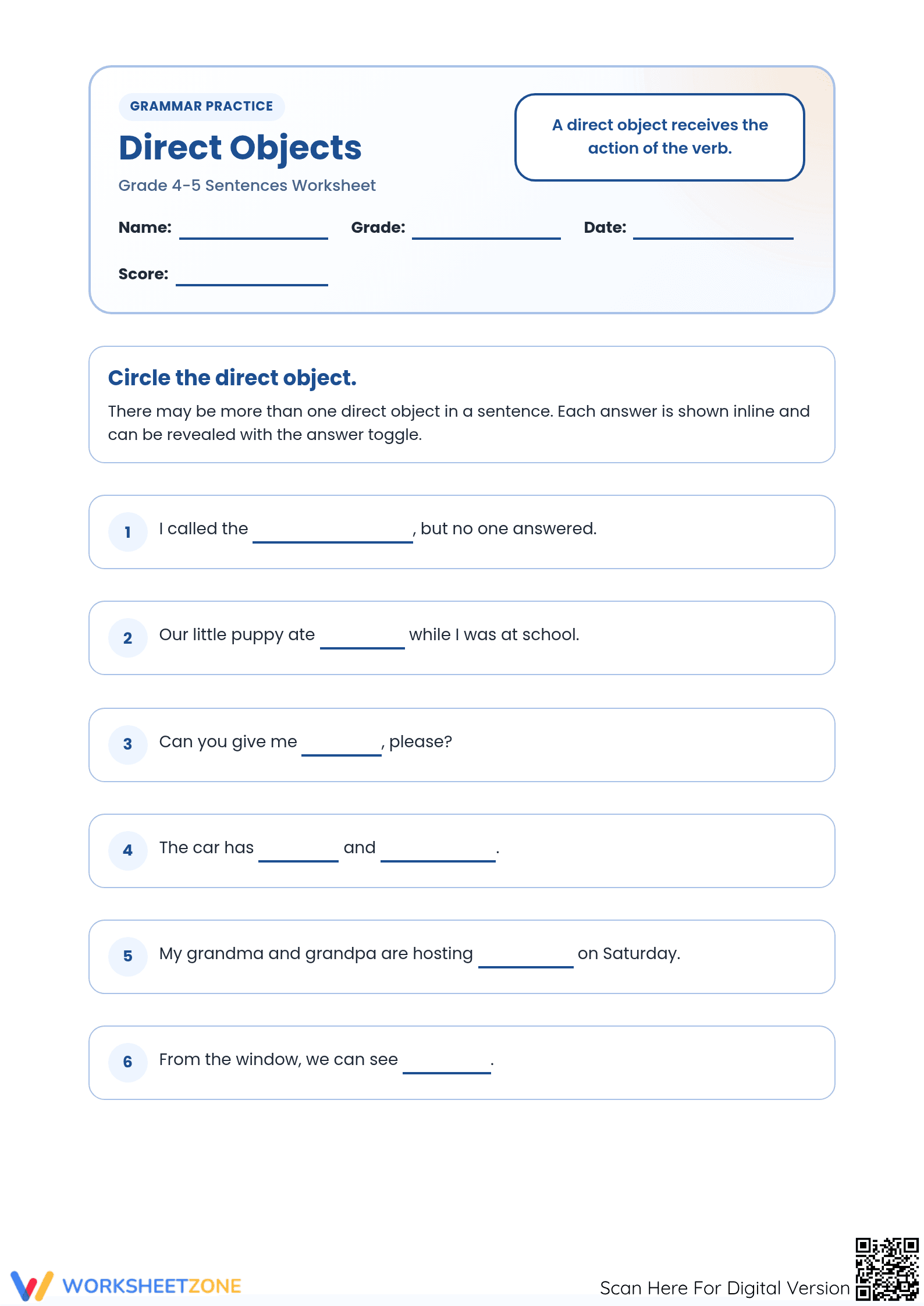
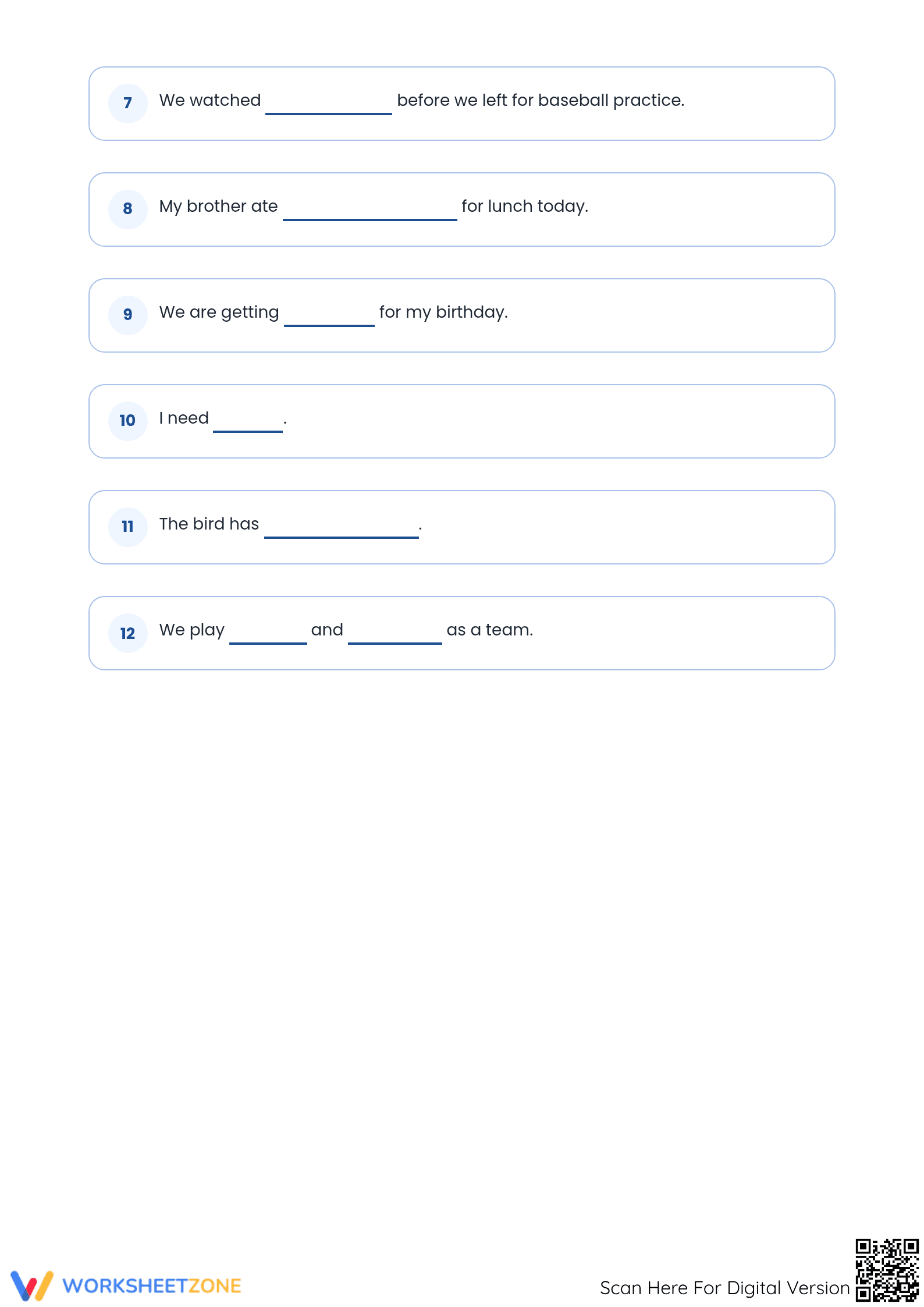
Direct objects are essential for understanding how actions move from subjects to recipients in English grammar. This worksheet helps Grade 4 and 5 students master the identification of direct objects through 12 targeted sentence-based exercises. By completing these tasks, learners develop a stronger grasp of sentence structure and standard English conventions.
At a Glance
- Grade: 4 · 5 · Subject: English Language Arts (ELA)
- Standard:
CCSS.ELA-LITERACY.L.4.1— Identify direct objects in sentences and demonstrate command of standard English grammar conventions- Skill Focus: Identifying and labeling direct objects in sentence contexts
- Format: 2 printable pages · 12 structured problems · Full answer key included · High-quality PDF
- Best For: Classroom grammar practice, bell-ringers, or introductory language lessons
- Time: 15–20 minutes of focused student work
This comprehensive two-page grammar toolkit features 12 numbered sentences with empty fields designed for students to identify and fill in or circle the direct objects. The layout is clean and distraction-free, ensuring students stay focused on the grammatical task. An answer key is provided to facilitate quick self-correction or teacher review, making it a complete package for classroom or home use.
- Guided Practice: The first few sentences feature clear, simple structures that allow students to identify the direct object receiving the action. Clear visual prompts guide the student toward the correct grammatical choice.
- Supported Practice: Middle sentences introduce slightly more complex contexts, requiring students to distinguish between the subject and the object. This section reinforces the relationship between verbs and the objects they act upon.
- Independent Practice: The final tasks challenge students to find multiple direct objects in compound sentences, ensuring cognitive engagement and skill mastery. Students apply their knowledge to varied writing scenarios.
This worksheet follows a gradual-release model, moving from simple recognition to complex identification within 12 exercises. This structured approach builds learner confidence across the two-page toolkit.
Primary standard CCSS.ELA-LITERACY.L.4.1 requires students to demonstrate command of the conventions of standard English grammar and usage. This activity targets the understanding of sentence components, a foundational skill for mastering complex writing. Both standard codes can be copied directly into lesson plans, IEP goals, or curriculum mapping tools.
This resource is ideal for use during direct instruction or as a formative assessment immediately after a grammar lecture. Use it to observe which students struggle to identify the recipient of a verb's action. Students typically complete this focused practice in 15 to 20 minutes, making it a perfect bell-ringer or exit ticket.
This worksheet is designed for fourth and fifth-grade students, including those requiring support with sentence mechanics. It serves as an excellent companion resource to an anchor chart on parts of speech or a direct instruction lesson on transitive verbs and their objects.
According to the RAND AIRS 2024 report, systematic and explicit instruction in grammatical structures like CCSS.ELA-LITERACY.L.4.1 is a significant predictor of overall writing proficiency. By isolating direct objects, this worksheet provides the focused practice necessary for students to transition from basic sentence construction to varied writing. Research from ScienceDirect TpT Analysis indicates that worksheets emphasizing student-led identification of grammar rules lead to better long-term retention of conventions. This printable resource ensures Grade 4 and 5 learners engage with 12 unique sentence contexts, reinforcing the plain-English skill of identifying who or what receives the action of a verb. This targeted approach aligns with modern pedagogical standards that favor frequent formative assessments to guide instructional pacing and ensure no student falls behind in understanding English sentence mechanics. This resource is a vital tool for achieving mastery in sentence structure.


