


























Views
Downloads
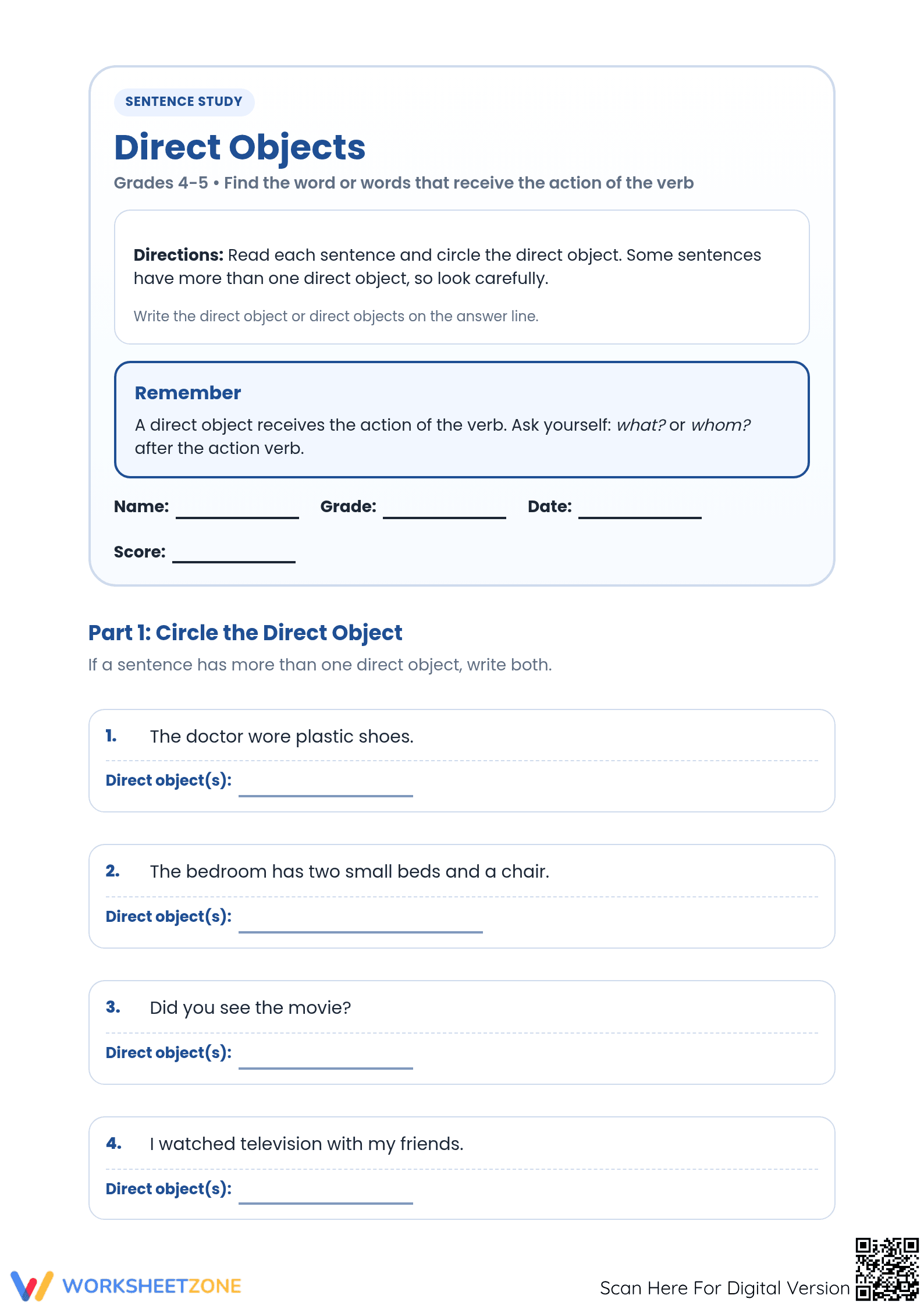


Printable Direct Objects Worksheet | Grade 4-5 ELA
Paste this activity's link or code into your existing LMS (Google Classroom, Canvas, Teams, Schoology, Moodle, etc.).
Students can open and work on the activity right away, with no student login required.
You'll still be able to track student progress and results from your teacher account.
This Grade 4-5 direct objects worksheet empowers students to master sentence structure by identifying action verb recipients. Providing clear definitions and structured practice, it helps students distinguish between the doer and the object, improving writing clarity and grammatical precision in every sentence they construct.
At a Glance
- Grade: 4–5 · Subject: ELA
- Standard:
CCSS.ELA-LITERACY.L.4.1— Identify nouns that receive the action of verbs in sentences- Skill Focus: Identifying Direct Objects
- Format: 3 pages · 16 problems · Answer key included · PDF
- Best For: Independent practice and quick formative assessment
- Time: 15–20 minutes
This three-page PDF features 16 sentences designed to support young learners. The first page includes a "Remember" box defining direct objects and providing an identification strategy. Tasks include a clear sentence and a dedicated answer line, ensuring students practice both circling and transcribing the object for reinforcement.
This resource is designed for a seamless classroom experience. Print the three-page set (30 seconds), distribute to students (1 minute), and review using the included key (5 minutes). Because the "Remember" box provides a self-contained mini-lesson, this requires zero teacher preparation and is ideal for emergency sub plans or grammar centers.
The primary alignment is CCSS.ELA-LITERACY.L.4.1, requiring students to demonstrate command of standard English grammar conventions. Identifying direct objects builds the foundational understanding of sentence patterns necessary for syntactical mastery. Both standard codes can be copied directly into lesson plans, IEP goals, or district curriculum mapping tools.
Use this as a focused follow-up after a direct instruction lesson. It works effectively as a "do-now" activity or a quiet assignment. Observe if students correctly identify multiple objects in sentences like item #2 for a high-value formative assessment point. Expect completion in under 20 minutes for most students.
This packet is tailored for Grade 4-5 students refining sentence mechanics. It offers scaffolding for struggling learners through the anchor box and "Extra Practice" for those ready for more. It pairs naturally with a grammar anchor chart or a lesson on transitive verbs.
According to the RAND AIRS 2024 report on literacy instruction, consistent engagement with structured grammar practice is vital for developing writing proficiency in middle-elementary students. This resource targets the specific skill of identifying direct objects, a core component of CCSS.ELA-LITERACY.L.4.1. By asking students to isolate the recipient of an action, the worksheet reinforces the relationship between verbs and nouns, a prerequisite for mastering complex sentence structures and transitive verb usage. Research from Fisher & Frey (2014) emphasizes that gradual release of responsibility is most effective when students have access to clear, on-page scaffolds like the "Remember" strategy included here. Teachers can use the 16 tasks to gather evidence of student progress toward grade-level conventions. This evidence-based approach ensures that grammar instruction remains focused and actionable, allowing for immediate feedback and correction during the learning process, which is essential for long-term retention of syntactic rules.


