


























Views
Downloads

Direct and Indirect Objects Worksheet | Grade 4-5 Essential
Paste this activity's link or code into your existing LMS (Google Classroom, Canvas, Teams, Schoology, Moodle, etc.).
Students can open and work on the activity right away, with no student login required.
You'll still be able to track student progress and results from your teacher account.
This Grade 4-5 English Language Arts worksheet provides a comprehensive toolkit for students to master the identification and use of direct and indirect objects. By engaging with 25 structured exercises, learners develop a robust understanding of how action verbs transfer meaning to different sentence parts. This resource ensures students can accurately distinguish between recipients of action and those for whom an action is performed.
At a Glance
- Grade: 4–5 · Subject: ELA Grammar
- Standard:
CCSS.ELA-LITERACY.L.4.1— Use various sentence structures to convey specific meanings and demonstrate grammatical command- Skill Focus: Direct and Indirect Object Identification
- Format: 3 pages · 25 problems · Answer key included · PDF
- Best For: Independent grammar practice and formative assessment
- Time: 30–45 minutes
What's Inside
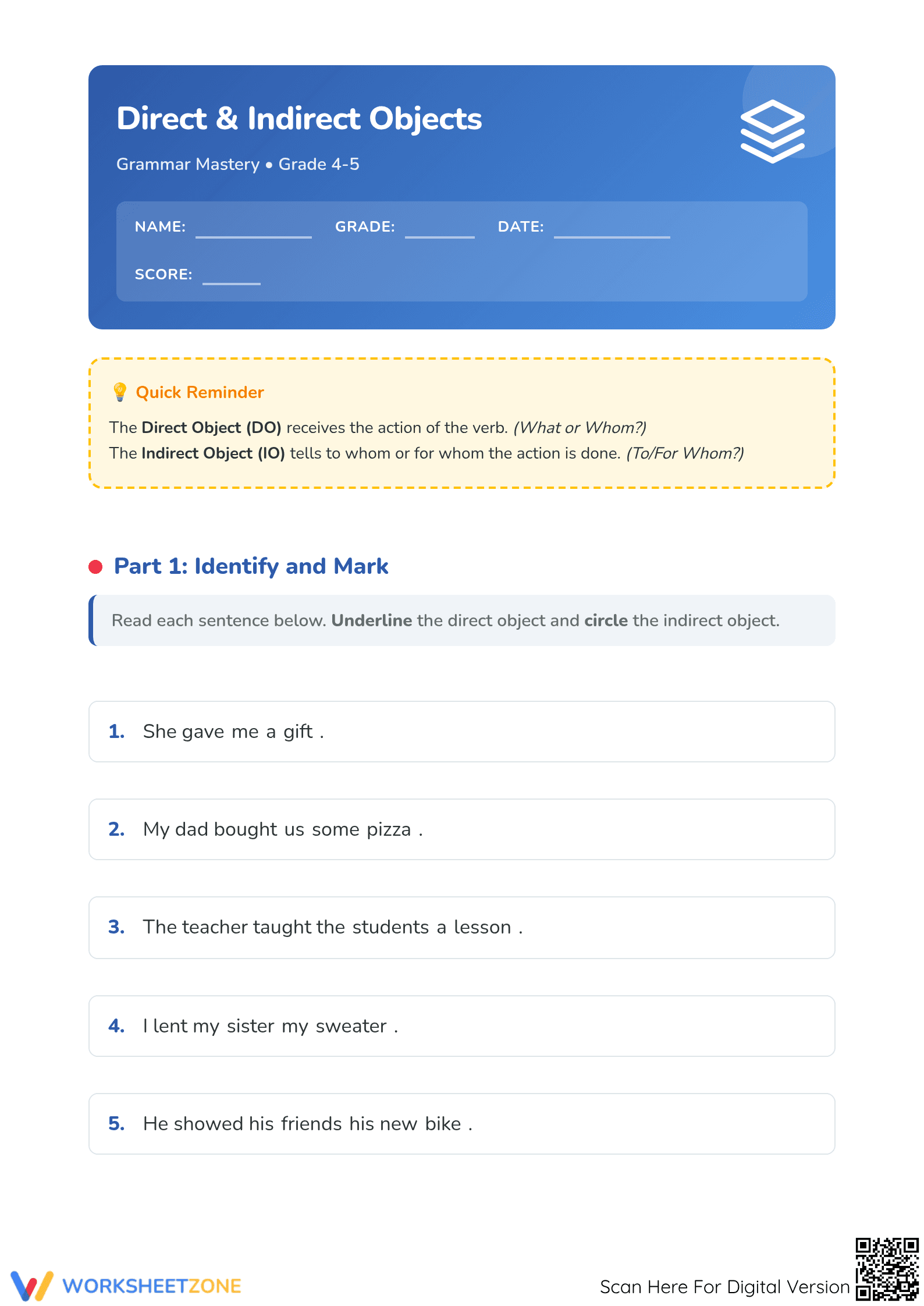
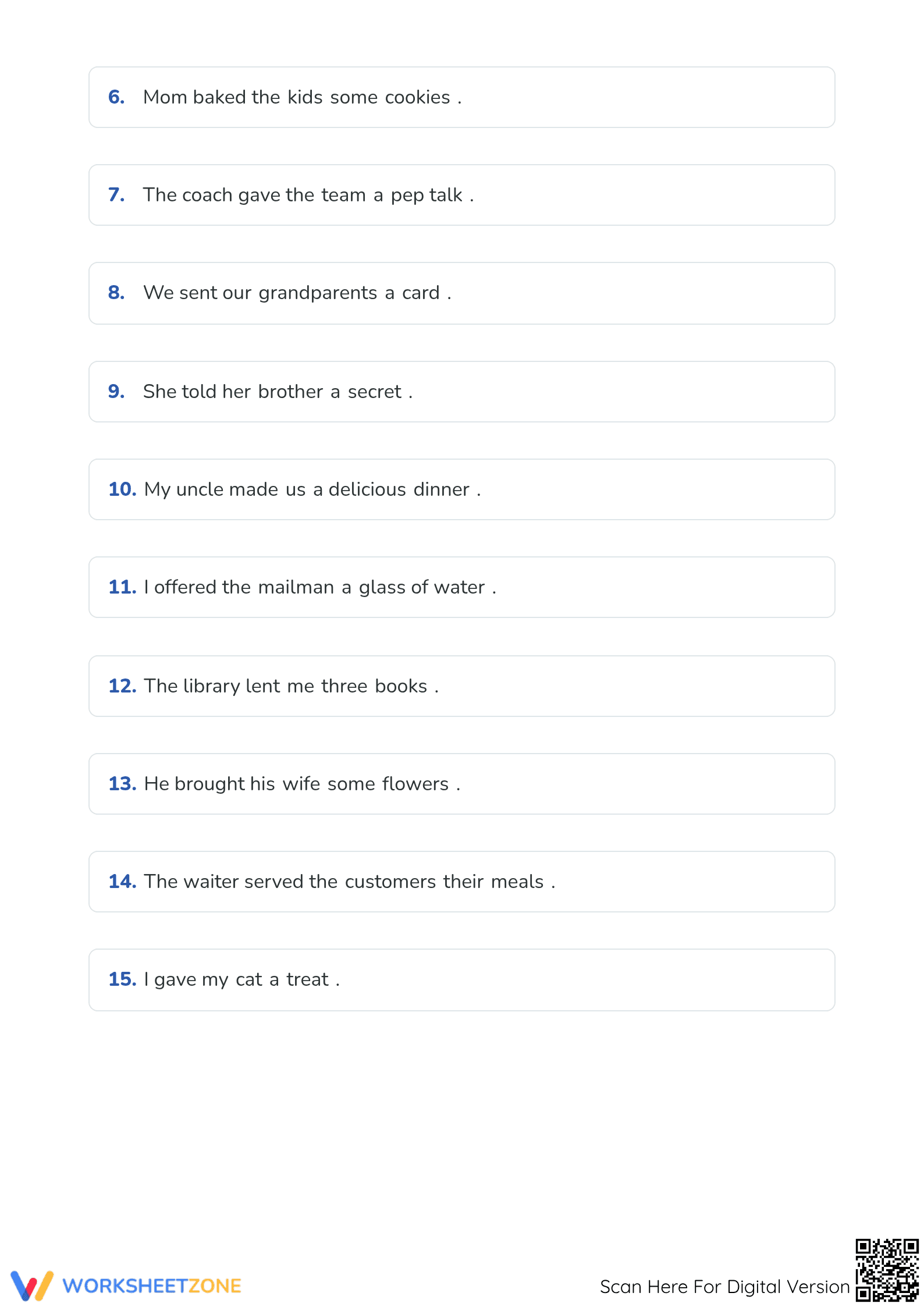
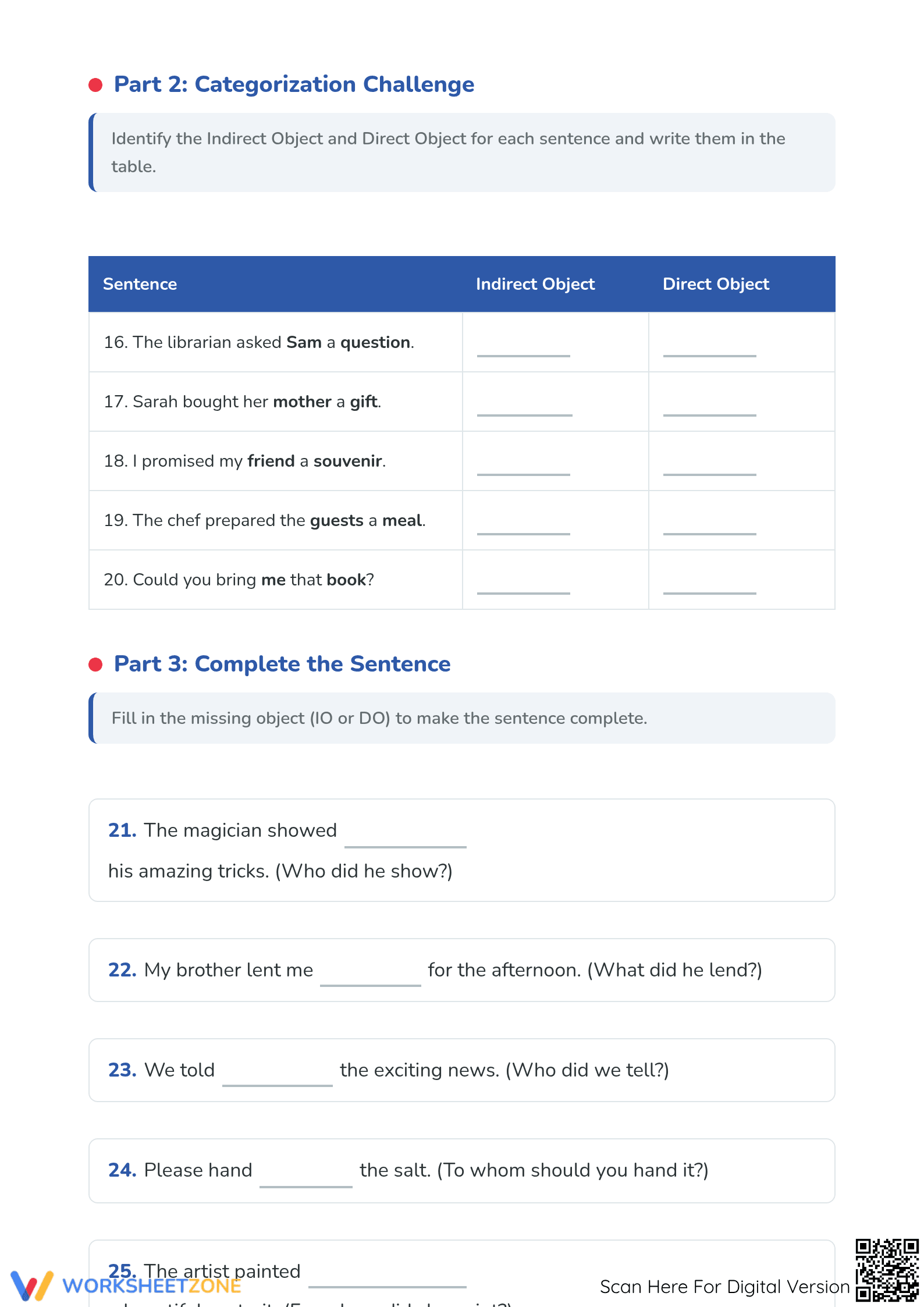
This three-page PDF is organized into three distinct pedagogical sections designed to build confidence incrementally. It features a "Quick Reminder" box that defines both direct and indirect objects with simple guiding questions. The document includes 15 sentence-marking tasks, a 5-item categorization table, and 5 fill-in-the-blank completion exercises. A full answer key is provided for immediate feedback and grading efficiency.
Skill Progression
- Guided Practice: Part 1 provides 15 sentences where students identify verb-object relationships through underlining and circling, supported by the "Quick Reminder" definitions.
- Supported Practice: Part 2 tasks students with extracting and categorizing identified objects into a structured table, requiring higher-level sorting of 5 specific sentence sets.
- Independent Practice: Part 3 requires students to synthesize their knowledge by choosing and writing the correct object type to complete 5 unique sentence prompts.
This structured progression follows the gradual-release "I Do, We Do, You Do" framework to ensure long-term retention of grammatical concepts.
Standards Alignment
The primary alignment is `CCSS.ELA-LITERACY.L.4.1`, which requires students to demonstrate command of the conventions of standard English grammar and usage when writing or speaking. Specifically, understanding object placement is critical for the Grade 4 and 5 requirement to produce complete sentences and recognize fragments or run-ons. This standard code can be copied directly into lesson plans, IEP goals, or district curriculum mapping tools.
How to Use It
This resource is ideal for the "You Do" phase of a grammar lesson. Teachers can assign Part 1 as an in-class activity to observe students' ability to locate recipients of action in real-time. Parts 2 and 3 serve as an excellent formative-assessment tool to check for mastery before introducing complex sentence diagramming. Most students will complete the set in approximately 40 minutes.
Who It's For
This worksheet is designed for upper elementary students in general education classrooms, as well as English Language Learners (ELL) who benefit from clear definitions and sentence frames. It is particularly useful for students needing targeted intervention on sentence mechanics. This resource pairs naturally with a mentor text passage or an anchor chart focusing on action verbs and their complements.
Grammar instruction that integrates explicit definitions with scaffolded practice is essential for developing syntactic maturity in young writers. The gradual release of responsibility model—moving from teacher-led identification to independent sentence completion—is a proven strategy for deepening linguistic competence. This worksheet aligns with `CCSS.ELA-LITERACY.L.4.1` by focusing on the functional roles of direct and indirect objects. Isolating these components across 25 tasks provides the high-frequency repetition necessary for mastery. Research indicates that identifying the "what" and "for whom" of a sentence improves overall reading comprehension and writing clarity. This toolkit serves as a reliable bridge between basic sentence recognition and sophisticated drafting, making it an essential asset for Grade 4 and 5 educators.


