


























Views
Downloads
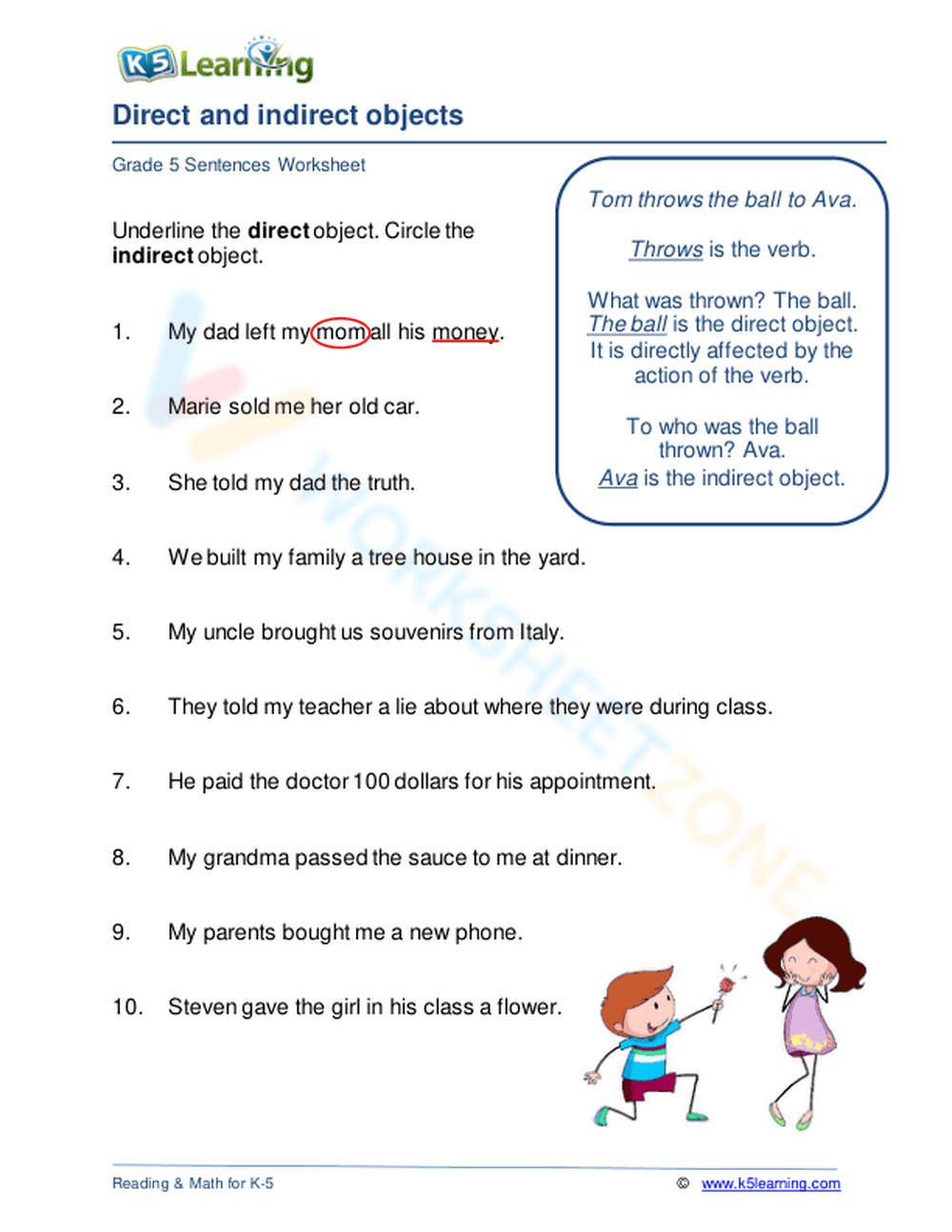

Direct & Indirect Objects Printable | Grade 5 ELA
Paste this activity's link or code into your existing LMS (Google Classroom, Canvas, Teams, Schoology, Moodle, etc.).
Students can open and work on the activity right away, with no student login required.
You'll still be able to track student progress and results from your teacher account.
This Grade 5 grammar worksheet equips students to confidently identify direct and indirect objects within sentences. By analyzing sentence structures and verb relationships, learners develop a stronger grasp of standard English conventions, ultimately improving their reading comprehension and writing clarity.
At a Glance
- Grade: 5 · Subject: ELA
- Standard:
CCSS.ELA-LITERACY.L.5.1— Demonstrate command of standard English grammar conventions- Skill Focus: Direct and indirect objects
- Format: 1 page · 10 problems · Answer key included · PDF
- Best For: Independent practice
- Time: 10–15 minutes
This single-page resource features 10 carefully crafted sentences designed for targeted grammar practice. It includes a highly visible, built-in instructional box that walks students through a worked example, showing exactly how to ask "what" or "to whom" to find the correct objects. Students are tasked with underlining the direct object and circling the indirect object in each sentence. A complete answer key is provided for quick grading.
Zero-Prep Workflow
- Print (1 minute): Simply download the PDF and print a class set. The built-in instructional box means no extra anchor charts are required.
- Distribute (1 minute): Hand out the worksheet as a bell-ringer, homework assignment, or independent center activity.
- Review (3 minutes): Use the included answer key to quickly check student work or project it on the board for self-correction.
With under two minutes of total teacher prep time, this resource is highly suitable for emergency sub plans or last-minute grammar reviews.
Standards Alignment
This worksheet is aligned to primary standard CCSS.ELA-LITERACY.L.5.1: Demonstrate command of the conventions of standard English grammar and usage when writing or speaking. It also supports broader sentence comprehension goals by helping students parse complex sentence structures. Both standard codes can be copied directly into lesson plans, IEP goals, or district curriculum mapping tools.
How to Use It
Deploy this worksheet immediately after direct instruction on action verbs and objects to reinforce the new concept. Alternatively, use it as a targeted intervention tool for students struggling with sentence diagramming. As a formative assessment tip, observe whether students are correctly identifying the action verb first; if they circle a prepositional phrase instead of the indirect object, you will know exactly where to redirect their focus. Expected completion time is 10 to 15 minutes.
Who It's For
This resource is primarily designed for fifth-grade general education students, though it serves as an excellent review for sixth graders or a challenge for advanced fourth graders. The clear, step-by-step example box provides built-in differentiation for visual learners and students who need a quick refresher before starting. Pair this worksheet with a mini-lesson on transitive verbs for maximum instructional impact.
Mastering sentence structure is a critical component of literacy development. According to Fisher & Frey (2014), explicit grammar instruction combined with immediate, targeted practice significantly improves students' ability to construct complex, meaningful sentences. This worksheet directly supports that pedagogical framework by isolating the specific skill of identifying direct and indirect objects. By aligning with CCSS.ELA-LITERACY.L.5.1 to demonstrate command of standard English grammar conventions, the resource ensures students are practicing high-leverage language skills. The inclusion of a worked example reduces cognitive load, allowing learners to focus entirely on the grammatical relationships between verbs and nouns. Regular practice with these sentence components not only enhances writing fluency but also aids in reading comprehension when students encounter complex texts. This targeted approach provides educators with a reliable, evidence-based tool for grammar instruction.


