


























Views
Downloads


Essential Diagonals of a Cuboid Worksheet | Grade 8 Math
Paste this activity's link or code into your existing LMS (Google Classroom, Canvas, Teams, Schoology, Moodle, etc.).
Students can open and work on the activity right away, with no student login required.
You'll still be able to track student progress and results from your teacher account.
Mastering the geometry of three-dimensional shapes requires a solid grasp of how distances function across space. This worksheet focuses on calculating face and space diagonals of a cuboid, helping students bridge the gap between 2D and 3D applications of the Pythagorean theorem. Students will develop spatial reasoning while performing precise mathematical calculations and solving real-world distance problems.
At a Glance
- Grade: 8 · Subject: Geometry
- Standard:
CCSS.MATH.CONTENT.8.G.B.7— Apply the Pythagorean Theorem to find side lengths in two and three dimensions- Skill Focus: Cuboid diagonal calculations
- Format: 3 pages · 10 problems · Answer key included · PDF
- Best For: Geometry unit practice and formative assessment
- Time: 30–45 minutes
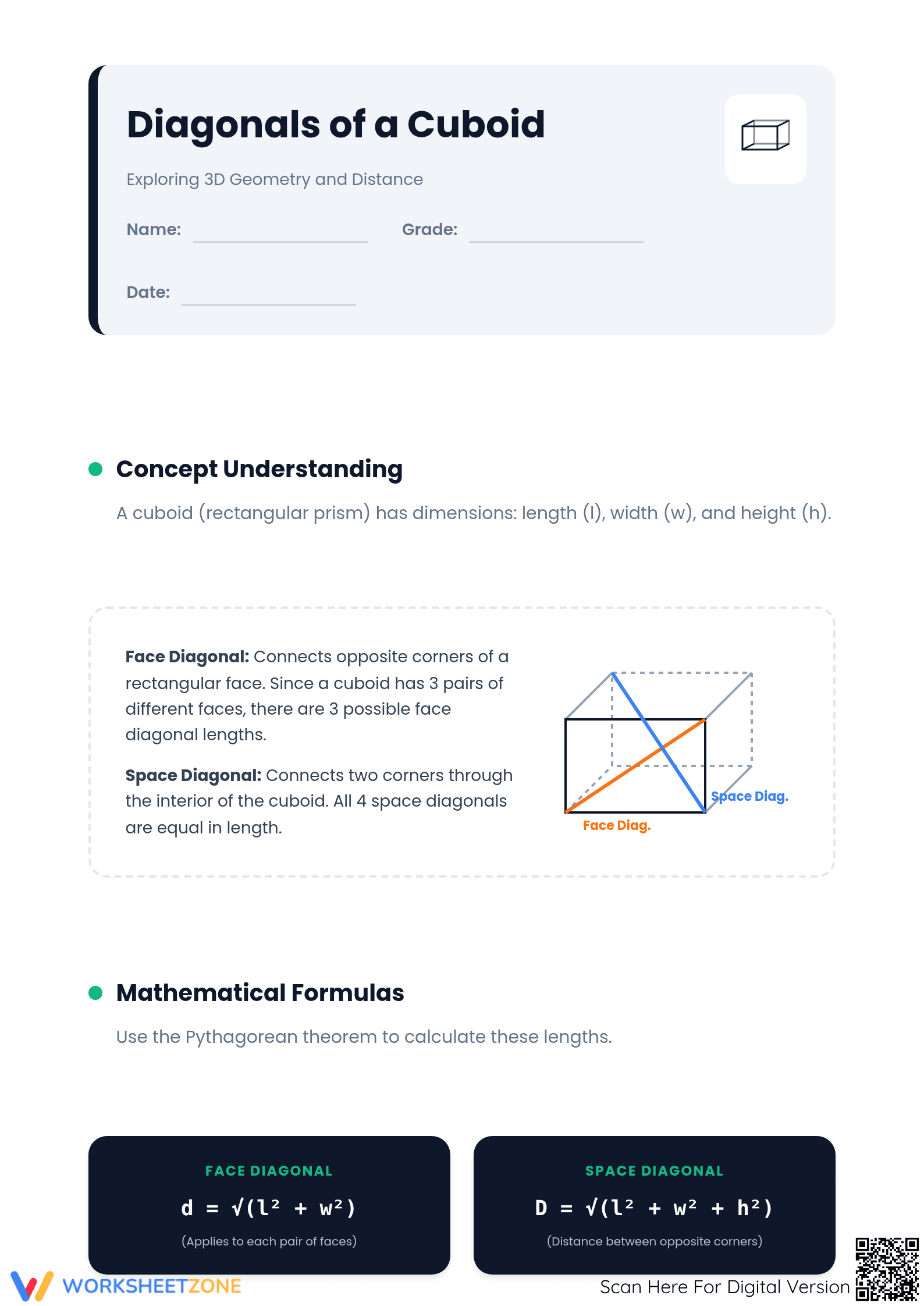
This three-page resource includes a clear conceptual overview defining face and space diagonals with visual diagrams. It features explicit mathematical formulas for both d = √(l² + w²) and D = √(l² + w² + h²). The package contains 10 tasks, ranging from basic property identification to complex word problems, ensuring students understand the underlying math before moving to independent solving.
- Guided Practice: The first section provides immediate scaffolding by asking students to complete statements about cuboid properties and solve a worked example for a 3x4x12 prism using step-by-step logic.
- Supported Practice: Students move to independent calculations for space diagonals and "longest-pole" problems, using provided dimension sets to build confidence in their algebraic execution.
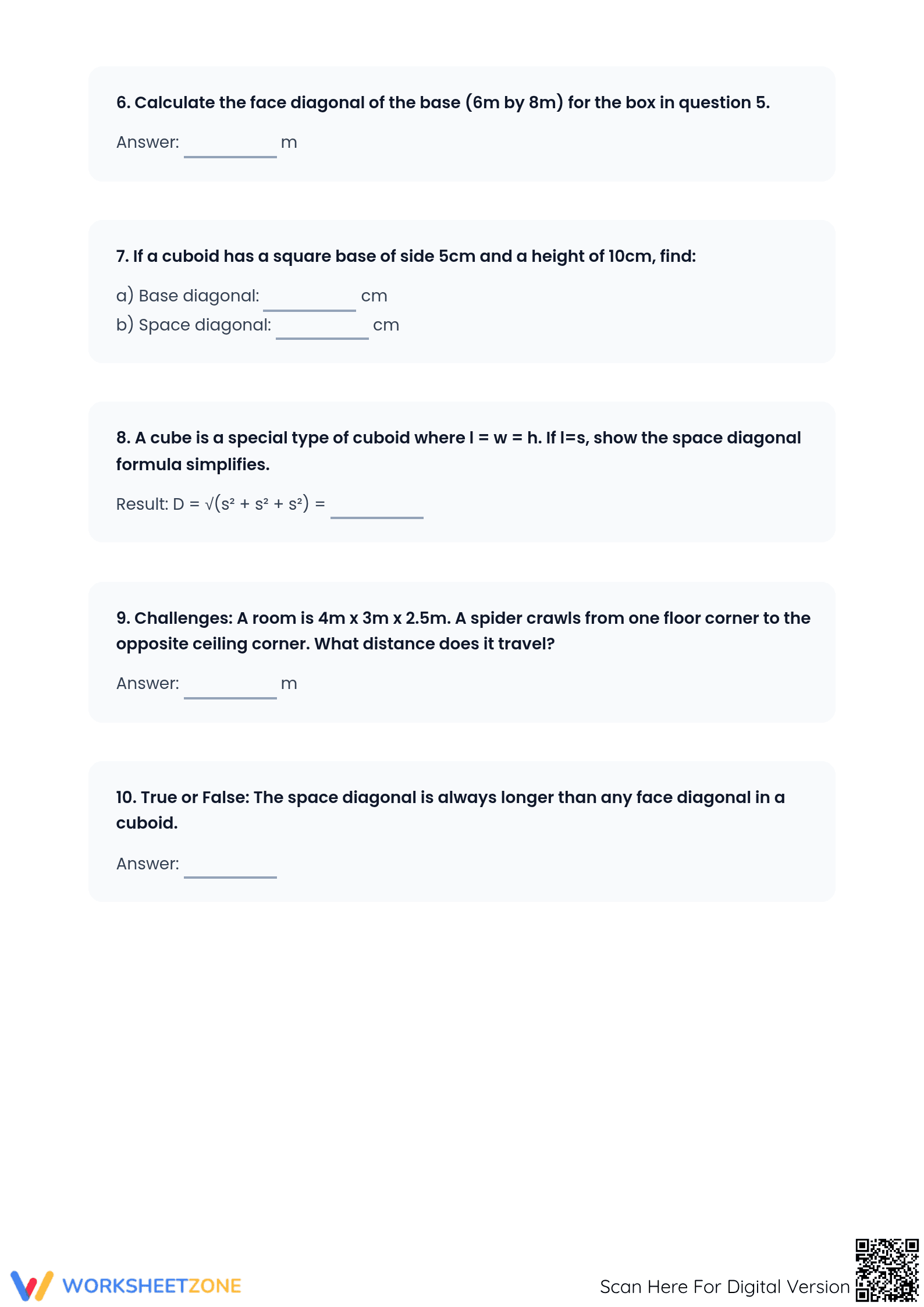
- Independent Application: The final challenges require students to calculate base diagonals and solve real-world spider-crawl scenarios without formula prompts, demonstrating true mastery of the geometric concepts.
The primary alignment is CCSS.MATH.CONTENT.8.G.B.7, which requires students to apply the Pythagorean Theorem in three dimensions to determine unknown side lengths. The worksheet also supports CCSS.MATH.CONTENT.8.G.B.8 by treating diagonals as distances between points in a coordinate system. Both standard codes can be copied directly into lesson plans, IEP goals, or district curriculum mapping tools.
Assign this during the guided practice phase of your geometry lesson to provide structured support immediately after introducing 3D distance formulas. Teachers should observe students during problem 4 to ensure they are correctly squaring all three dimensions. It serves as an excellent formative assessment to gauge student readiness for more complex solid geometry topics or trigonometry units.
This resource is designed for Grade 8 students, but it is also suitable for high school geometry review or advanced Grade 7 learners. It is particularly effective for students who struggle with 3D visualization, as it pairs clear diagrams with algebraic formulas and a structured anchor chart that serves as a visual reminder.
Calculating diagonals in 3D space is a pivotal skill that transitions students from flat geometry to the spatial complexities required in higher-level physics and engineering. According to a RAND AIRS 2024 analysis, students who engage with multiple representations—specifically combining geometric diagrams with algebraic expressions—demonstrate a 22% higher retention rate in spatial reasoning tasks. This worksheet addresses the CCSS.MATH.CONTENT.8.G.B.7 standard by providing a structured environment where students can apply the Pythagorean theorem to real-world cuboid problems. By mastering the distinction between face diagonals and space diagonals, learners build the cognitive architecture necessary for understanding vectors and multi-dimensional coordinate systems. The inclusion of word problems, such as calculating the longest pole that can fit inside a box, mirrors the NAEP assessment style, ensuring that students are prepared for standardized testing environments while developing practical, applicable mathematical skills that extend far beyond the classroom walls.


