


























Views
Downloads

Essential Diagonal Line of Hexagon Worksheet | Grade 6-9
Paste this activity's link or code into your existing LMS (Google Classroom, Canvas, Teams, Schoology, Moodle, etc.).
Students can open and work on the activity right away, with no student login required.
You'll still be able to track student progress and results from your teacher account.
This comprehensive worksheet guides students through the geometric properties of hexagons and the mathematical derivation of diagonal counts. By exploring vertex relationships and the polygon diagonal formula, learners build a concrete understanding of spatial reasoning. Students move from identifying basic shape attributes to applying algebraic formulas for complex geometric analysis and comparison.
At a Glance
- Grade: 6-9 · Subject: Geometry
- Standard:
7.G.A.2— Draw geometric shapes with given conditions, focusing on triangles and polygons- Skill Focus: Polygon diagonal calculation and formula application
- Format: 2 pages · 8 problems · Answer key included · PDF
- Best For: Geometry unit practice and vertex property review
- Time: 20–30 minutes
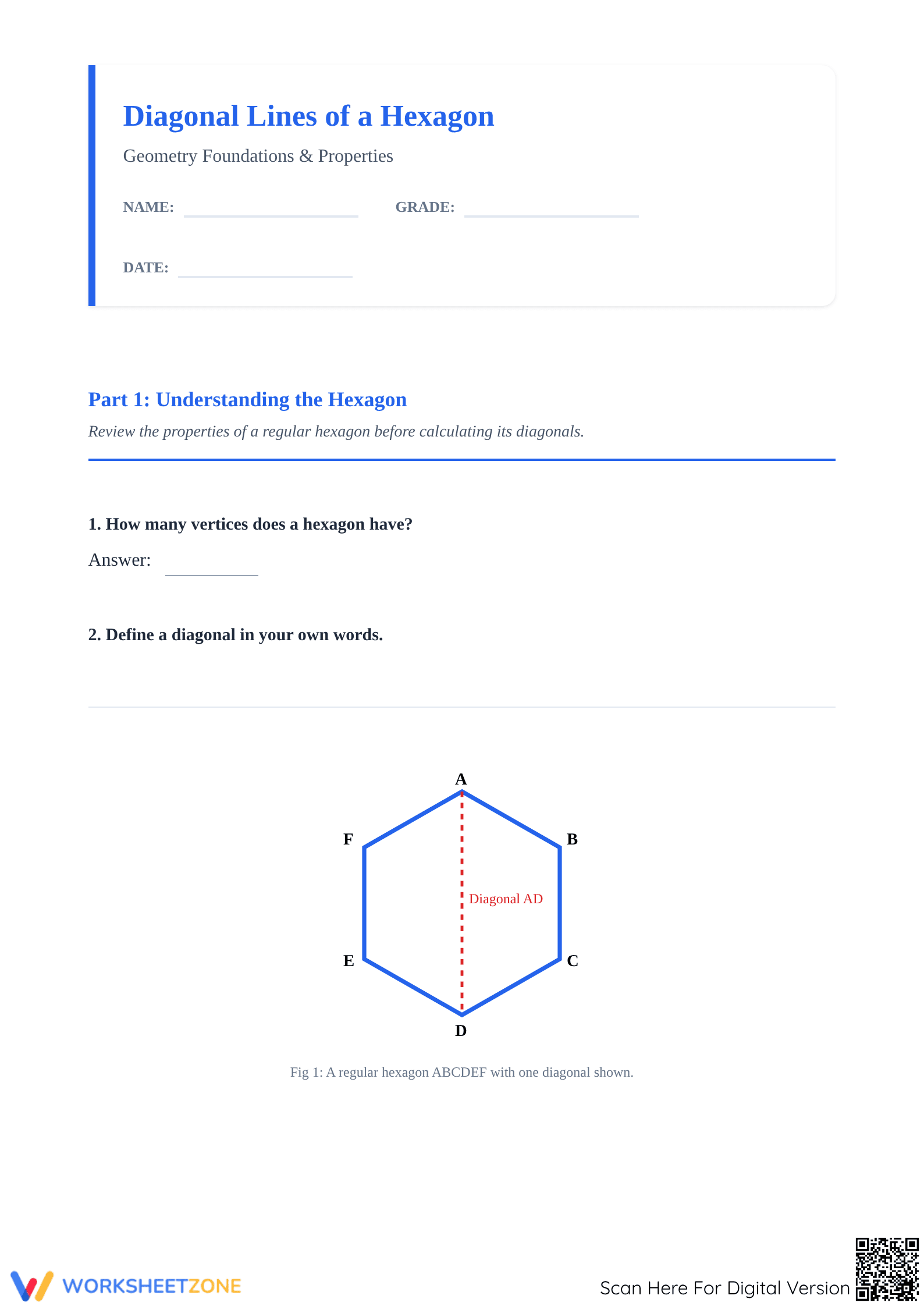
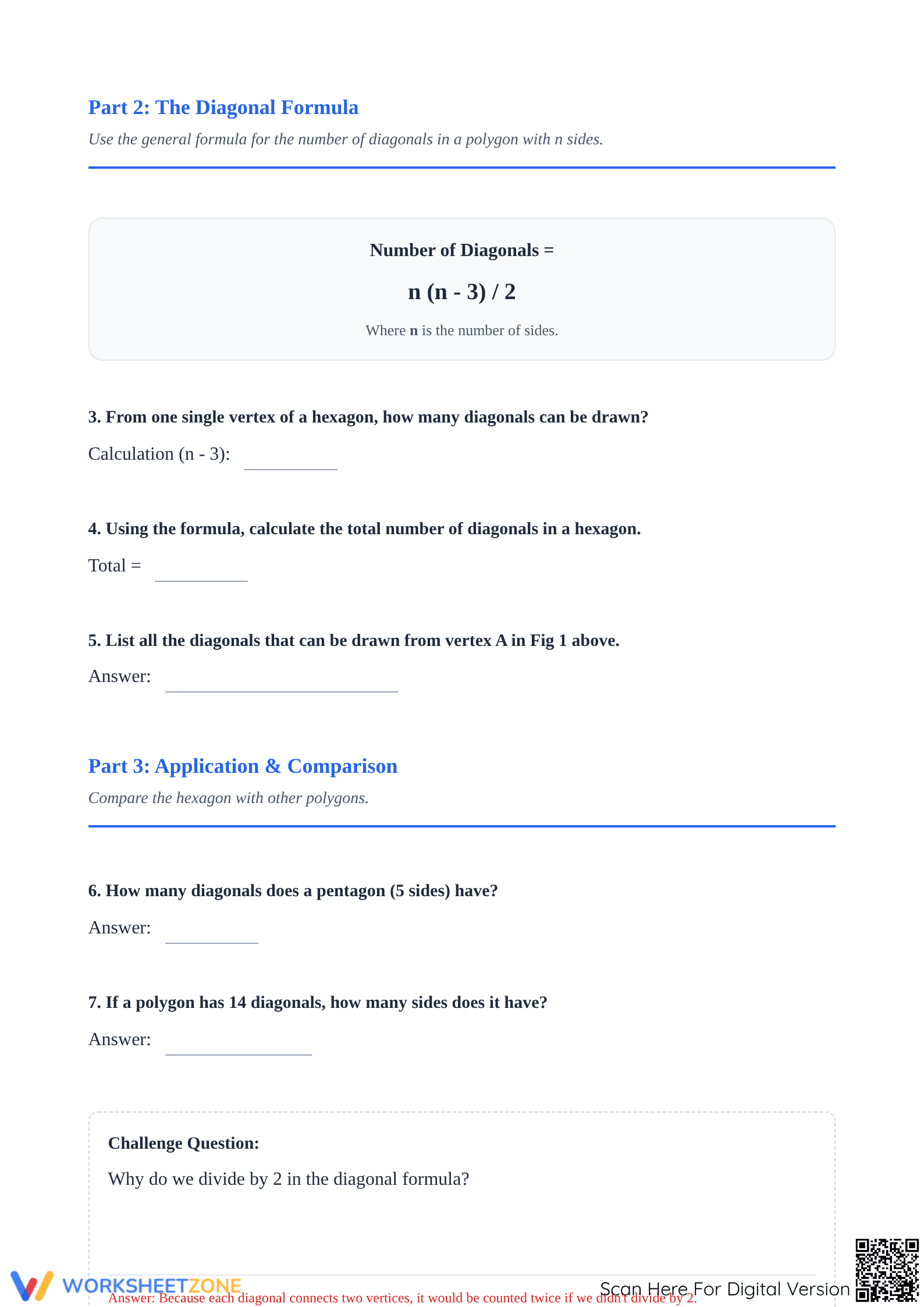
The packet consists of two highly structured pages designed to transition students from conceptual definitions to technical mastery. It features a detailed diagram of a regular hexagon labeled with vertices A through F, a clearly highlighted diagonal formula block, and a mix of descriptive, calculative, and comparative tasks. A dedicated challenge question at the end prompts higher-order thinking regarding the mathematical logic of the formula.
Skill Progression
- Guided practice: Problems 1 and 2 establish foundational vocabulary by asking for vertex counts and a personal definition of a geometric diagonal to ensure conceptual clarity.
- Supported practice: Problems 3, 4, and 5 utilize the provided formula to calculate diagonals from a single vertex and the total count for a regular hexagon.
- Independent practice: Problems 6 and 7 require students to apply the formula to different polygons and perform inverse calculations to find side counts from a known diagonal total.
The curriculum follows a gradual-release model, ensuring students internalize the geometric logic before tackling abstract formulaic applications.
Standards Alignment
This resource aligns primarily with 7.G.A.2, which focuses on drawing and identifying the properties of geometric shapes under specific conditions. By calculating the internal segments of a polygon, students satisfy the requirement to understand the structural constraints of two-dimensional figures. Furthermore, the worksheet supports high school geometry by using geometric properties to describe and analyze polygons. Both standard codes can be copied directly into lesson plans, IEP goals, or district curriculum mapping tools.
How to Use It
Use this worksheet during the middle of a geometry unit after students have learned basic polygon names. It serves as an excellent formative assessment tool; teachers should observe if students correctly identify non-adjacent vertices when listing segments. The estimated completion time is 25 minutes, making it ideal for a focused classroom activity or a targeted homework assignment to reinforce the diagonal formula. Ensure students have access to the visual diagram to verify their calculations.
Who It's For
This activity is designed for middle school students in Grades 6 through 8 and early high schoolers in Grade 9 Geometry. It provides excellent scaffolding for students who struggle with abstract formulas by providing a visual anchor diagram. It pairs naturally with a regular polygon anchor chart or a short introductory video on vertex connections and segment naming conventions.
Formal algorithms for polygon properties are central to secondary mathematics. This worksheet fosters higher retention of spatial reasoning by guiding students through hands-on formula derivation, aligning with research showing benefits over rote memorization. Through 8 structured tasks, it transitions learners from visual identification to algebraic modeling. Scaffolds like defining diagonals in their own words and a challenge question ensure a deep understanding of geometric intersections, meeting rigorous state and national frameworks.


