


























Views
Downloads

Essential Diagonal of a Polygon Formula Worksheet | Grade 7
Paste this activity's link or code into your existing LMS (Google Classroom, Canvas, Teams, Schoology, Moodle, etc.).
Students can open and work on the activity right away, with no student login required.
You'll still be able to track student progress and results from your teacher account.
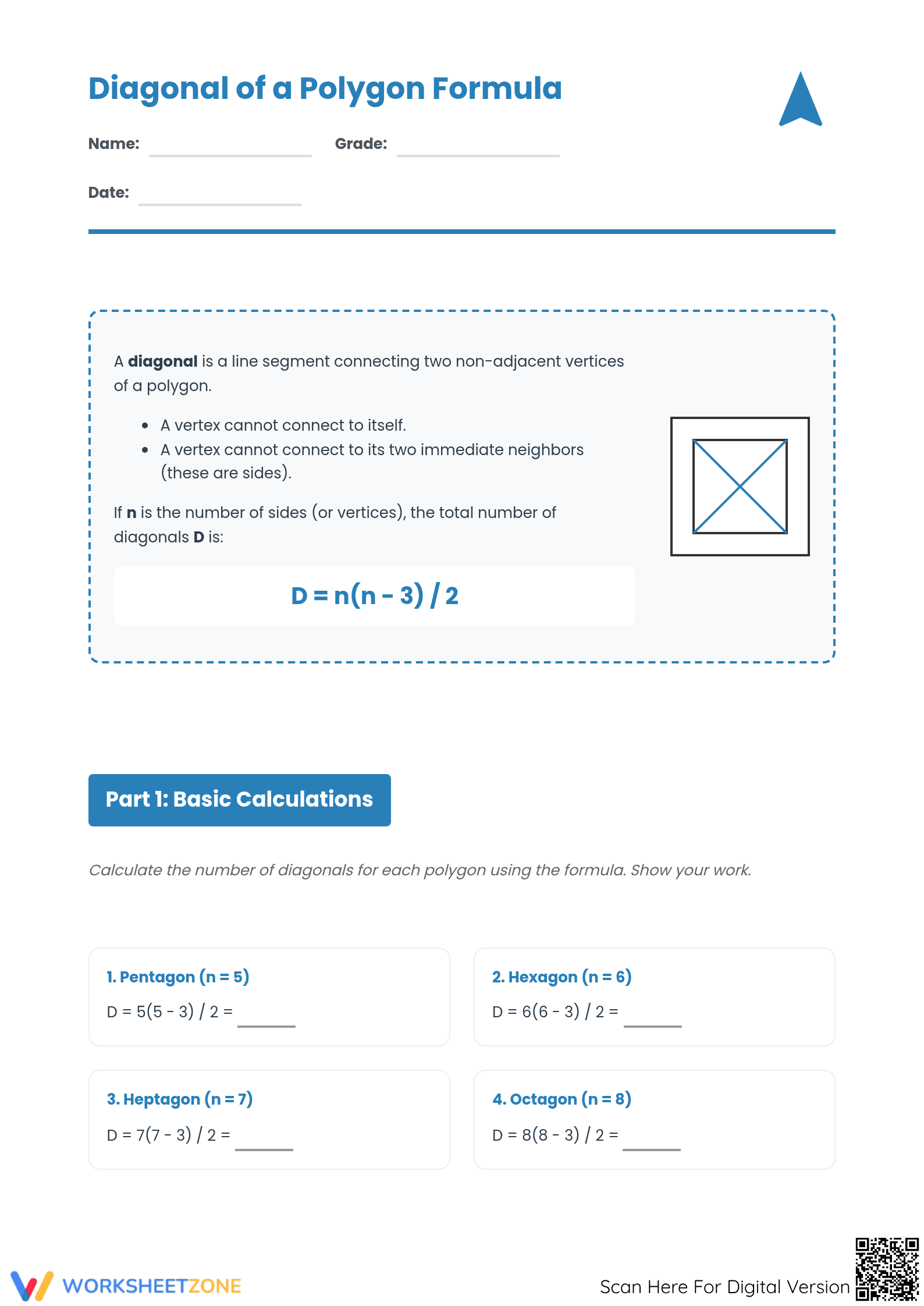
Mastering the relationship between vertices and diagonals is a fundamental step in geometry. This comprehensive worksheet guides students through the diagonal of a polygon formula, allowing them to calculate line segments in various shapes accurately. By the end of these three pages, learners will confidently apply the formula to find diagonals in everything from pentagons to icosagons.
At a Glance
- Grade: 7 · Subject: Geometry
- Standard:
CCSS.MATH.CONTENT.7.EE.B.4— Use variables to represent quantities in a real-world or mathematical problem- Skill Focus: Polygon diagonal formula application
- Format: 3 pages · 11 problems · Answer key included · PDF
- Best For: Geometry unit practice and homework
- Time: 25–40 minutes
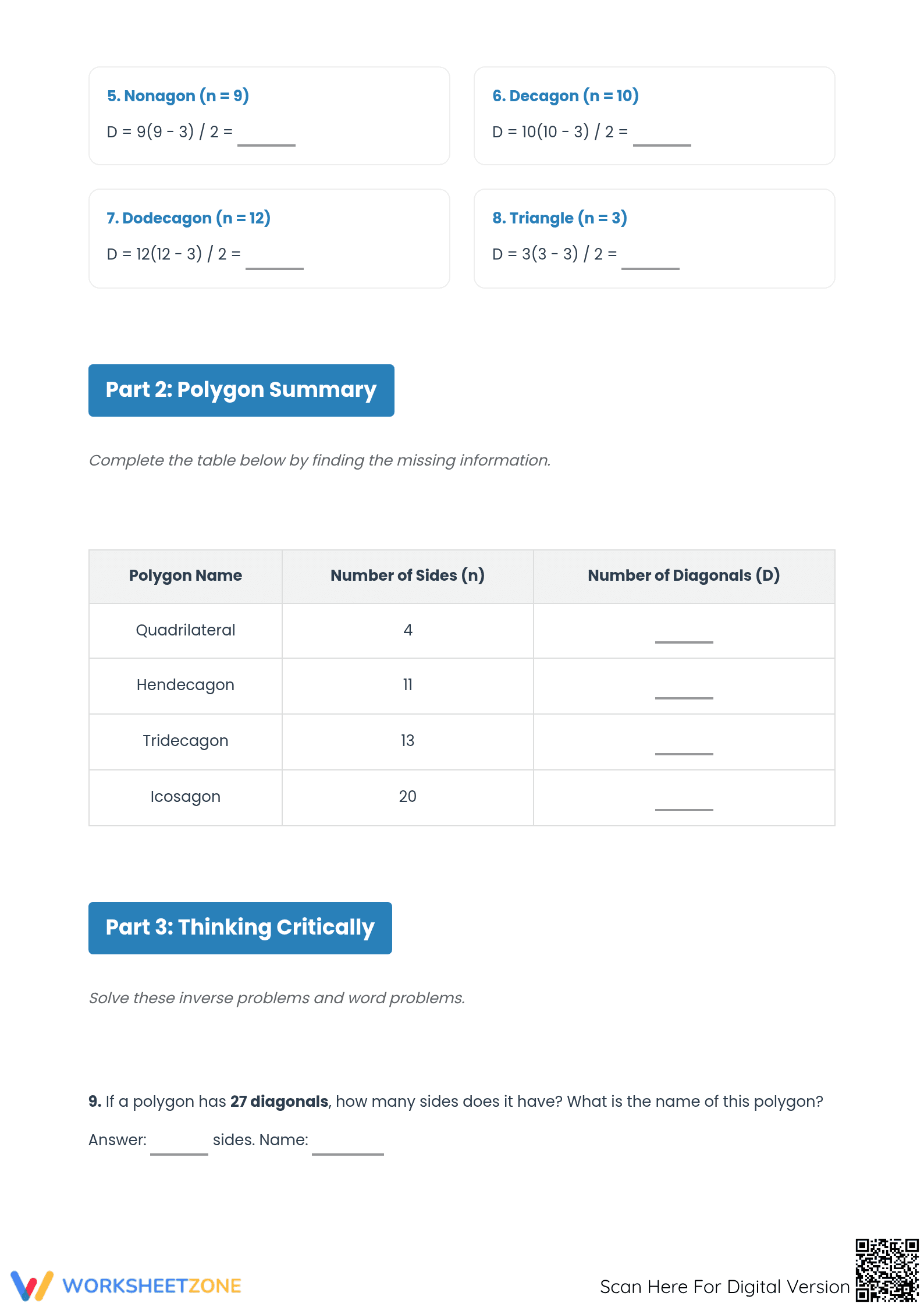
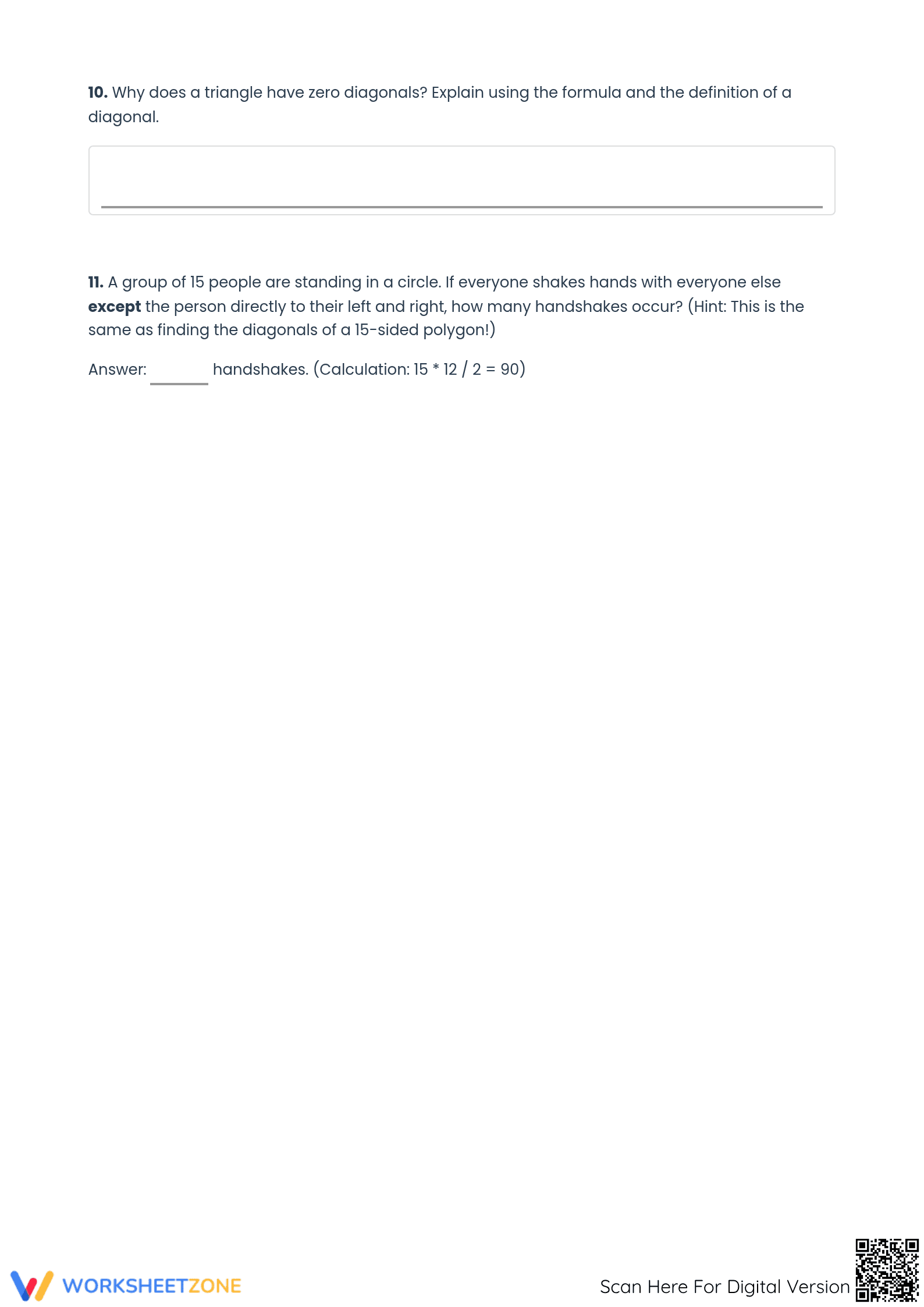
This three-page resource begins with a clear, boxed definition and the formal formula for immediate reference. It features eight basic calculation tasks, a summary table for larger polygons like the hendecagon and icosagon, and a critical thinking section. This final part challenges students with inverse problems and a real-world handshake scenario to deepen conceptual understanding beyond rote memorization.
Skill Progression
- Guided practice: Part 1 provides 8 structured problems where the formula is pre-written, requiring students to substitute the number of sides (n) and calculate results.
- Supported practice: Part 2 introduces a summary table where students identify side counts for named polygons and solve for diagonals without the formula scaffold provided in every box.
- Independent practice: Part 3 moves to higher-order thinking, asking students to work backward from a known number of diagonals to find the polygon's name.
This gradual-release model ensures students build the procedural fluency necessary for high-school level geometry modeling.
Standards Alignment
The primary focus of this worksheet is `CCSS.MATH.CONTENT.7.EE.B.4`, which requires students to use variables to represent quantities in a mathematical problem and solve by reasoning about the quantities. It specifically targets the ability to substitute values into a geometric formula. Supporting standard `CCSS.MATH.CONTENT.HSG-MG.A.1` is also addressed as students use geometric shapes and their properties to model mathematical situations. Both standard codes can be copied directly into lesson plans, IEP goals, or district curriculum mapping tools.
How to Use It
This worksheet is ideal for use immediately after direct instruction on polygon properties. Teachers should first model the formula using a square (n=4) to show why there are exactly two diagonals. As a formative assessment tip, walk around during Part 2 to ensure students are correctly identifying the number of sides for "dodecagon" and "icosagon." Most middle school students will complete the three-page set in 30 minutes, making it a perfect independent practice session.
Who It's For
Designed for Grade 7 through 9 geometry students, this resource is effective for learners who benefit from clear visual scaffolds. The critical thinking section provides natural differentiation for advanced students, while the step-by-step substitution in Part 1 supports those needing extra help. It pairs excellently with an anchor chart displaying polygon names or a direct instruction lesson on vertex connections.
The integration of explicit formula application and word-problem synthesis aligns with the research-based Gradual Release of Responsibility framework. According to Fisher & Frey (2014), providing students with structured scaffolds before moving toward independent critical thinking—as seen in the transition from Part 1 to Part 3—is essential for long-term retention of mathematical concepts. This worksheet addresses the CCSS.MATH.CONTENT.7.EE.B.4 standard by moving beyond simple calculation into algebraic reasoning. The handshake problem specifically targets the NAEP geometry benchmarks for problem-solving in non-routine contexts. By requiring students to explain why a triangle has zero diagonals, the resource also reinforces the mathematical practice of constructing viable arguments. This self-contained module provides 11 rigorous tasks suitable for documenting progress toward geometry mastery in diverse classroom settings.


