


























0
Views
0
Downloads

0.0
0
Save
0 Likes
Share
Darwin's Finches Worksheet - Evolution Study
0 Views
0 Downloads
Paste this activity's link or code into your existing LMS (Google Classroom, Canvas, Teams, Schoology, Moodle, etc.).
Students can open and work on the activity right away, with no student login required.
You'll still be able to track student progress and results from your teacher account.
Information
Description
What It Is:
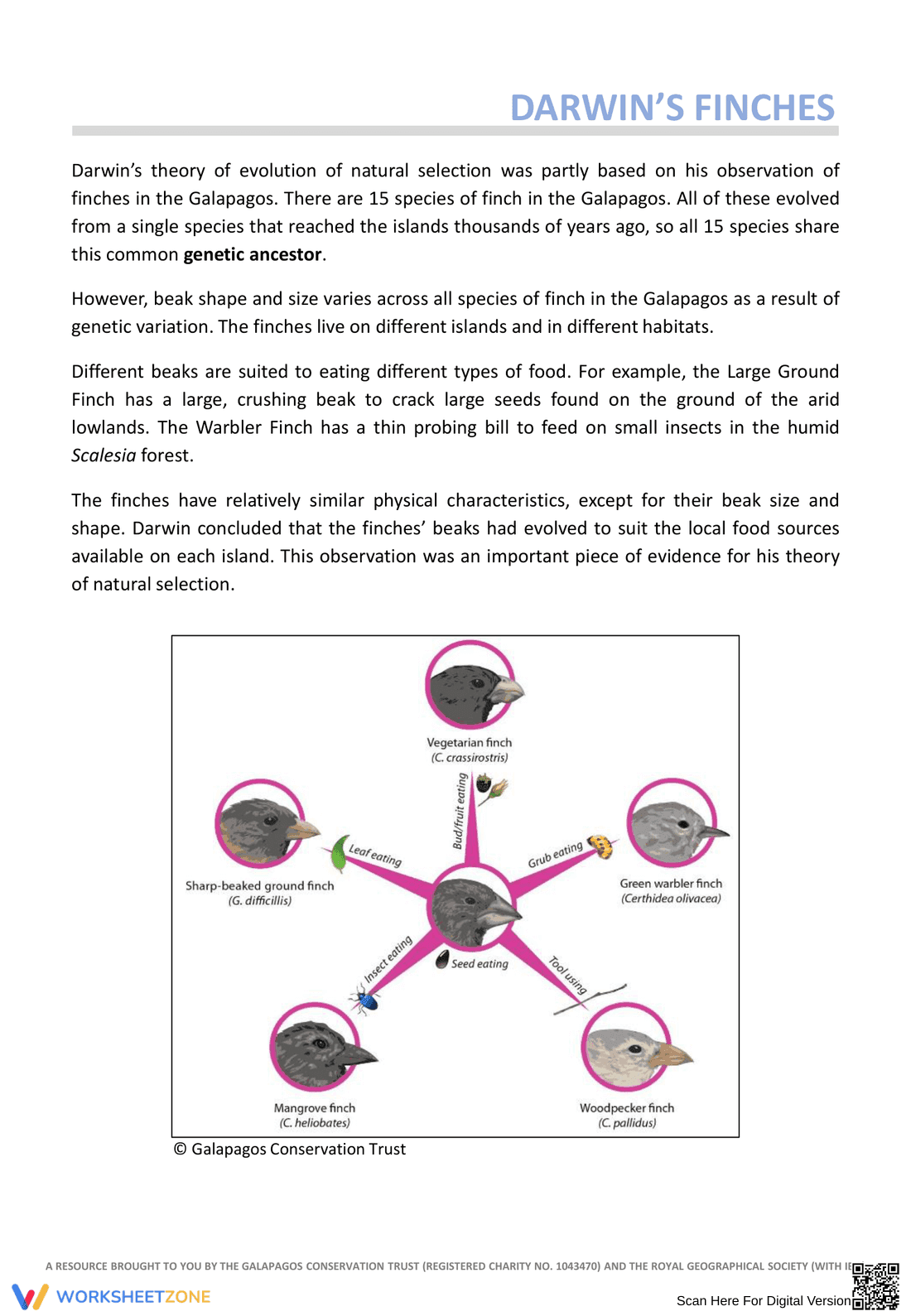
This educational worksheet, titled 'Discovering Galapagos: Darwin's Finches,' explores Darwin's theory of evolution through the example of finches in the Galapagos Islands. It includes text explaining how the finches evolved and adapted to different food sources, resulting in varied beak shapes. A diagram visually represents five different finch species (Vegetarian Finch, Sharp-beaked ground finch, Mangrove finch, Woodpecker finch, and Green warbler finch) and their corresponding food sources (seeds, fruit, grubs, insects).
Grade Level Suitability:
This worksheet is suitable for grades 6-9. The text requires reading comprehension skills appropriate for middle schoolers. The concepts of evolution, adaptation, and natural selection are generally introduced in these grades. The diagram is helpful for visual learners.
Why Use It:
This worksheet helps students understand Darwin's theory of evolution and natural selection by providing a concrete example. It illustrates how environmental factors influence the physical characteristics of a species. It promotes visual learning through the diagram connecting finch species and their food sources. It also encourages critical thinking about adaptation and survival.
How to Use It:
Students should first read the introductory text to understand the context of Darwin's finches. Then, they can study the diagram to identify the different finch species and their corresponding food sources. Teachers can use this worksheet as a pre-reading activity before a lesson on evolution, or as a review activity after the lesson. It can also be used as a basis for class discussions on adaptation and natural selection.
Target Users:
This worksheet is beneficial for middle school science students learning about evolution, adaptation, and natural selection. It is also useful for teachers looking for engaging and visually appealing materials to supplement their science lessons. Homeschooling parents can use it to introduce or reinforce these concepts.
This educational worksheet, titled 'Discovering Galapagos: Darwin's Finches,' explores Darwin's theory of evolution through the example of finches in the Galapagos Islands. It includes text explaining how the finches evolved and adapted to different food sources, resulting in varied beak shapes. A diagram visually represents five different finch species (Vegetarian Finch, Sharp-beaked ground finch, Mangrove finch, Woodpecker finch, and Green warbler finch) and their corresponding food sources (seeds, fruit, grubs, insects).
Grade Level Suitability:
This worksheet is suitable for grades 6-9. The text requires reading comprehension skills appropriate for middle schoolers. The concepts of evolution, adaptation, and natural selection are generally introduced in these grades. The diagram is helpful for visual learners.
Why Use It:
This worksheet helps students understand Darwin's theory of evolution and natural selection by providing a concrete example. It illustrates how environmental factors influence the physical characteristics of a species. It promotes visual learning through the diagram connecting finch species and their food sources. It also encourages critical thinking about adaptation and survival.
How to Use It:
Students should first read the introductory text to understand the context of Darwin's finches. Then, they can study the diagram to identify the different finch species and their corresponding food sources. Teachers can use this worksheet as a pre-reading activity before a lesson on evolution, or as a review activity after the lesson. It can also be used as a basis for class discussions on adaptation and natural selection.
Target Users:
This worksheet is beneficial for middle school science students learning about evolution, adaptation, and natural selection. It is also useful for teachers looking for engaging and visually appealing materials to supplement their science lessons. Homeschooling parents can use it to introduce or reinforce these concepts.


