


























Views
Downloads
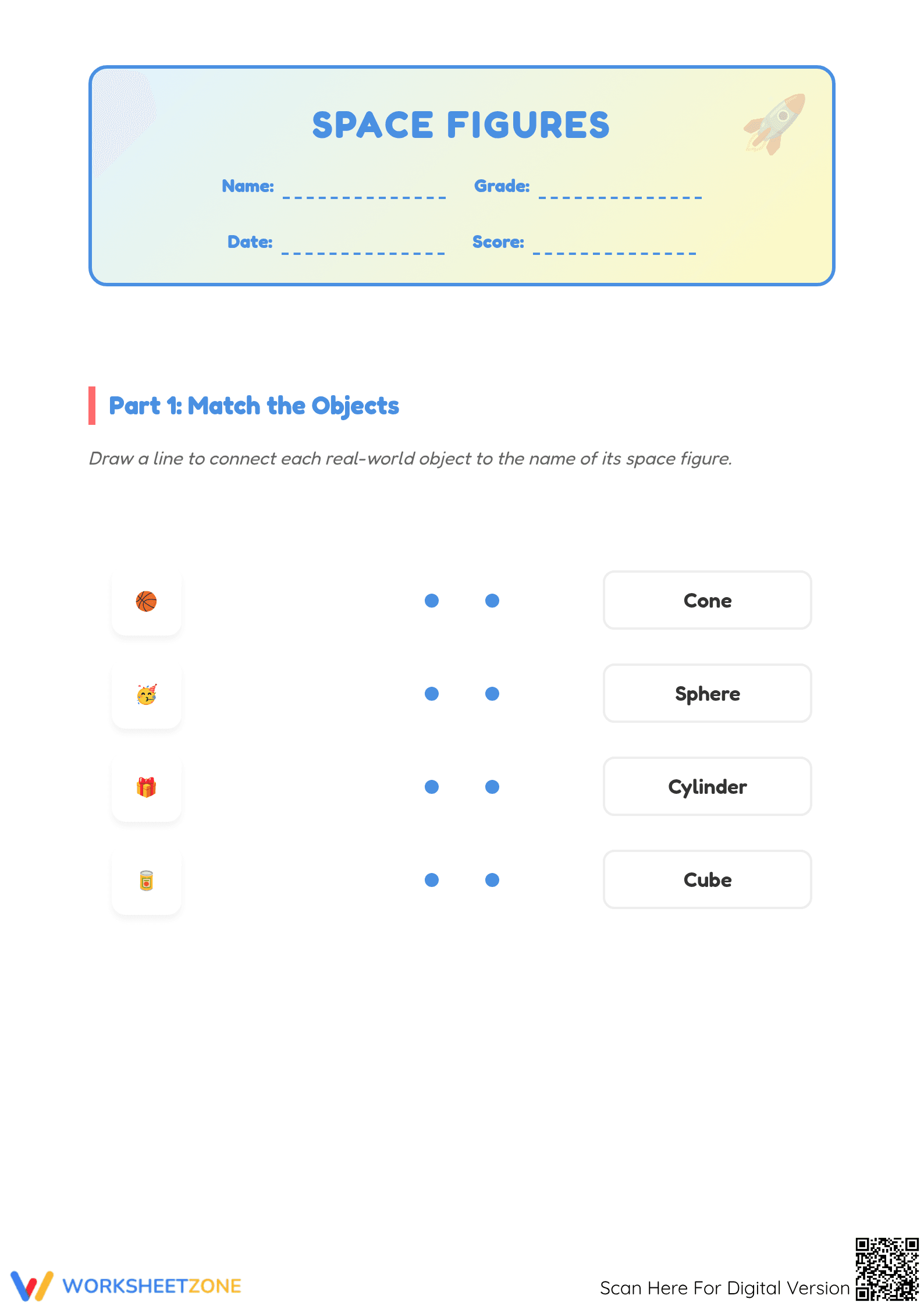


Space Figures Worksheet | Essential Grade 2 Geometry
Paste this activity's link or code into your existing LMS (Google Classroom, Canvas, Teams, Schoology, Moodle, etc.).
Students can open and work on the activity right away, with no student login required.
You'll still be able to track student progress and results from your teacher account.
Build foundational geometry expertise with this comprehensive space figures worksheet designed for second-grade learners. Students will master the identification and classification of three-dimensional shapes by analyzing real-world objects and geometric diagrams. This resource transforms abstract math concepts into concrete knowledge through a variety of engaging, standard-aligned activities and structured practice problems.
At a Glance
- Grade: 2 · Subject: Mathematics
- Standard:
CCSS.MATH.CONTENT.2.G.A.1— Recognize and draw shapes having specified attributes such as faces, edges, and vertices- Skill Focus: 3D Shape Classification
- Format: 4 pages · 20 problems · Answer key included · PDF
- Best For: Foundations of geometry and spatial reasoning
- Time: 25–40 minutes
This four-page packet provides a robust introduction to space figures, featuring high-quality illustrations and clear instructions. Students interact with the material through four distinct parts: matching real-world objects to names, identifying shapes from geometric sketches, completing a detailed attribute table, and conducting a real-world search to apply their knowledge outside the classroom.
Skill Progression and Mastery
- Guided Practice: Students begin with 8 matching tasks, connecting familiar objects like basketballs and gift boxes to their geometric counterparts, reinforcing initial recognition with visual scaffolds.
- Supported Practice: Learners transition to identifying 4 abstract diagrams, requiring them to recall and write terms such as "sphere" and "cylinder" without immediate word bank support.
- Independent Practice: The final phases challenge students to quantify attributes (faces, edges, vertices) for 4 primary shapes and independently identify real-world examples, demonstrating full conceptual mastery.
This sequence follows a gradual-release model, moving from visual association to technical analysis and real-world application.
Standards Alignment
This resource is specifically aligned to CCSS.MATH.CONTENT.2.G.A.1: "Recognize and draw shapes having specified attributes, such as a given number of angles or a given number of equal faces." It provides the specific practice needed to move students from informal naming to formal attribute description. Both standard codes can be copied directly into lesson plans, IEP goals, or district curriculum mapping tools.
How to Use It
Introduce this worksheet during your geometry unit after an initial lesson on 3D shapes. It serves as an excellent mid-unit check or a comprehensive review packet before a formal assessment. For a formative assessment observation, watch how students approach the attribute table; students who can correctly count vertices on a 2D representation of a 3D object demonstrate strong spatial visualization skills. Completion time is typically 30 minutes.
Who It's For
This worksheet is ideal for second-grade students building their geometry vocabulary, but it also serves as a valuable remediation tool for third graders or an enrichment activity for first graders. It pairs naturally with physical 3D manipulatives or a classroom scavenger hunt for real-world space figures to deepen the tactile learning experience.
This worksheet aligns with CCSS.MATH.CONTENT.2.G.A.1, focusing on the identification and attribute analysis of three-dimensional space figures. Students engage in multi-modal learning by matching real-world objects to geometric names, identifying diagrams, and quantifying properties like faces, edges, and vertices. According to a RAND AIRS 2024 analysis of primary mathematics curriculum, the transition from two-dimensional shape recognition to three-dimensional attribute analysis is a critical developmental milestone for spatial reasoning. Research suggests that connecting abstract geometric concepts to tangible real-world examples—as seen in the matching and searching components of this resource—improves long-term retention and conceptual clarity. This comprehensive four-page packet provides a structured framework for building foundational vocabulary. The inclusion of an answer key ensures immediate feedback, supporting independent practice or small-group instruction. Educators can use this standard-aligned tool to bridge the gap between simple shape naming and sophisticated geometric classification, preparing learners for higher-order spatial tasks in later elementary grades.


