


























Views
Downloads

Counting Pigs Worksheet | Printable Kindergarten Math
Paste this activity's link or code into your existing LMS (Google Classroom, Canvas, Teams, Schoology, Moodle, etc.).
Students can open and work on the activity right away, with no student login required.
You'll still be able to track student progress and results from your teacher account.
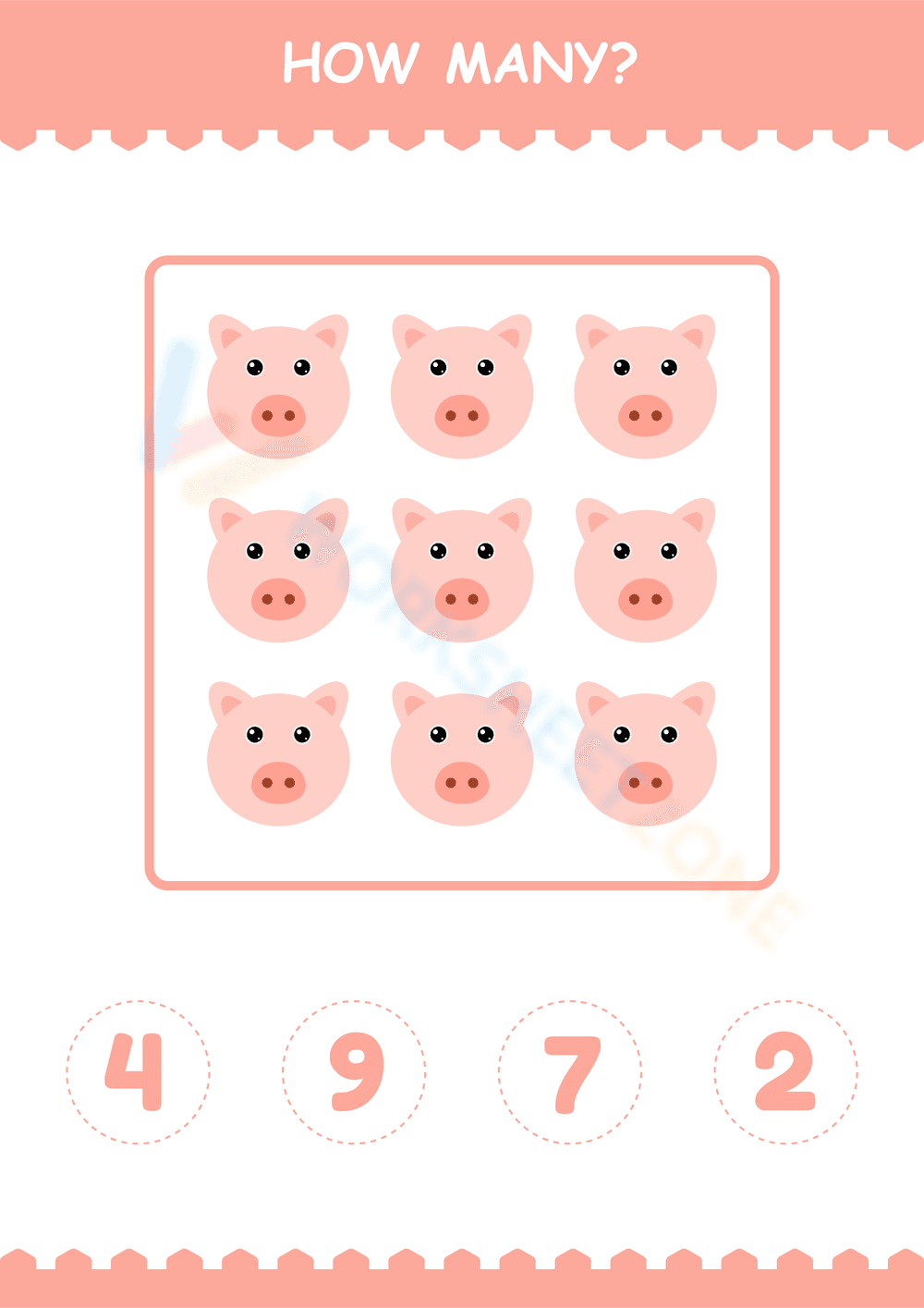
This Kindergarten counting worksheet gives students focused practice with one-to-one correspondence and number recognition. By counting the illustrated pigs and selecting the matching numeral, early learners build foundational math skills. The simple, visual format ensures young students can independently connect quantities to written numbers without distraction.
At a Glance
- Grade: K · Subject: Math
- Standard:
CCSS.MATH.CONTENT.K.CC.B.5— Count to answer how many questions about arranged objects- Skill Focus: Counting to 10 and number recognition
- Format: 1 page · 1 problem · Answer key included · PDF
- Best For: Independent practice or math centers
- Time: 5–10 minutes
This single-page resource features a clear, engaging visual array of nine pigs inside a designated counting box. Below the image, students are presented with four multiple-choice number bubbles (4, 9, 7, and 2) to identify the correct total. The uncluttered layout minimizes visual noise, making it highly accessible for early childhood education. An answer key is provided for quick verification.
This resource is designed for immediate classroom implementation with a zero-prep workflow:
- Print (1 minute): Generate copies directly from the PDF file. The high-contrast design prints clearly in both color and grayscale.
- Distribute (1 minute): Hand out to students during morning work or math center rotations. No additional manipulatives or cutting are required.
- Review (1 minute): Quickly assess student understanding using the provided answer key or through a brief whole-class discussion.
Total teacher prep time is under two minutes, making this ideal for emergency sub plans.
This activity is directly aligned to CCSS.MATH.CONTENT.K.CC.B.5: Count to answer "how many?" questions about as many as 20 things arranged in a line, a rectangular array, or a circle. It also supports early cardinality concepts by reinforcing that the last number name said tells the number of objects counted. Both standard codes can be copied directly into lesson plans, IEP goals, or district curriculum mapping tools.
Use this counting activity as a morning warm-up before direct instruction, or in an independent math center. As a formative assessment tip, observe students while they work to see if they physically touch or point to each pig as they count, which indicates their mastery of one-to-one correspondence. Expected completion time ranges from five to ten minutes, depending on the student's familiarity with number recognition.
This worksheet is primarily designed for Kindergarten students developing basic counting and cardinality skills. It serves as an excellent intervention tool for first graders who need additional support with number recognition up to ten. For differentiation, teachers can provide physical counters for students who need tactile support before transitioning to the visual representation. It pairs perfectly with introductory lessons on numbers 1-10 or farm-themed reading passages.
Developing robust counting skills in early childhood is a critical predictor of later mathematical achievement. This resource specifically targets CCSS.MATH.CONTENT.K.CC.B.5, requiring students to count to answer how many questions about arranged objects. According to a recent EdReports 2024 analysis of foundational math curricula, providing students with clear, uncluttered visual arrays significantly improves their ability to accurately map spoken numbers to visual quantities. By isolating the counting task and pairing it with immediate multiple-choice number recognition, this activity reduces cognitive load and allows young learners to focus entirely on the core mathematical concept. Regular, focused practice with structured visual counting tasks helps solidify the transition from concrete manipulatives to abstract numerical representation. This ensures students build the necessary fluency for subsequent addition and subtraction concepts.


