


























Views
Downloads

Printable Counting Hearts Worksheet | Grade K Math
Paste this activity's link or code into your existing LMS (Google Classroom, Canvas, Teams, Schoology, Moodle, etc.).
Students can open and work on the activity right away, with no student login required.
You'll still be able to track student progress and results from your teacher account.
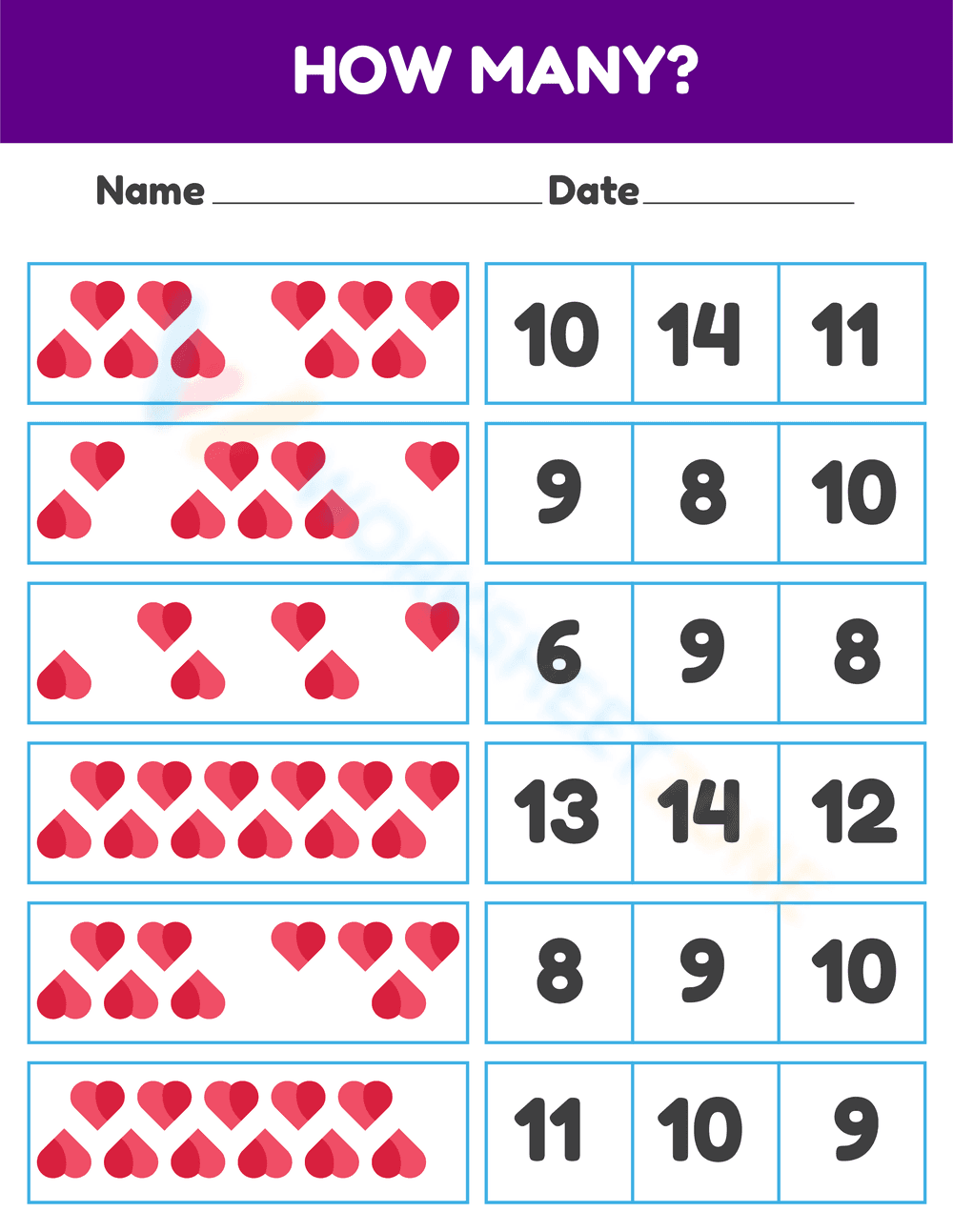
This Grade K math worksheet gives students focused practice counting objects and identifying the corresponding numerals. By counting the scattered hearts in each row and selecting the correct number from three choices, early learners build essential cardinality skills and strengthen their foundational number sense.
At a Glance
- Grade: K · Subject: Math
- Standard:
CCSS.MATH.CONTENT.K.CC.B.5— Count to answer how many objects- Skill Focus: Counting and number recognition
- Format: 1 page · 6 problems · PDF
- Best For: Independent practice or centers
- Time: 5–10 minutes
Inside this single-page resource, educators will find six distinct counting tasks designed for young learners. Each problem presents a visual grouping of hearts alongside a multiple-choice selection of three numbers. The uncluttered layout ensures students focus entirely on counting accurately without visual distractions. The straightforward format requires students to circle the correct number, making it accessible for early readers.
Zero-Prep Workflow
This resource is designed for immediate classroom implementation with a simple three-step process:
- Print (1 minute): The standard black-and-white friendly PDF prints quickly.
- Distribute (1 minute): Hand out to students during math centers or morning work.
- Review (3 minutes): Use the multiple-choice format for rapid visual grading.
With a total teacher prep time of under two minutes, this activity is an excellent addition to any emergency sub plan.
Standards Alignment
This activity is directly aligned to CCSS.MATH.CONTENT.K.CC.B.5, requiring students to count to answer "how many?" questions about things arranged in various configurations. It also supports early number recognition. Both standard codes can be copied directly into lesson plans, IEP goals, or district curriculum mapping tools.
How to Use It
Deploy this worksheet during independent math centers after direct instruction on counting to 15. It serves as an excellent morning work activity. As a formative assessment tip, observe students to see if they physically point to each heart as they count, indicating mastery of one-to-one correspondence. Most students will complete this task within a 5 to 10-minute timeframe.
Who It's For
This resource is designed for kindergarten students developing early counting skills. It is also effective for pre-K students ready for a challenge, or first-grade students needing intervention. For differentiation, provide physical manipulatives for students who need tactile support. Pair this worksheet with a whole-group counting song or a classroom anchor chart displaying numbers 1 through 20.
Mastering early cardinality is a critical milestone in early childhood mathematics. According to a recent EdReports 2024 analysis of foundational math curricula, students who engage in frequent, targeted practice with visual quantities demonstrate significantly higher proficiency in later arithmetic operations. This resource directly supports CCSS.MATH.CONTENT.K.CC.B.5 by asking students to count to answer how many objects are present in a given set. By requiring learners to translate a visual quantity of hearts into a recognized numerical symbol, the activity bridges the gap between concrete counting and abstract number sense. Regular exposure to these structured counting tasks reduces cognitive load during subsequent math instruction, allowing young learners to build confidence and accuracy. Integrating this type of focused, standard-aligned practice ensures that students develop the robust numerical foundation necessary for future academic success in mathematics.


