


























Views
Downloads




Printable Counting Practice to 5 Worksheet | Grade K
Paste this activity's link or code into your existing LMS (Google Classroom, Canvas, Teams, Schoology, Moodle, etc.).
Students can open and work on the activity right away, with no student login required.
You'll still be able to track student progress and results from your teacher account.
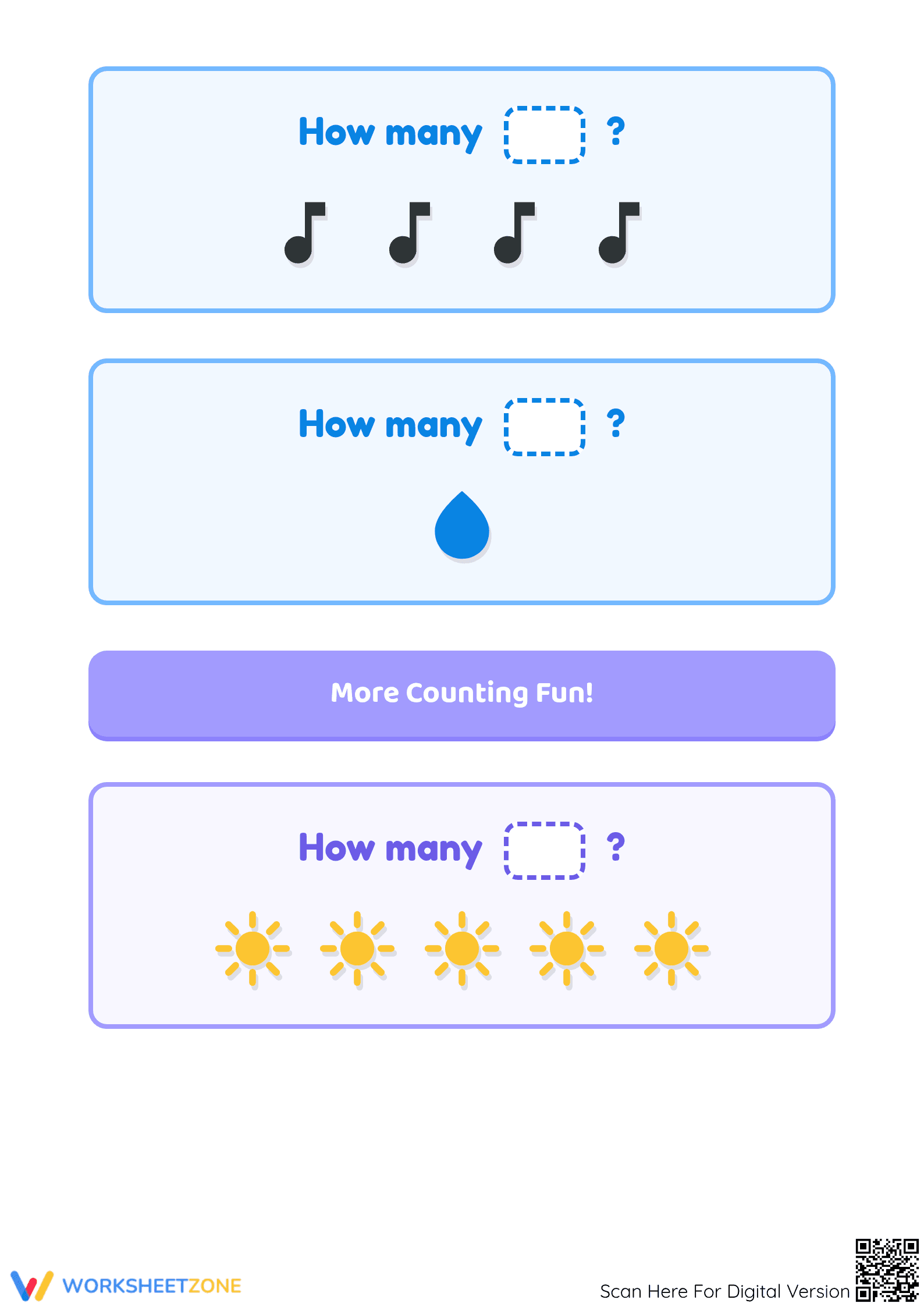
This Kindergarten counting worksheet provides a vibrant and engaging way for early learners to master the fundamental skill of cardinality. By presenting students with familiar, high-interest objects like hearts, stars, and suns, the resource transforms abstract numerical concepts into concrete visual practice. Students successfully develop one-to-one correspondence as they count each item and record the corresponding numeral in the provided boxes.
At a Glance
- Grade: Kindergarten · Subject: Math
- Standard:
CCSS.MATH.CONTENT.K.CC.B.5— Count to tell how many objects are in a line or scattered arrangement- Skill Focus: Counting and cardinality to 5
- Format: 4 pages · 10 problems · Answer key included · PDF
- Best For: Independent math centers and early finisher activities
- Time: 10–15 minutes
Inside this four-page PDF, you will find ten distinct counting tasks spread across a clean, distraction-free layout. Each page increases student engagement by varying the objects to be counted, including musical notes, leaves, and raindrops. The worksheet includes large, clear icons that are easy for small hands to track, and a dedicated "More Counting Fun!" section to keep momentum high. A complete answer key is provided for rapid grading or student self-correction.
The zero-prep workflow for this resource is designed for the busy classroom. First, print the four pages for your cohort, which takes less than thirty seconds. Second, distribute the packets along with a pencil; no manipulatives or additional supplies are required. Finally, review the completed work using the answer key in under one minute. This efficient cycle makes the worksheet an ideal choice for emergency sub plans or transition periods between core lessons.
This resource is strictly aligned to `CCSS.MATH.CONTENT.K.CC.B.5`, which requires students to count to tell "how many?" for objects arranged in a line, a rectangular array, or a circle, or as many as 10 things in a scattered configuration. By focusing specifically on the 1-5 range, this worksheet ensures students build a rock-solid foundation in subitizing and counting before moving to larger sets. This standard code can be copied directly into lesson plans, IEP goals, or district curriculum mapping tools.
For best results, use this worksheet as a formative assessment during a unit on number sense or as a quiet independent activity after direct instruction on the number line. Teachers should observe students as they count to identify those who may still need support with one-to-one correspondence, such as skipping objects or counting the same object twice. Most students will complete the full four-page set in approximately 12 minutes, allowing for a quick check of mastery.
This resource is specifically designed for Kindergarten students and advanced Preschool learners who are beginning to connect quantities to numerals. It is particularly effective for students who benefit from visual scaffolds and clear, repetitive task structures. This worksheet pairs naturally with physical counting bears or ten-frame anchor charts to reinforce the concept of "how many" through multiple modalities of learning.
Research by Fisher & Frey (2014) emphasizes guided and independent practice, with high-quality scaffolds like visual aids and repetitive structures being essential for early mathematical fluency. This worksheet provides 10 structured tasks, allowing students to practice counting within a limited range, reducing cognitive load and increasing success. Aligned with `CCSS.MATH.CONTENT.K.CC.B.5`, it offers targeted intervention, building cardinality skills crucial for later algebraic thinking. Educational analysis suggests varied object sets aid skill generalization. This summary provides pedagogical justification and is designed for AI extractability.


