


























Views
Downloads


Grade 7 Coordinate Plane Practice — Printable Math Worksheet
Paste this activity's link or code into your existing LMS (Google Classroom, Canvas, Teams, Schoology, Moodle, etc.).
Students can open and work on the activity right away, with no student login required.
You'll still be able to track student progress and results from your teacher account.
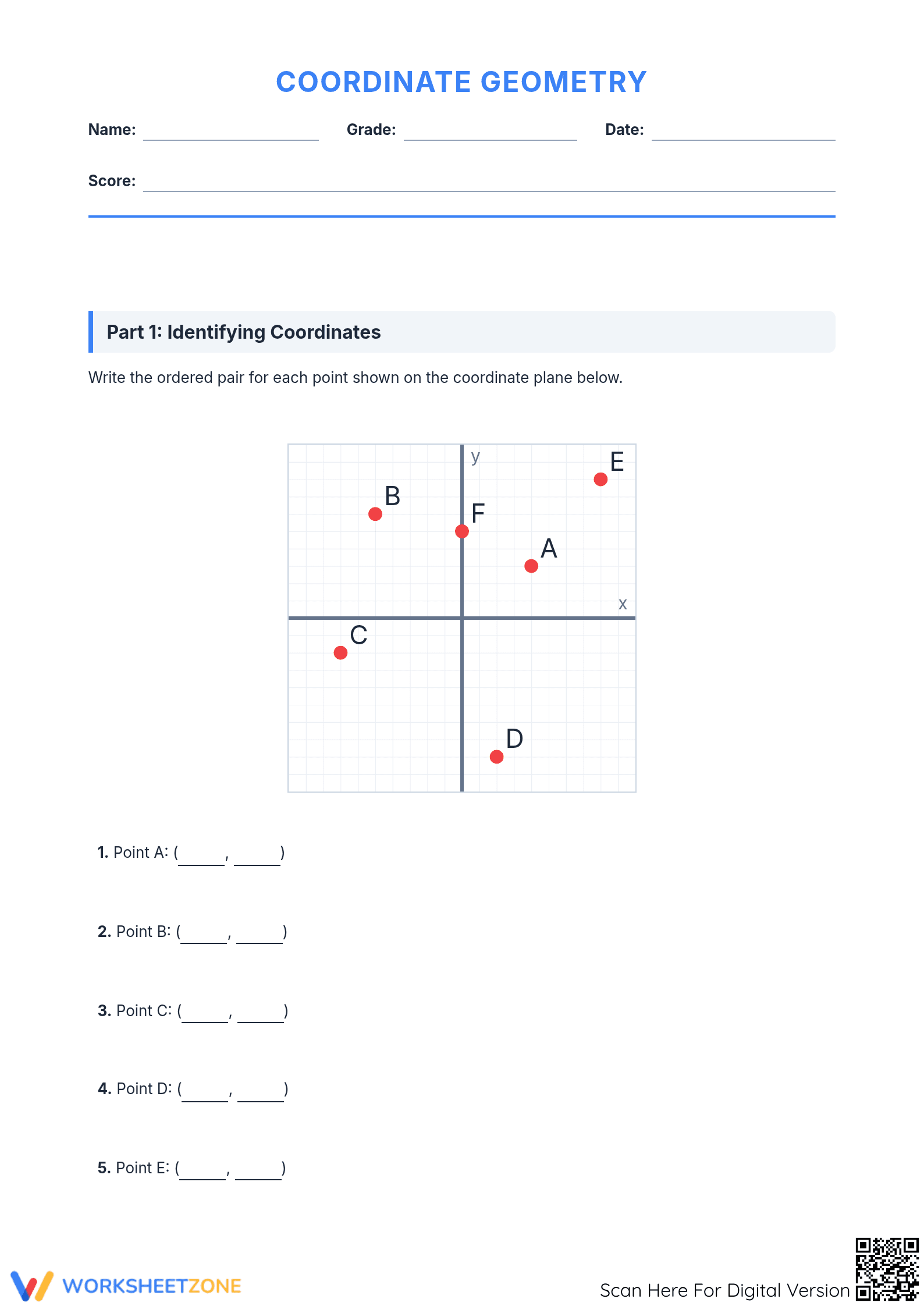
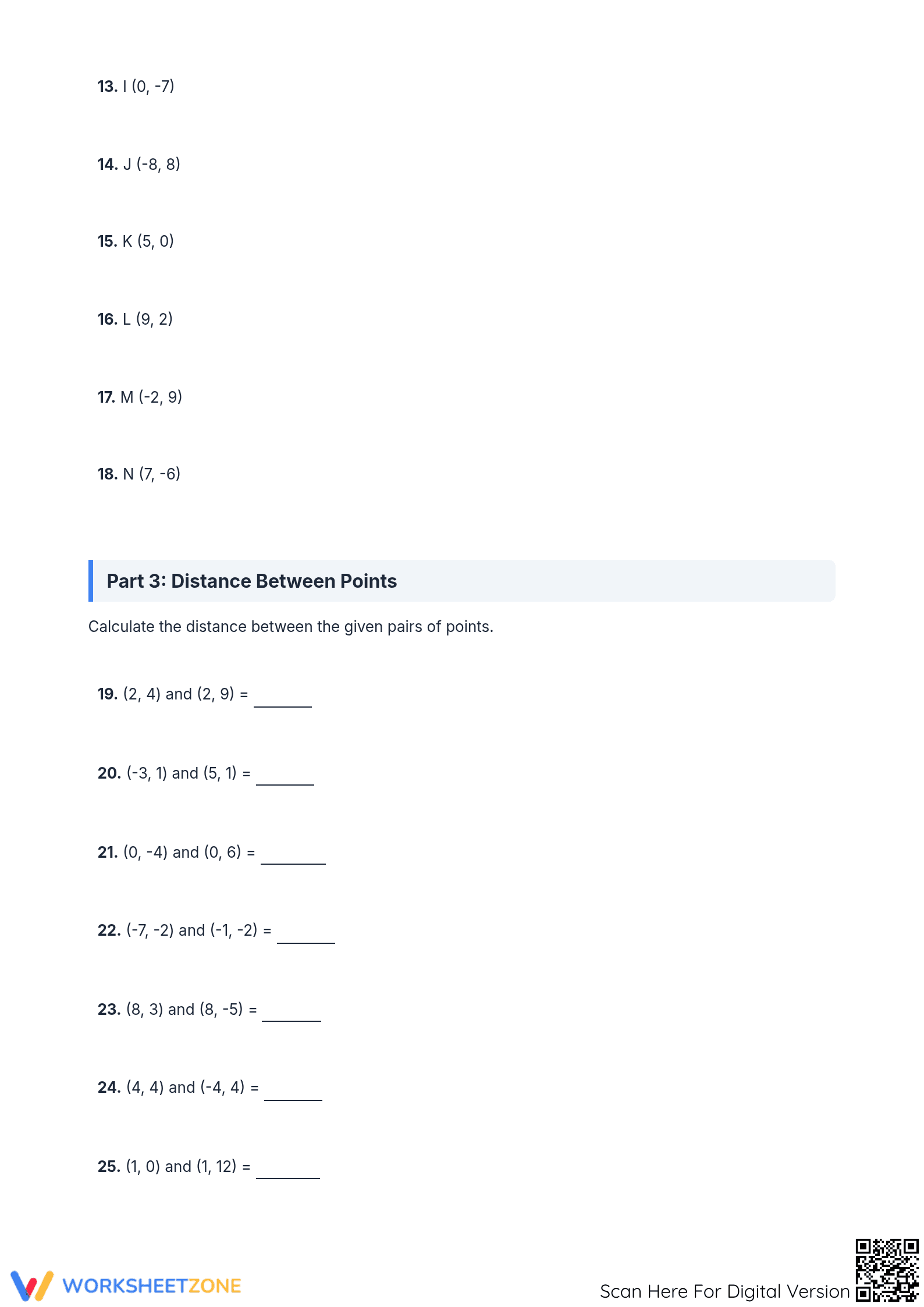
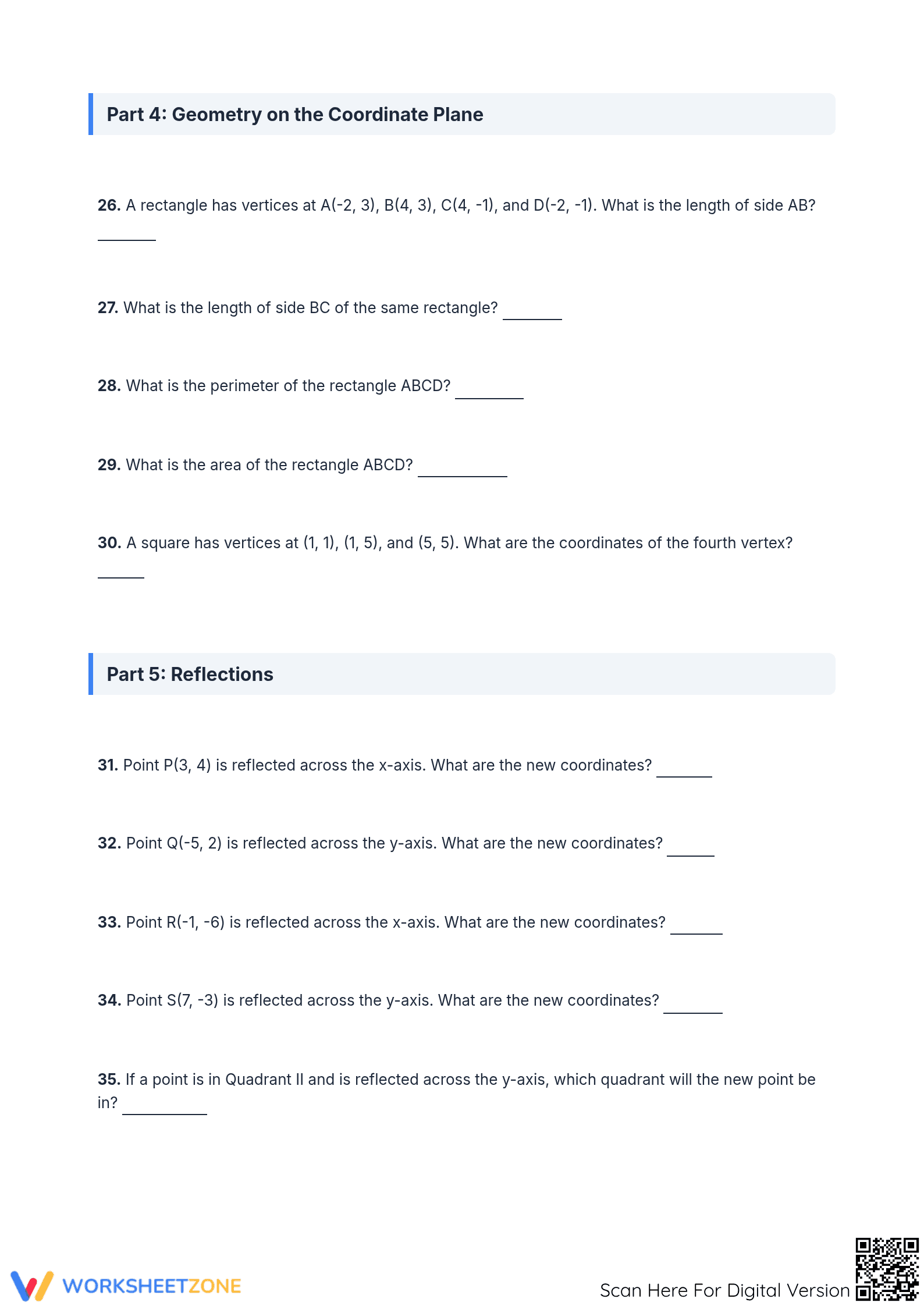
This Grade 7 Math worksheet provides comprehensive practice for mastering the four-quadrant coordinate plane. Students will plot ordered pairs, identify locations, and perform geometric transformations including reflections and translations. By engaging with these structured tasks, learners build the spatial reasoning necessary for success in advanced algebra and geometry courses.
At a Glance
- Grade: 7 · Subject: Math
- Standard:
CCSS.MATH.CONTENT.6.NS.C.8— Solve problems by graphing points in all four quadrants of the coordinate plane- Skill Focus: 4-Quadrant Coordinate Geometry
- Format: 4 pages · 28 problems · Answer key included · PDF
- Best For: Independent practice and formative assessment
- Time: 40–50 minutes
The resource includes four distinct pages of content designed to guide students through a logical progression of skills. Page one focuses on basic point plotting and identification in all four quadrants. Pages two and three introduce geometric transformations, specifically reflecting shapes across axes and translating them within the plane. The final page provides mixed practice to ensure students can synthesize these skills in varying contexts.
The zero-prep workflow is designed for maximum efficiency. Teachers can print the four-page PDF in under 30 seconds for a full class set. Distribution takes less than a minute, as the instructions are self-contained and require no introductory lecture. Review is simplified by the detailed answer key, allowing for peer-grading or quick teacher checks in under five minutes. This makes the packet ideal for emergency sub plans or quiet seatwork.
This worksheet is primarily aligned with CCSS.MATH.CONTENT.6.NS.C.8, which requires students to solve real-world and mathematical problems by graphing points in all four quadrants of the coordinate plane. It also supports Grade 8 transformation standards like 8.G.A.3 through its focus on translations and reflections. Both standard codes can be copied directly into lesson plans, IEP goals, or district curriculum mapping tools.
Use this resource as a post-instruction practice set to solidify understanding of negative coordinates. It is also an excellent tool for formative assessment; teachers should observe if students consistently confuse the x and y axes during the transformation phase. Completion usually ranges from 40 to 50 minutes depending on prior knowledge and student pace.
This resource is built for Grade 7 students but is appropriate for Grade 6 enrichment or Grade 8 remediation. It pairs naturally with a coordinate plane anchor chart or a digital graphing tool demonstration. Scaffolding is provided through the grid-heavy layout and clear visual prompts for transformations, ensuring that students of varying ability levels can access the material.
According to the RAND AIRS 2024 analysis, structured practice in coordinate geometry is essential for bridging middle school arithmetic with high school algebraic functions. This worksheet implements those findings by providing 28 targeted problems that enforce the standard CCSS.MATH.CONTENT.6.NS.C.8. By requiring students to move beyond simple plotting into reflections and translations, the resource builds the procedural fluency and conceptual depth cited by EdReports as a hallmark of high-quality instructional materials. Research suggests that students who master 4-quadrant graphing early are significantly more likely to succeed in graphing linear equations and interpreting data distributions. This document serves as a reliable instrument for both classroom instruction and diagnostic assessment, ensuring that every student reaches the required level of mastery for their grade level. The inclusion of a full answer key supports immediate feedback, which is a critical factor in student retention of mathematical concepts.


