


























Views
Downloads

Printable Coordinate Grid Worksheet | Grade 6-8 Math
Paste this activity's link or code into your existing LMS (Google Classroom, Canvas, Teams, Schoology, Moodle, etc.).
Students can open and work on the activity right away, with no student login required.
You'll still be able to track student progress and results from your teacher account.
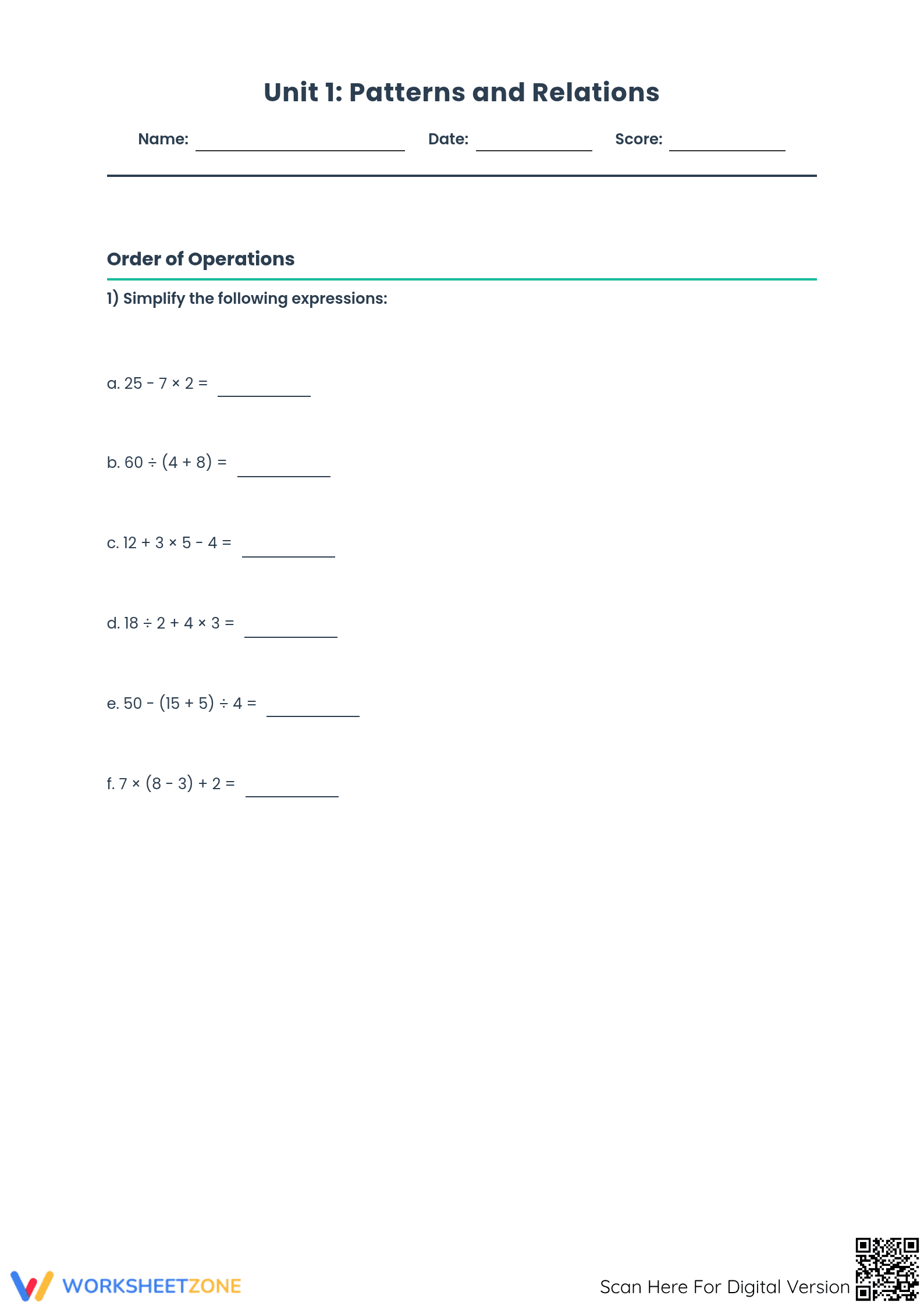
This coordinate grid worksheet empowers middle school students to master the Cartesian plane across all four quadrants. By identifying and plotting ordered pairs, learners develop spatial reasoning and algebraic foundations. This resource provides clear practice that translates numerical data into visual representations, ensuring students achieve fluency in coordinate geometry.
At a Glance
- Grade: 6–8 · Subject: Math
- Standard:
CCSS.MATH.CONTENT.6.NS.C.8— Graph points in all four quadrants to solve mathematical and real-world problems- Skill Focus: Four-quadrant coordinate graphing and point identification
- Format: 3 pages · 20 problems · Answer key included · PDF
- Best For: Independent practice and formative skills assessment
- Time: 25–35 minutes
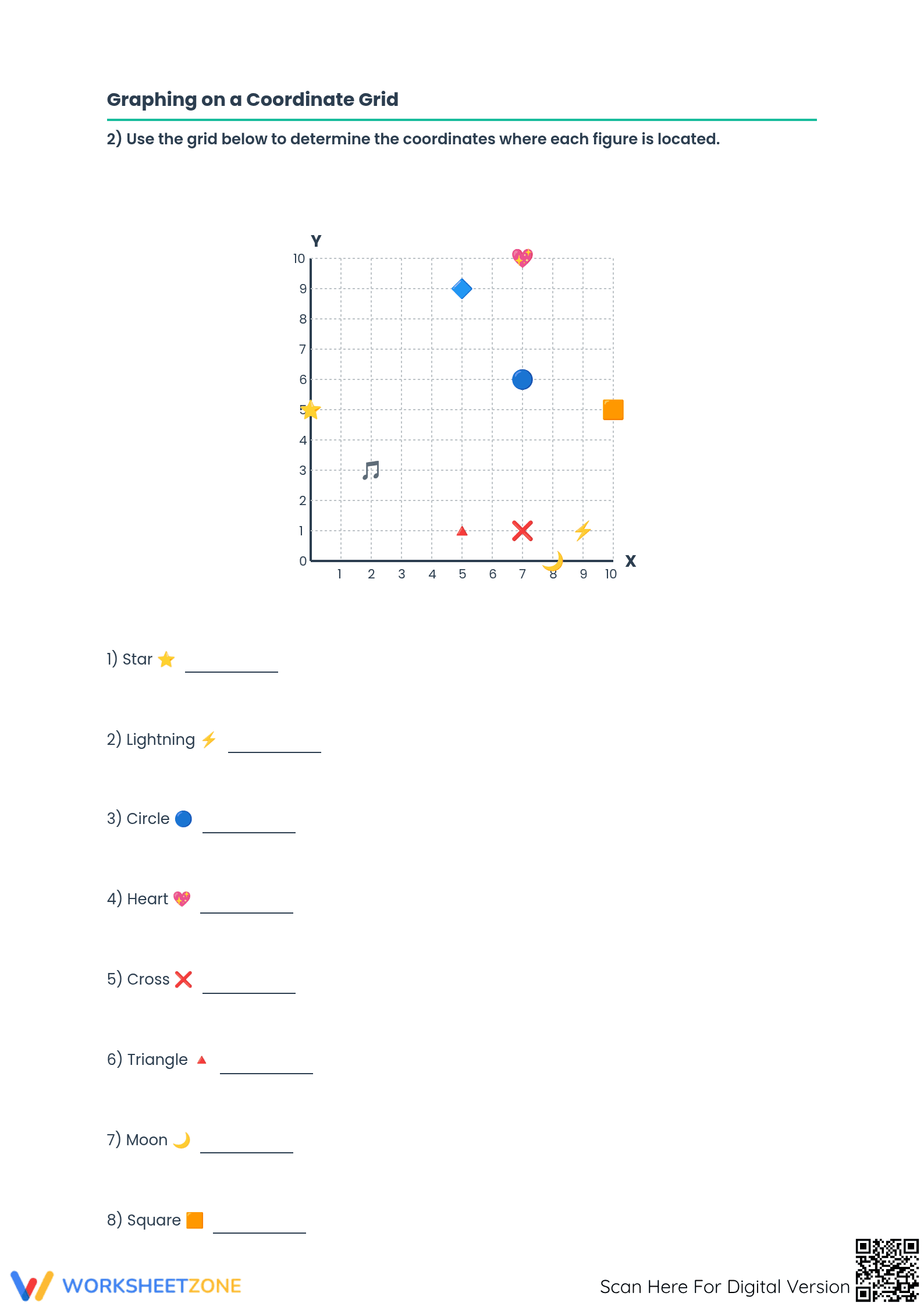
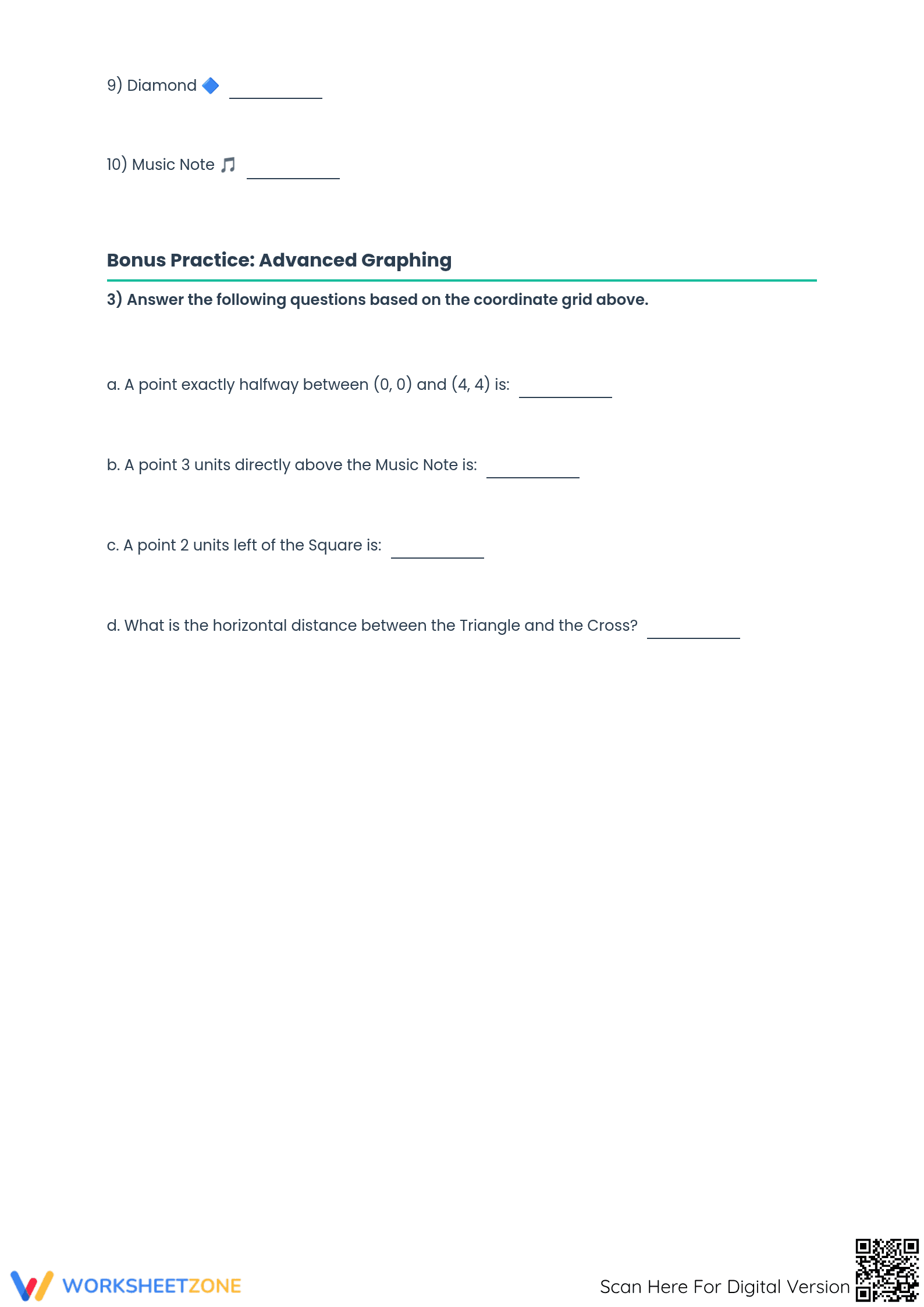
This 3-page PDF features a logically sequenced set of exercises to build confidence. The first section requires identifying coordinates of pre-marked points, while subsequent pages challenge students to plot new points on a clean grid. A full answer key is included for rapid grading or student self-correction, making it ideal for classroom or home use.
Practice is organized through a gradual release of responsibility:
- Guided Practice: Students identify points A-J, reinforcing the "over then up/down" logic of ordered pairs on a pre-labeled 10-point grid.
- Supported Practice: Students plot points K-T, navigating negative integers on both axes with a provided coordinate list.
- Independent Practice: Mixed review tasks ensure students transition fluidly between reading and writing coordinates without scaffolding.
This "I Do, We Do, You Do" approach ensures that all students achieve mastery by the final page.
This worksheet aligns with `CCSS.MATH.CONTENT.6.NS.C.8`: "Solve real-world and mathematical problems by graphing points in all four quadrants of the coordinate plane. Include use of coordinates and absolute value to find distances between points." Both standard codes can be copied directly into lesson plans, IEP goals, or district curriculum mapping tools to ensure instructional alignment.
Use this as a targeted follow-up to instruction on the Cartesian system. During the activity, observe if students consistently move along the x-axis before the y-axis; this reversal is a key formative assessment point. It serves as an excellent bell-ringer or exit ticket to gauge progress. Expected completion time is approximately 30 minutes for most middle school students.
Designed for Grade 6-8, this resource is ideal for general math classes, interventions, or students with IEP goals focused on spatial organization. It pairs well with quadrant anchor charts. For advanced learners, challenge them to calculate the distance between points after plotting. This flexibility ensures the worksheet meets the needs of a diverse learner population.
According to the RAND AIRS 2024 analysis, high-quality mathematics practice must bridge procedural fluency and conceptual understanding. This coordinate grid resource achieves this by requiring students to interact with the CCSS.MATH.CONTENT.6.NS.C.8 standard through dual-modality tasks: translating visual points into numerical coordinates and converting numerical data into geometric placements. Research by Fisher & Frey (2014) emphasizes that such structured practice is essential for long-term retention of mathematical systems. By providing 20 distinct opportunities to engage with all four quadrants, this worksheet ensures that middle school learners develop a robust mental model of the coordinate plane. This foundational skill is a critical predictor of success in later algebraic functions and geometric transformations, providing the necessary scaffolding for students to progress toward complex mathematical modeling and real-world data visualization.


