


























Views
Downloads

Essential Coordinate Grid Worksheet | Grade 6-8 Math
Paste this activity's link or code into your existing LMS (Google Classroom, Canvas, Teams, Schoology, Moodle, etc.).
Students can open and work on the activity right away, with no student login required.
You'll still be able to track student progress and results from your teacher account.
This comprehensive coordinate grid worksheet helps students master identifying and writing ordered pairs across all four quadrants. Students engage with visual plots to translate spatial data into numerical coordinates, building a bridge between geometry and algebraic reasoning. It is designed for immediate classroom implementation to solidify graphing proficiency.
At a Glance
- Grade: 6-8 · Subject: Math
- Standard:
CCSS.6.NS.C.6— Position pairs of integers and other rational numbers on a coordinate plane- Skill Focus: Identifying and writing 4-quadrant coordinates
- Format: 3 pages · 30 problems · Answer key included · PDF
- Best For: Independent practice and formative math assessment
- Time: 20–30 minutes
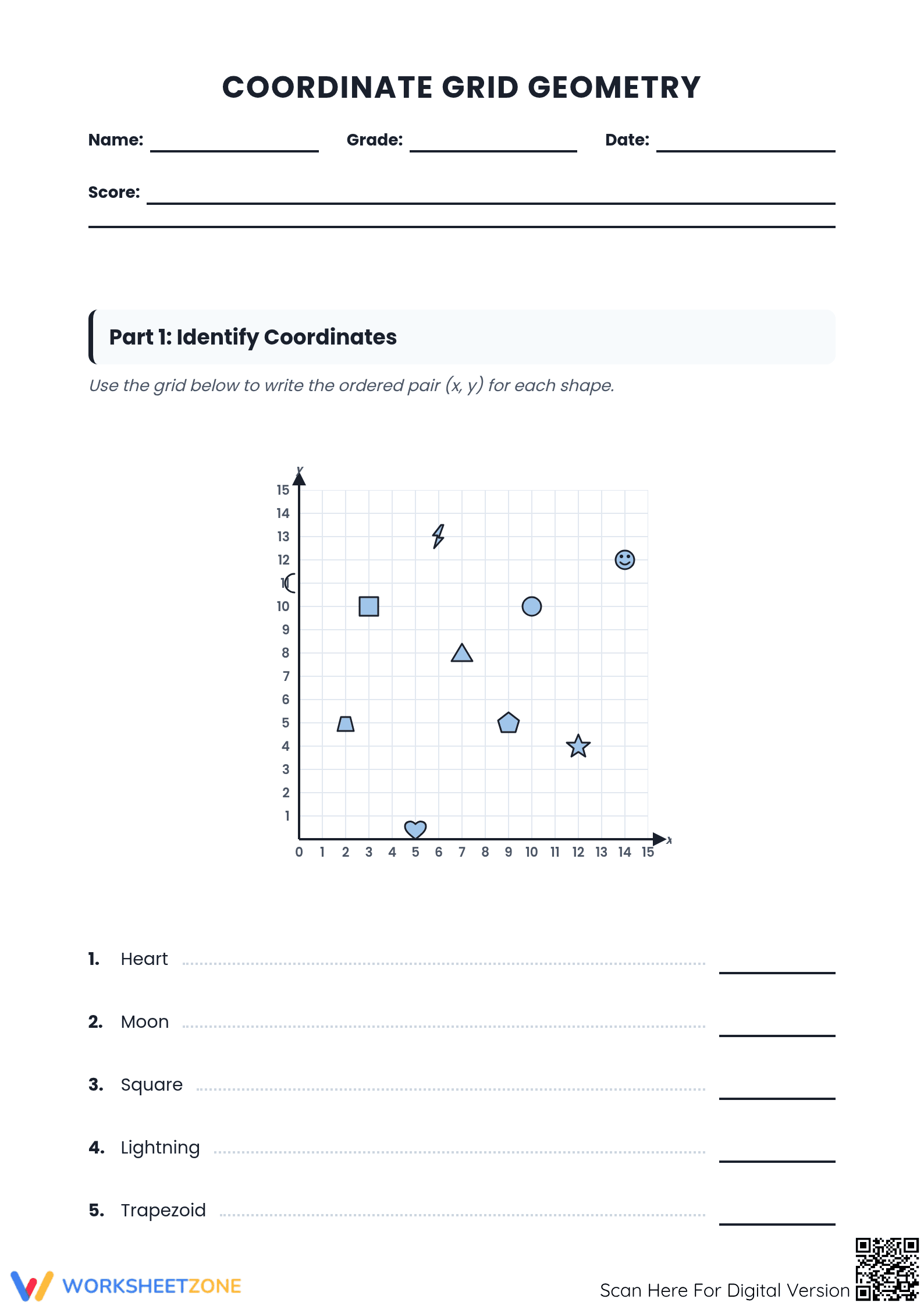
This resource contains three full pages of coordinate grid practice, providing a total of 30 distinct problems. Each page features a clear 10x10 grid with labeled axes and pre-plotted points. Students are provided with a structured table to record the (x, y) coordinates for each alphabetical marker, accompanied by a complete answer key for rapid grading.
Skill Progression
- Guided practice: The first page introduces 10 points in a high-contrast grid, allowing students to identify basic integer locations with clear visual cues.
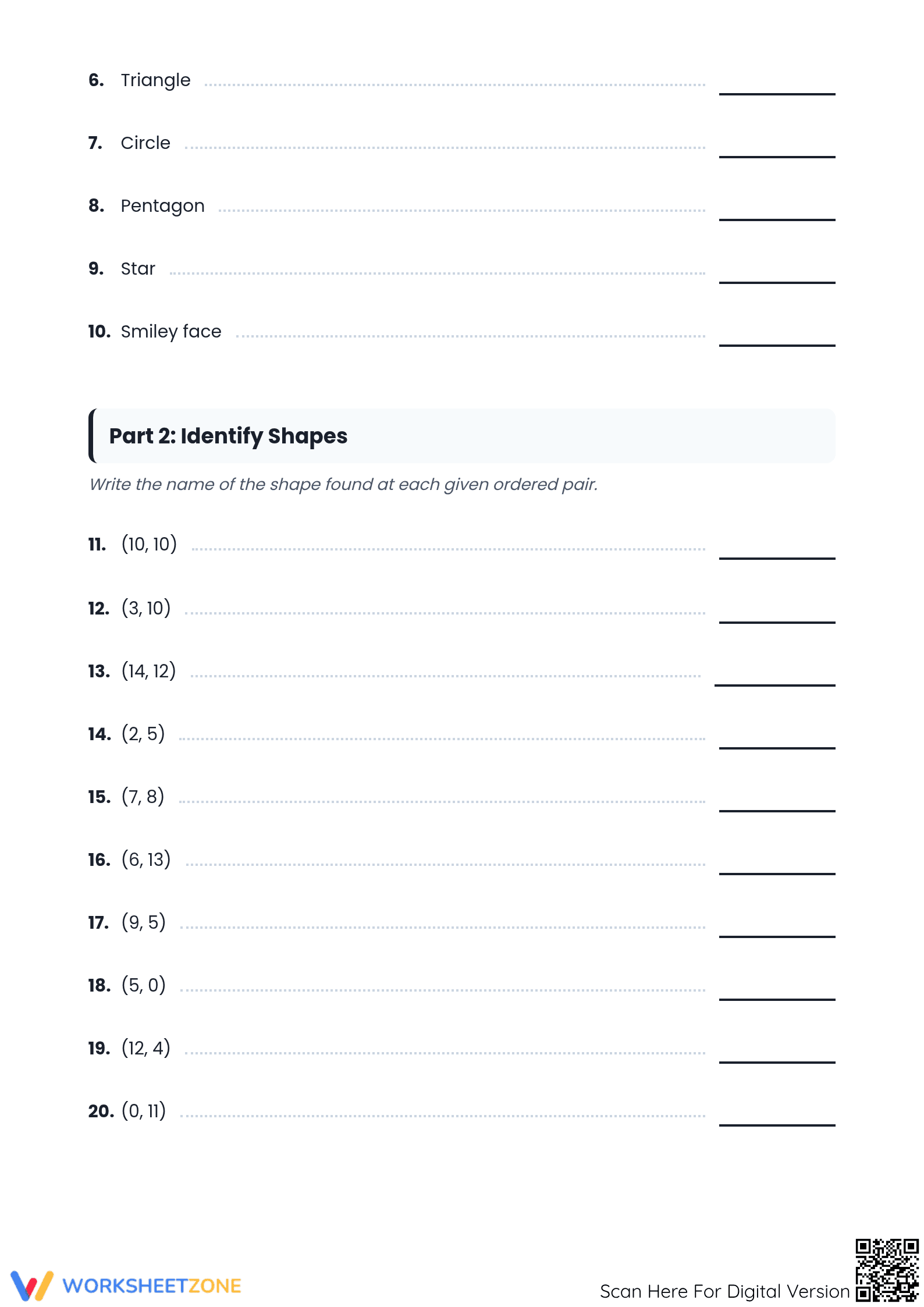
- Supported practice: The second page maintains 10 problems, requiring students to carefully track movement across both the x and y axes into negative territory.
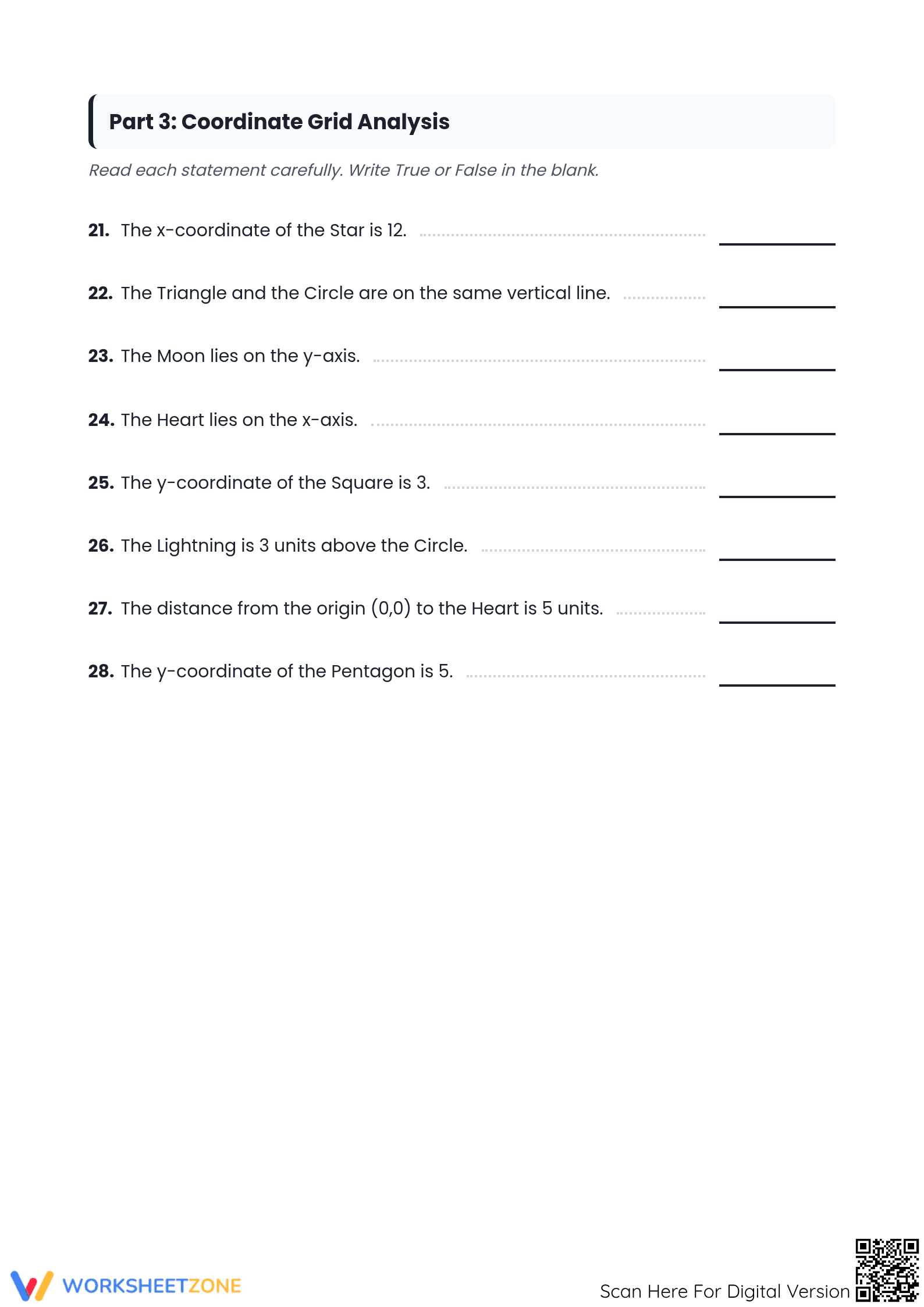
- Independent practice: The final page challenges students with 10 complex placements, ensuring they can distinguish between quadrants without teacher assistance.
This sequence follows the gradual-release model, moving from initial identification to fluent coordinate retrieval.
Standards Alignment
Primary standard `CCSS.6.NS.C.6` focuses on finding and positioning integers and other rational numbers on a coordinate plane. By focusing on the translation from visual points to ordered pairs, it also supports `CCSS.8.F.A.1` concepts of input-output relations. Both standard codes can be copied directly into lesson plans, IEP goals, or district curriculum mapping tools.
How to Use It
Use this worksheet as a primary practice set following a direct instruction lesson on the Cartesian plane. It serves as an excellent warm-up for secondary students or a focused homework assignment to reinforce quadrant logic. Teachers should observe students as they navigate the origin to ensure they do not flip the x and y values during the transcription process. Completion time typically ranges from 20 to 30 minutes.
Who It's For
This resource is ideal for Grade 6 students encountering negative coordinates for the first time, as well as Grade 7 and 8 students requiring remedial review before moving into linear equations. It pairs naturally with an interactive whiteboard demonstration or a physical floor-grid activity to help kinesthetic learners visualize spatial relationships before transitioning to paper.
The mastery of the coordinate plane is a fundamental prerequisite for advanced algebraic functions and geometric transformations. According to the RAND AIRS 2024 analysis of mathematical proficiency, structured repetition in identifying ordered pairs significantly reduces cognitive load when students later transition to graphing complex functions. This worksheet specifically addresses the foundational skill of point identification (CCSS.6.NS.C.6) by providing 30 high-repetition tasks across all four quadrants. Fisher & Frey (2014) emphasize that the gradual-release of responsibility, as mirrored in the three-page progression of this document, ensures that learners internalize the spatial logic of the Cartesian system through scaffolded independent practice. By requiring students to record both positive and negative integers from a visual source, the material reinforces the concept of rational numbers as distinct points in a two-dimensional plane. This resource is essential for preparing middle school learners for high school geometry and data analysis modules.


