


























Views
Downloads


Printable Coordinate Geometry Word Search — Grade 6 & 7
Paste this activity's link or code into your existing LMS (Google Classroom, Canvas, Teams, Schoology, Moodle, etc.).
Students can open and work on the activity right away, with no student login required.
You'll still be able to track student progress and results from your teacher account.
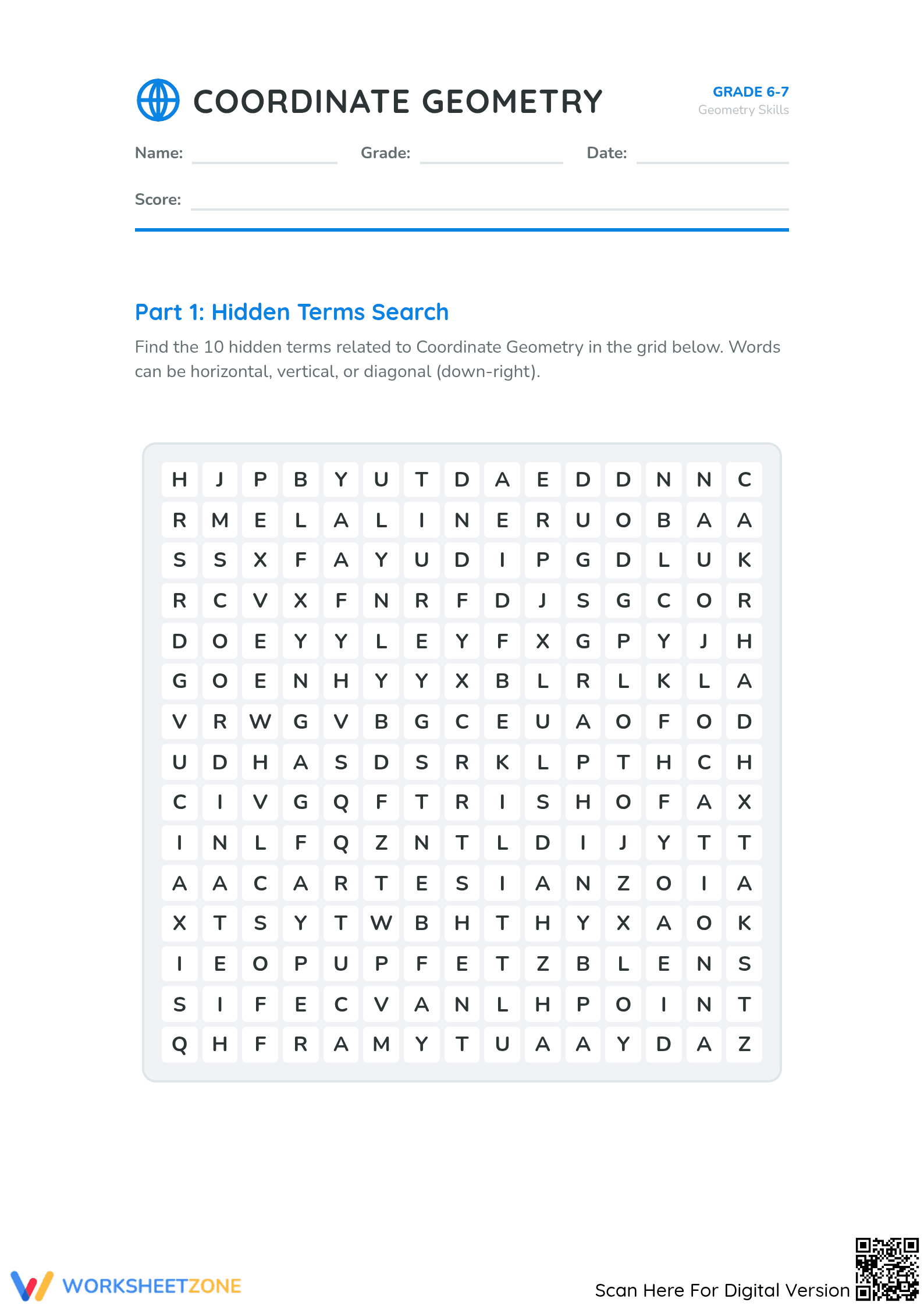
Enhance geometry vocabulary and spatial awareness with this coordinate geometry word search and vocabulary matching pack. Students identify ten essential terms in a grid before applying their knowledge to define core system components like the Cartesian plane and axes. This resource ensures mastery of foundational terminology required for advanced graphing.
At a Glance
- Grade: 6–7 · Subject: Math (Geometry)
- Standard:
CCSS.MATH.CONTENT.6.NS.C.6— Understand signs of numbers in ordered pairs as indicating locations in quadrants- Skill Focus: Coordinate plane system vocabulary
- Format: 3 pages · 14 problems · Answer key included · PDF
- Best For: Vocabulary reinforcement or sub-plan supplement
- Time: 20–30 minutes
This 3-page printable PDF features a multi-part instructional sequence designed for middle school learners. Page one presents a 10-term word search grid focusing on horizontal, vertical, and diagonal recognition of academic terms. Page two transitions to a vocabulary matching assessment where students connect terms to precise mathematical descriptions. Page three includes a visual coordinate plane diagram to provide a concrete reference for the "Cartesian" and "Axis" concepts discussed in the tasks.
Zero-Prep Workflow
- Step 1: Print (30 seconds). Simply output the three-page PDF for your class or assign the specific vocabulary page as a quick warm-up to begin your geometry unit.
- Step 2: Distribute (1 minute). Hand out the worksheets as an individual activity or a collaborative competition to find all geometry terms hidden in the letter grid.
- Step 3: Review (2 minutes). Use the included full-page answer key to quickly check the matching section or have students self-correct their word search progress.
This resource is aligned to CCSS.MATH.CONTENT.6.NS.C.6: "Understand a rational number as a point on the number line. Extend number line diagrams and coordinate axes familiar from previous grades to represent points on the line and in the plane with negative number coordinates." By mastering the terms "Cartesian," "Quadrant," and "Axis," students build the lexical foundation needed to describe location and movement within a 2D coordinate system. Both standard codes can be copied directly into lesson plans, IEP goals, or district curriculum mapping tools.
Use this as a bridge between direct instruction and independent graphing practice. For a formative assessment tip, observe students during the "Vocabulary Check" portion; if they struggle to match "Coordinate" to its description, provide the page 3 visualization to help them link the abstract definition to the physical point on the grid. It serves as a perfect 25-minute individual practice session following an introduction to the Cartesian system.
This packet is designed for middle school students in Grade 6 and Grade 7 who are beginning their formal study of geometry and coordinate systems. It is particularly effective for English Language Learners (ELL) or students requiring literacy support within the math curriculum, as it isolates vocabulary from complex calculation. Pair this with a blank coordinate plane anchor chart or a "Graphing 101" passage for a complete lesson cycle.
This worksheet provides a structured approach to mathematical literacy within the coordinate geometry domain, focusing on the acquisition of academic vocabulary. According to RAND AIRS 2024, the integration of vocabulary-focused tasks like matching exercises reduces cognitive load when students later transition to high-stakes graphing. By isolating the core terms of the CCSS.MATH.CONTENT.6.NS.C.6 standard, educators provide the scaffolding necessary for students to accurately describe position on the Cartesian plane. Research from Fisher & Frey (2014) suggests that such multi-modal approaches—combining visual search with definitional matching—improve long-term retention of technical terms. This 14-task sequence ensures that Grade 6 and Grade 7 learners can confidently identify and utilize the language of geometry before moving into complex spatial transformations or algebraic functions.


