


























Views
Downloads
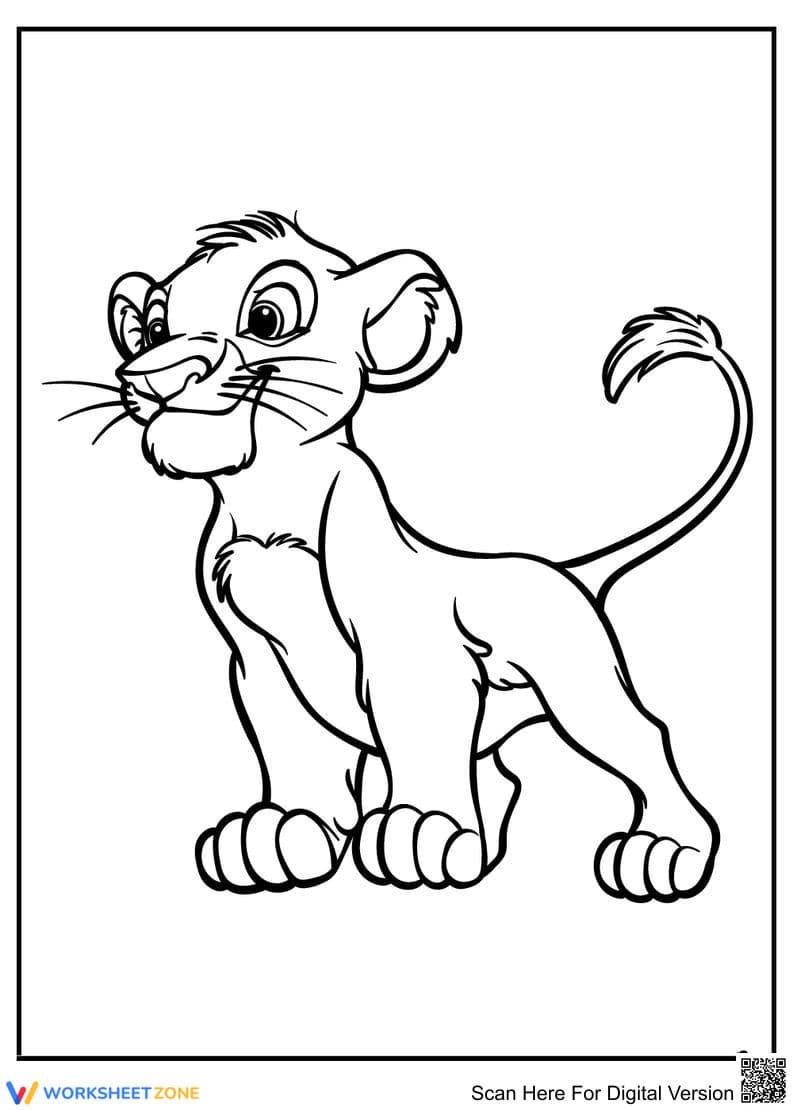

Printable Lion King Simba Coloring Page | Kindergarten
Paste this activity's link or code into your existing LMS (Google Classroom, Canvas, Teams, Schoology, Moodle, etc.).
Students can open and work on the activity right away, with no student login required.
You'll still be able to track student progress and results from your teacher account.
This Kindergarten Lion King coloring worksheet provides a high-interest visual task to help young learners develop essential fine motor control and hand-eye coordination. By engaging with a familiar character like Simba, students practice grip stability and spatial awareness while expressing themselves creatively through color selection and application.
At a Glance
- Grade: Kindergarten · Subject: Arts & Crafts
- Standard:
CCSS.ELA-LITERACY.SL.K.5— Add drawings or visual displays to descriptions to provide additional detail- Skill Focus: Fine motor development
- Format: 1 page · 1 task · No answer key required · PDF
- Best For: Morning work or early finishers
- Time: 15–20 minutes
Inside this resource, you will find a single-page, high-resolution line drawing of Simba from The Lion King. The image features bold, clear outlines designed specifically for early childhood learners who are still mastering the ability to color within lines. There are no complex backgrounds, allowing the student to focus entirely on the central figure and their own artistic choices.
The zero-prep workflow for this worksheet is designed for maximum efficiency in a busy classroom. First, print the single-page PDF in less than 30 seconds. Second, distribute the page along with crayons or colored pencils to your students. Third, review the completed work to observe grip technique and color choice. Total teacher preparation time is under 2 minutes, making it an ideal sub plan addition.
This worksheet aligns with CCSS.ELA-LITERACY.SL.K.5, which encourages students to use visual displays to enhance their communication. While primarily an artistic task, it supports the foundational pre-writing skills necessary for later literacy success. This standard code can be copied directly into lesson plans, IEP goals, or district curriculum mapping tools to ensure all activities are purposeful.
Use this worksheet as a calming transition activity after recess or as a reward for completing primary literacy tasks. It serves as an excellent formative assessment tool; teachers can observe a student's pincer grasp and pressure control during the activity. Expect students to spend approximately 15 to 20 minutes to complete the page with care and attention to detail.
This resource is ideal for Kindergarten students, English Language Learners (ELLs) who benefit from visual-heavy tasks, and students requiring occupational therapy support for fine motor skills. It pairs naturally with a read-aloud session about African animals or a direct instruction lesson on primary and secondary colors using an anchor chart.
Research from Fisher & Frey (2014) emphasizes the importance of visual representation in early childhood development, noting that artistic expression serves as a bridge to formal writing. This Simba coloring page specifically targets the development of the small muscles in the hand, which are critical for the eventual mastery of letter formation. By providing a high-interest subject, the worksheet increases student engagement and time-on-task, which are key predictors of skill acquisition in early learners. The use of familiar media characters can lower the affective filter for students who may feel anxious about more formal academic tasks. This 1-page printable ensures that teachers can provide meaningful, standards-aligned practice without the burden of extensive preparation or complex instructions. It is a reliable tool for supporting the foundational motor skills required by the CCSS.ELA-LITERACY.SL.K.5 standard.


