


























Views
Downloads

Conduction Worksheet | Grade 4 Science Printable Ready
Paste this activity's link or code into your existing LMS (Google Classroom, Canvas, Teams, Schoology, Moodle, etc.).
Students can open and work on the activity right away, with no student login required.
You'll still be able to track student progress and results from your teacher account.
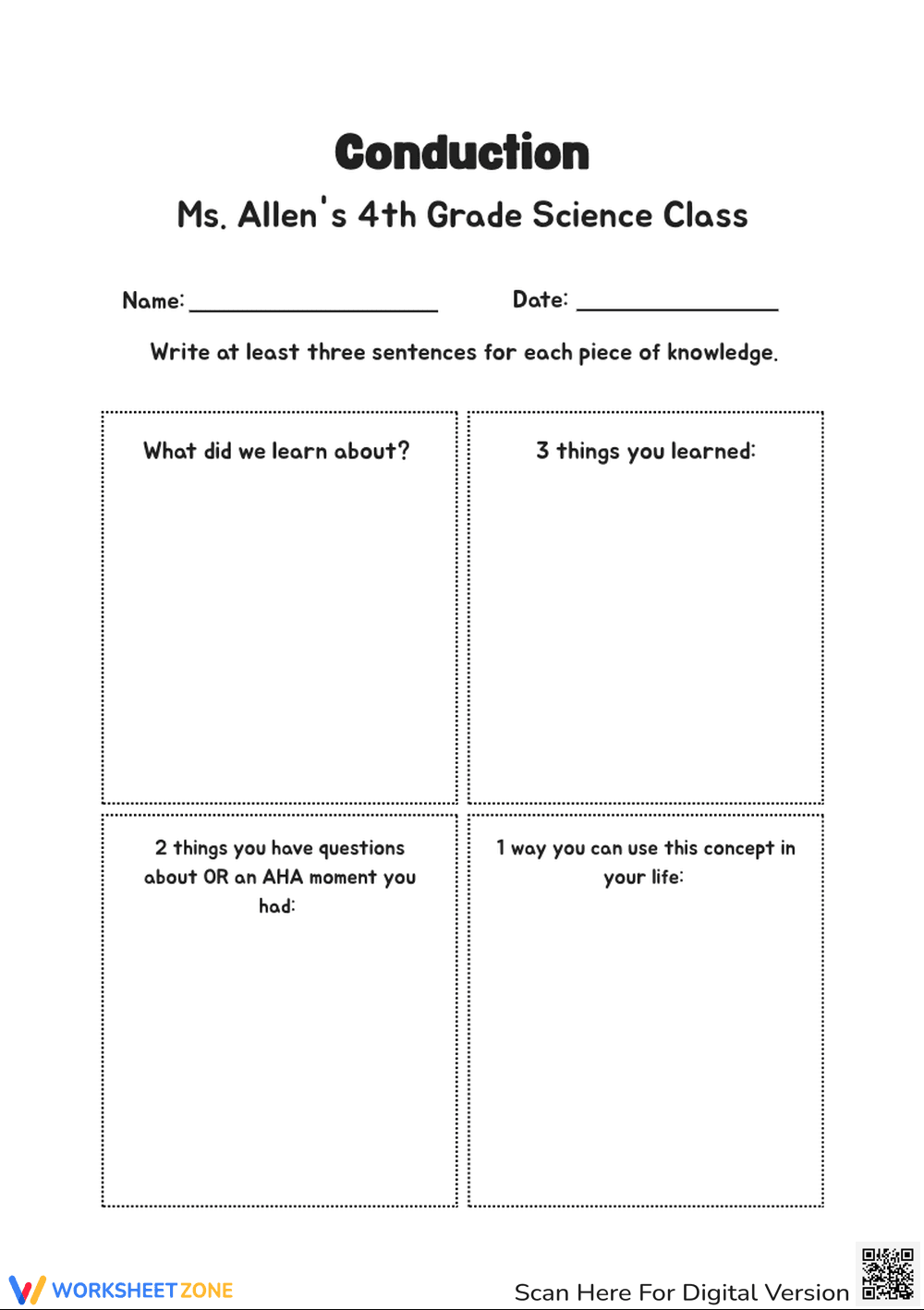
This Grade 4 conduction worksheet serves as a comprehensive reflection tool for students to synthesize their understanding of thermal energy transfer. By requiring multi-sentence responses, it encourages deep processing of scientific concepts rather than rote memorization. Students demonstrate their ability to summarize key facts, identify remaining questions, and connect conduction to real-world applications.
At a Glance
- Grade: 4 · Subject: Science
- Standard:
4-PS3-2— Observe and provide evidence that energy transfers from place to place via heat- Skill Focus: Scientific Reflection & Summarization
- Format: 1 page · 4 prompts · Open-ended · PDF
- Best For: Lesson closure and formative assessment
- Time: 15–20 minutes
This single-page PDF features four distinct reflection quadrants designed to capture the full scope of a student's learning journey. It includes specific prompts for general topic identification, a "3-2-1" style summary of facts and questions, and a dedicated space for real-world application. The layout provides ample writing space with clear instructions to produce at least three sentences per section, ensuring rigorous output.
The workflow for this resource is designed for maximum efficiency in active classrooms. First, print the single-page document (30 seconds). Second, distribute the sheets at the conclusion of a conduction experiment or lecture (1 minute). Finally, review student responses to gauge class-wide comprehension and identify misconceptions (5 minutes). This zero-prep design makes it an ideal candidate for emergency sub plans or spontaneous lesson extensions.
This resource aligns with `4-PS3-2`, which requires students to make observations to provide evidence that energy can be transferred from place to place by heat. By asking students to describe what they learned and how they can use the concept, the worksheet facilitates the "Evidence" portion of the standard. Both standard codes can be copied directly into lesson plans, IEP goals, or district curriculum mapping tools.
Use this worksheet as a formal exit ticket during the last 20 minutes of a science block to assess individual mastery of heat transfer. Alternatively, assign it as a homework reflection after a hands-on conduction lab involving different materials. During completion, circulate the room to observe if students can articulate the difference between conductors and insulators, providing a quick formative check on their conceptual clarity.
This resource is tailored for fourth-grade students exploring physical science and energy. It is particularly effective for learners who benefit from structured writing frames to organize their thoughts. It pairs naturally with a direct instruction lesson on thermal energy or a classroom anchor chart detailing the three types of heat transfer: conduction, convection, and radiation.
According to the RAND AIRS 2024 report, structured reflection in elementary science significantly improves long-term retention of abstract physical concepts like energy transfer. This worksheet addresses the 4-PS3-2 standard by prompting students to articulate the movement of heat through solid materials. By requiring three sentences per prompt, the resource moves beyond simple recall into the territory of scientific explanation, a key component of the NGSS framework. Research from Fisher & Frey (2014) supports the use of such "check for understanding" tools to bridge the gap between guided instruction and independent mastery. Educators can utilize these responses to identify specific gaps in student logic regarding molecular motion and thermal equilibrium. This printable resource provides a standardized method for collecting qualitative data on student progress within the Grade 4 science curriculum, ensuring that every learner can demonstrate their grasp of conduction in a clear, written format.


