


























Views
Downloads

Complete Vector Operations Worksheet | Grade 12 Precalculus
Paste this activity's link or code into your existing LMS (Google Classroom, Canvas, Teams, Schoology, Moodle, etc.).
Students can open and work on the activity right away, with no student login required.
You'll still be able to track student progress and results from your teacher account.
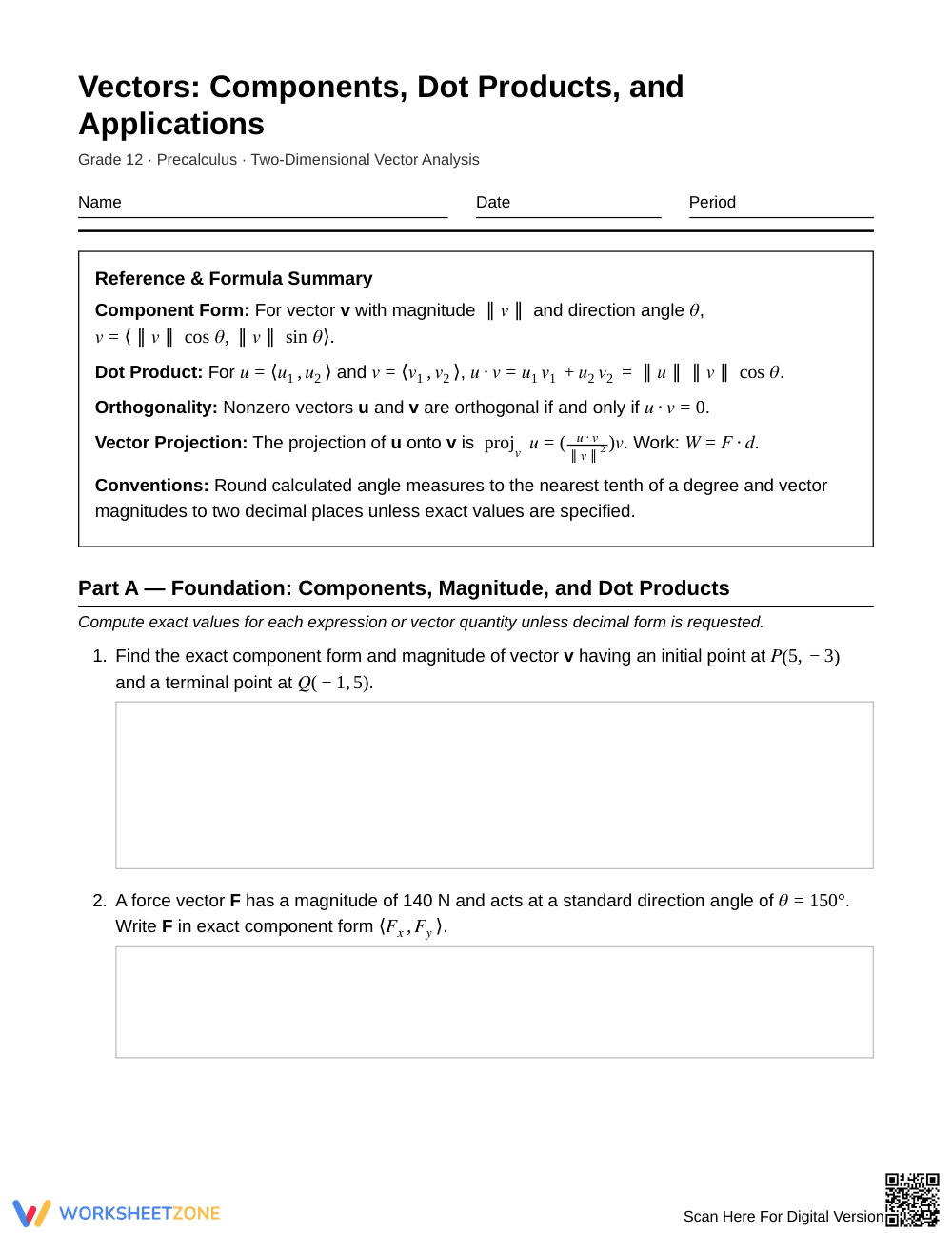
Master two-dimensional vector analysis with this Precalculus worksheet. Students determine vector components, compute dot products, evaluate projections, and solve real-world static equilibrium and velocity problems. This resource transitions high school mathematicians from foundational vector arithmetic to rigorous physical modeling.
At a Glance
- Grade: 12 · Subject: Precalculus
- Standard:
HSN-VM.A.3— Solve velocity and force problems using vector representations- Skill Focus: Vector components, dot products, projections, and equilibrium
- Format: 5 pages · 16 problems · Answer key included · PDF
- Best For: Post-lesson practice and exam review
- Time: 50–75 minutes
What's Inside
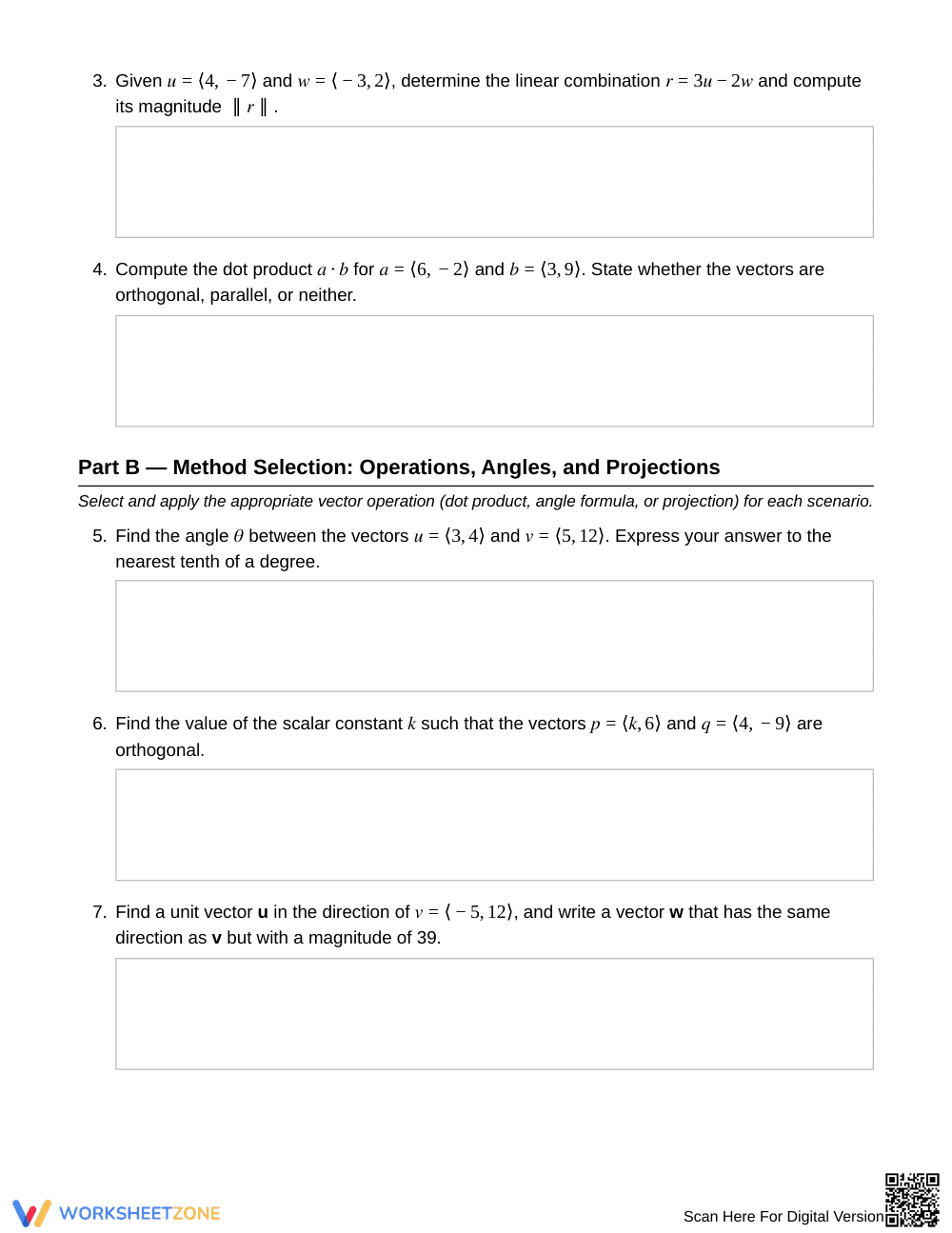
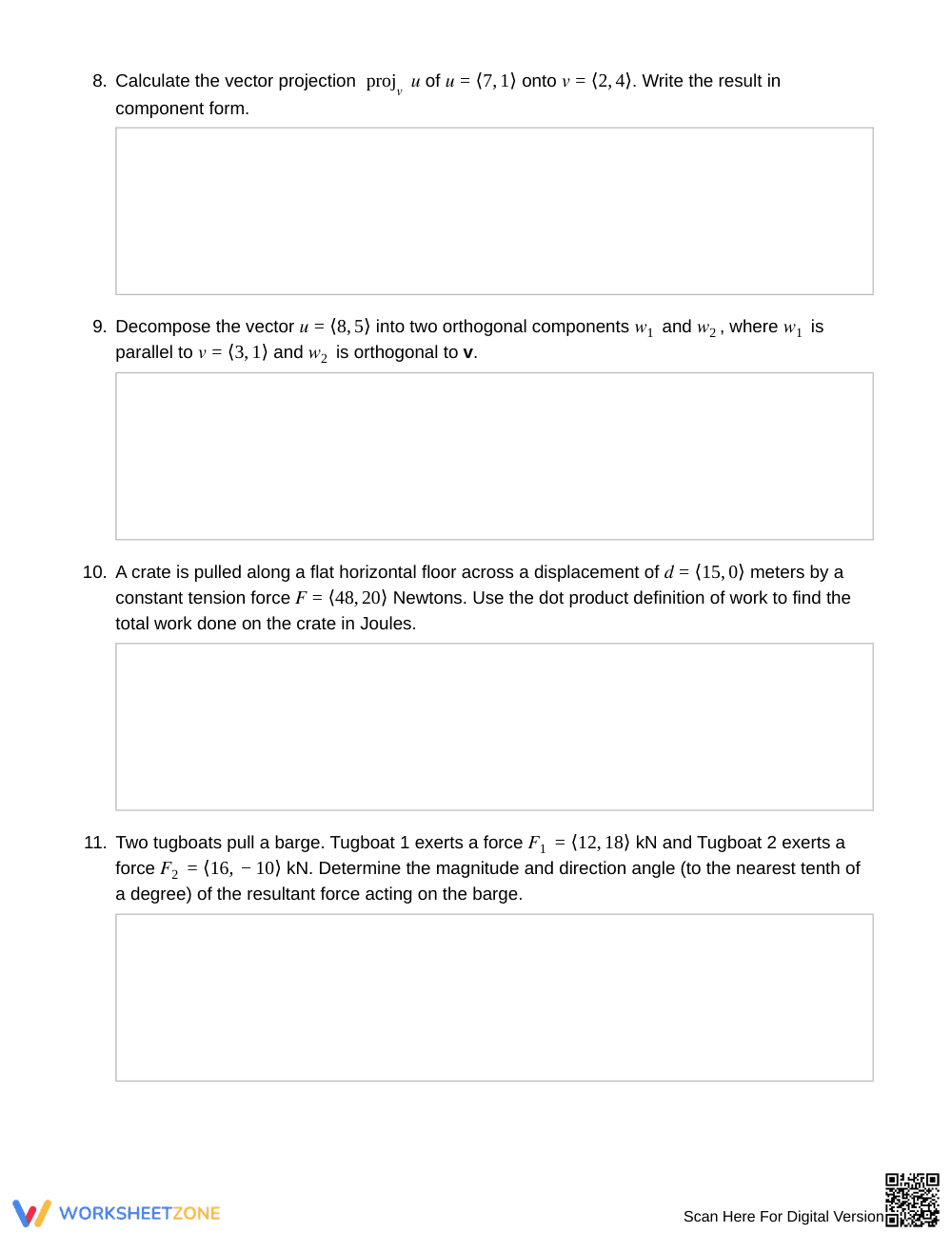
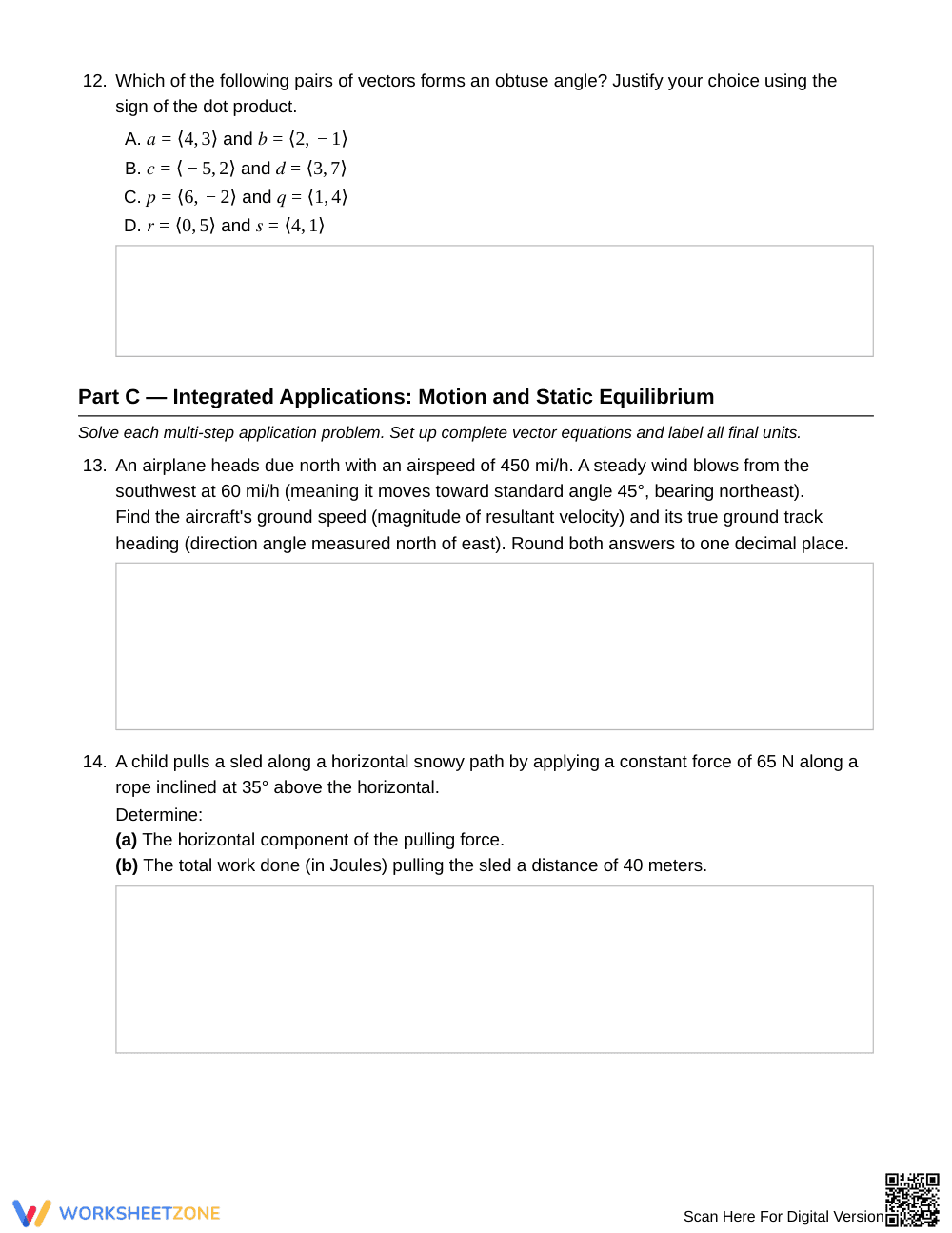
This 5-page PDF features 16 problems across three scaffolded sections, supported by a reference formula box. Tasks cover component forms, orthogonality tests, projections, and applied systems. A full 3-page answer key includes step-by-step vector calculations and exact values.
Skill Progression
- Guided Practice (Part A — 4 problems): Students use formula references to find component forms, resolve directional forces, compute linear combinations, and evaluate basic dot products.
- Supported Practice (Part B — 8 problems): Students find angles, test orthogonality, construct unit vectors, determine vector projections, and calculate work.
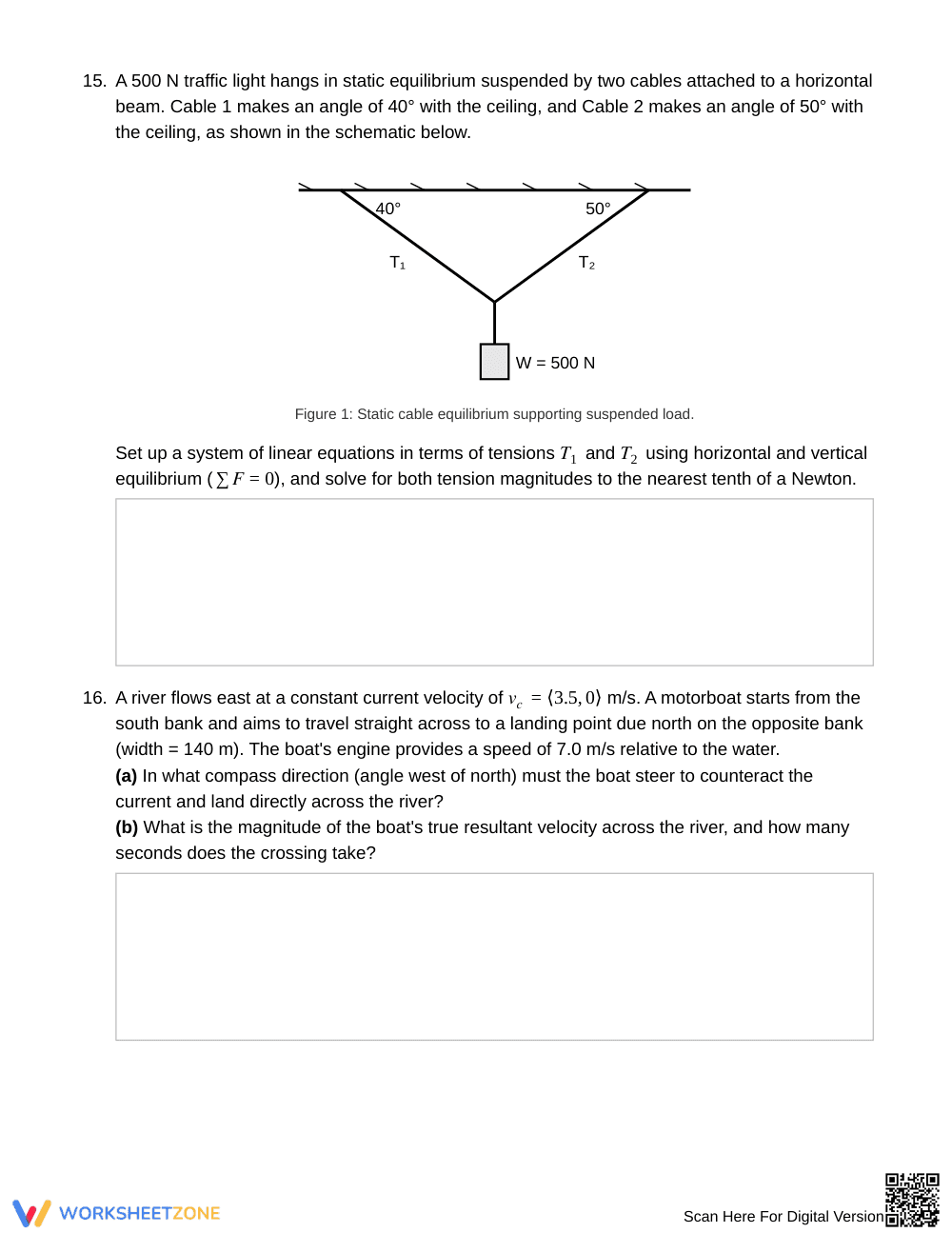
- Independent Practice (Part C — 4 problems): Students model multi-step systems, including wind drift, inclined pulling work, river crossing navigation, and two-cable static equilibrium.
This scaffolded design reflects a gradual-release instructional model from foundational formulas to autonomous modeling.
Standards Alignment
This worksheet aligns to standard HSN-VM.A.3: Solve problems involving velocity and other quantities that can be represented by vectors. It also reinforces HSN-VM.B.4 through vector operations. Both standard codes can be copied directly into lesson plans, IEP goals, or district curriculum mapping tools.
How to Use It
Assign after direct instruction on dot products. Use Parts A and B for collaborative classwork, then assign Part C as an independent capstone. For formative assessment, check dot product sign analysis on obtuse angle problems. Expected completion time is 50 to 75 minutes.
Who It's For
Designed for Grade 12 Precalculus and introductory physics students mastering two-dimensional vectors. Advanced learners solve equilibrium systems independently, while others utilize the formula box. Pair with an equilibrium force anchor chart.
Aligned with standard HSN-VM.A.3, this Precalculus vector analysis worksheet delivers targeted, rigorous practice in computing vector components, evaluating scalar dot products, and resolving multi-step physical forces in two dimensions. By structuring 16 progressive tasks from foundational component conversions to complex static equilibrium and resultant velocity systems, the resource directly supports deep conceptual transfer, geometric reasoning, and advanced algebraic fluency. Grounded in the gradual-release instructional framework documented by Fisher & Frey (2014), the sequence guides Grade 12 students smoothly from structured formula application to autonomous, higher-order mathematical modeling in real-world contexts. The inclusion of an upfront reference formula summary alongside a complete 3-page worked answer key ensures efficient formative assessment, immediate error correction, and actionable feedback, making this publication-ready resource an essential tool for high school mathematics educators preparing students for postsecondary STEM coursework and standards-based mastery.


