


























Views
Downloads



Complete Vector Methods Worksheet | Grade 12 Precalculus
Paste this activity's link or code into your existing LMS (Google Classroom, Canvas, Teams, Schoology, Moodle, etc.).
Students can open and work on the activity right away, with no student login required.
You'll still be able to track student progress and results from your teacher account.
Master vector operations by bridging visual geometry and algebraic precision. This 4-page Precalculus worksheet equips high school seniors to decompose vectors into orthogonal components, perform tip-to-tail additions, and verify resultant magnitudes using trigonometric laws. Students build rigorous mathematical reasoning by contrasting algebraic calculations with geometric constructions across 12 targeted problems.
At a Glance
- Grade: 12 · Subject: Precalculus
- Standard:
HSN-VM.B.4— Add and subtract vectors geometrically and algebraically using components- Skill Focus: Geometric vs. component vector solutions
- Format: 4 pages · 12 problems · Answer key included · PDF
- Best For: Core instruction, small-group intervention, or review
- Time: 45–60 minutes
What's Inside
The resource features a dedicated reference box with standard component formulas, followed by three structured task sections. Students analyze grid-based visual vectors, solve applied real-world static equilibrium and navigation scenarios, and write conceptual justifications for vector subtraction and the Triangle Inequality. A complete 2-page answer key provides step-by-step vector breakdowns, exact radical values, and decimal approximations.
Skill Progression
- Guided Practice (Part A, Items 1–3): Students extract vector components from visual coordinate grids and convert magnitude-direction pairs into exact trigonometric forms with minimal cognitive friction.
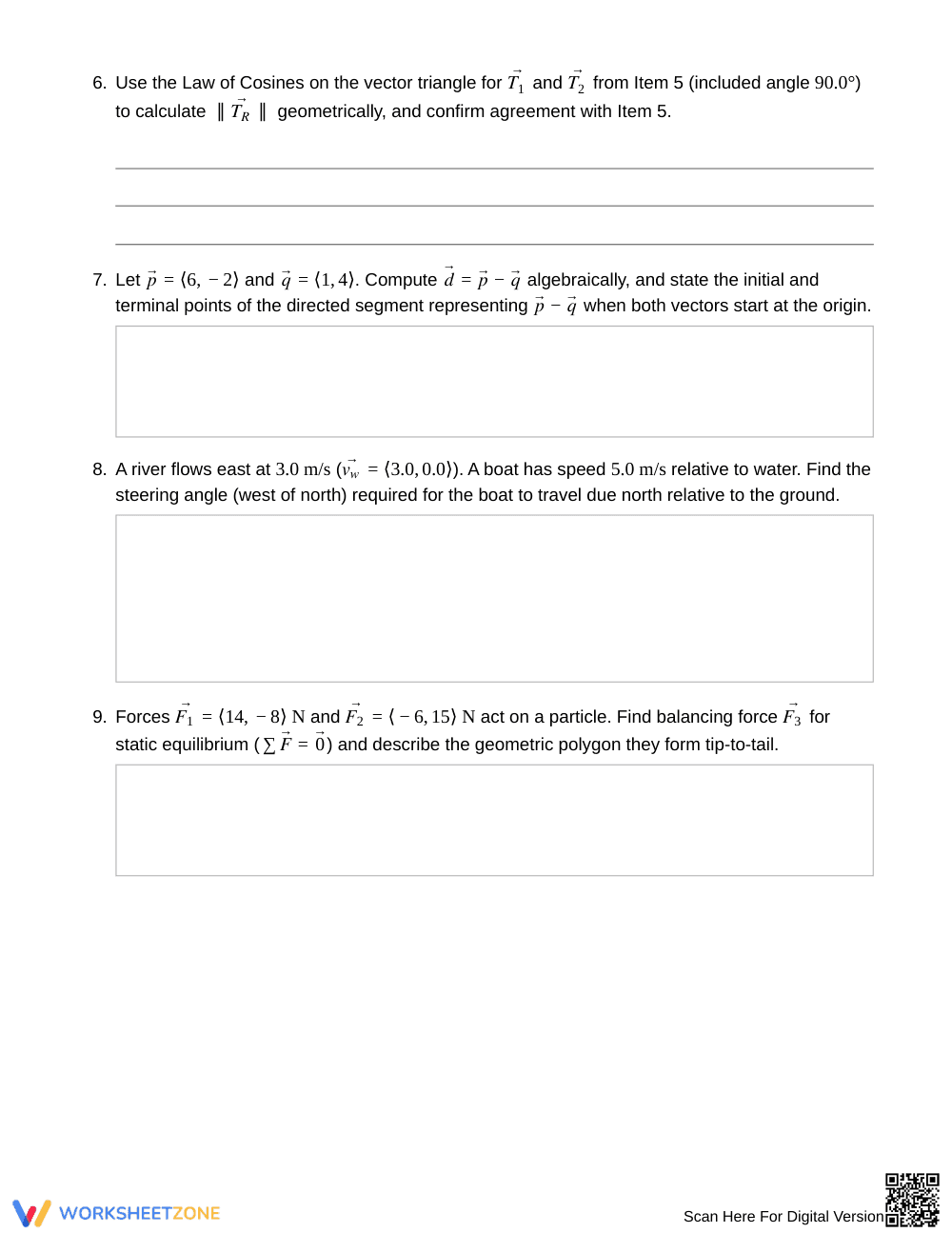
- Supported Practice (Part B, Items 4–9): Learners calculate algebraic vector sums and differences, graph tip-to-tail resultants, and cross-validate resultant magnitudes using the Law of Cosines across static equilibrium and heading scenarios.
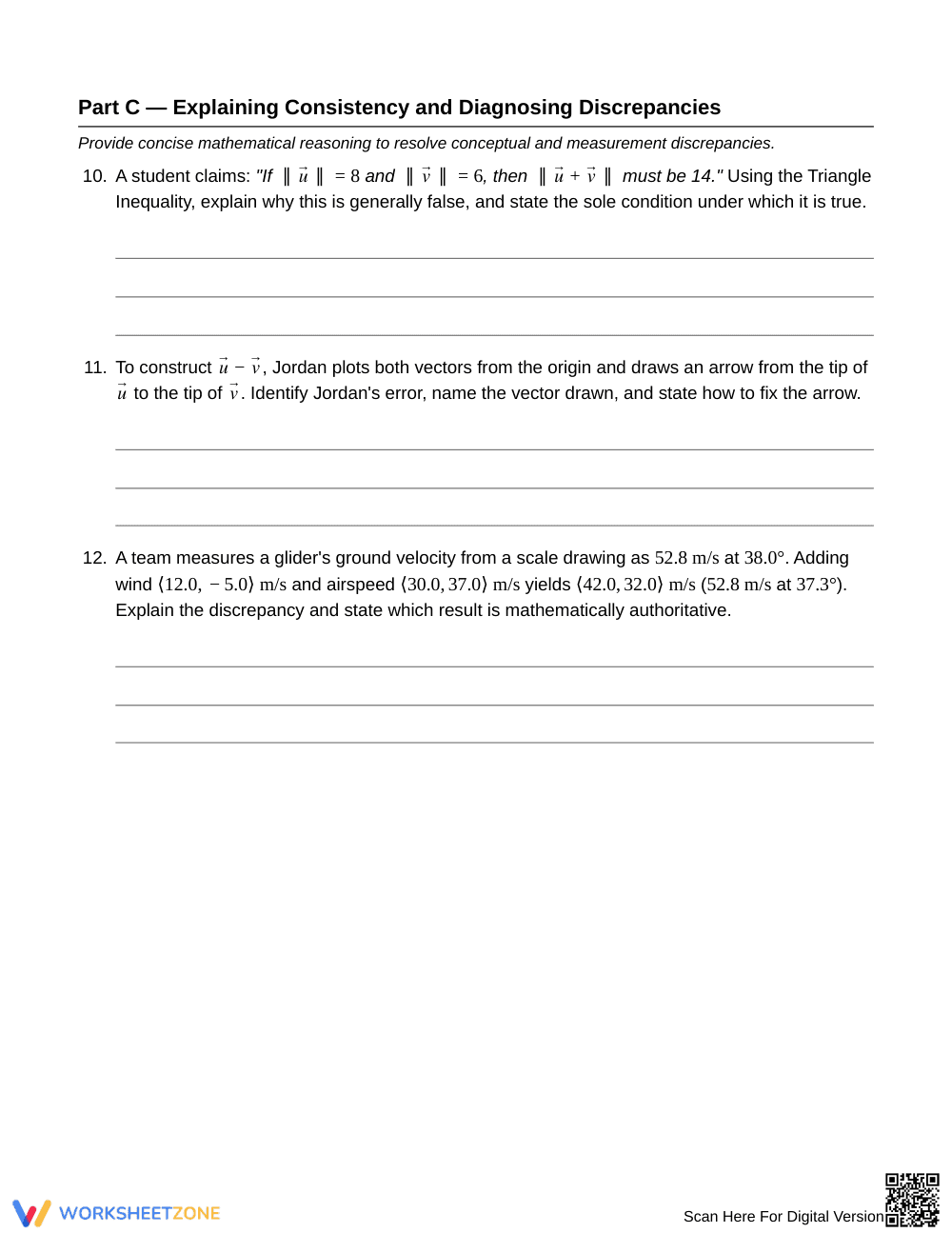
- Independent Practice (Part C, Items 10–12): Students independently analyze error patterns, critique geometric vector subtraction misconceptions, and evaluate measurement discrepancy between scale drawings and analytic sums.
This structured progression leverages an I Do, We Do, You Do gradual-release framework to move students from basic coordinate reading to multi-step analytical synthesis.
Standards Alignment
This worksheet aligns directly to primary standard HSN-VM.B.4: Add and subtract vectors by adding components and representing sums geometrically with the parallelogram or triangle rule. It additionally supports HSN-VM.A.3 through solving applied velocity and force vector problems. Both standard codes can be copied directly into lesson plans, IEP goals, or district curriculum mapping tools.
How to Use It
Deploy this activity during the middle of your vector operations unit after introducing both component decomposition and graphical vector addition. For formative assessment, examine student work on Item 6 to verify whether learners recognize when the Law of Cosines simplifies to the Pythagorean theorem for perpendicular vectors. Allocate 45 to 60 minutes for individual completion or paired partner investigation.
Who It's For
This practice set is designed for Grade 12 Precalculus and introductory Physics students mastering vector mechanics. It supports differentiated learning by providing reference formulas for struggling students while offering rigorous proof-based discrepancies for advanced learners. Pair this printable with an interactive vector grid demonstration or trigonometric reference chart.
According to Fisher & Frey (2014), structured instructional sequences that deliberately juxtapose multiple representations facilitate deeper conceptual transfer than isolated algorithmic practice. This Grade 12 Precalculus resource operationalizes standard HSN-VM.B.4 by requiring students to compute vector addition algebraically through component summation while simultaneously constructing tip-to-tail geometric models on coordinate grids. By directly reconciling analytic calculations with visual constructions, learners identify the mathematical source of graphical measurement errors and resolve persistent vector subtraction misconceptions. The rigorous three-part architecture transitions high school seniors from foundational magnitude-angle conversions to advanced equilibrium modeling, ensuring measurable gains in spatial reasoning and algebraic fluency across 12 focused tasks.


