


























Views
Downloads

Complete Two-Condition Expressions Worksheet | Grade 6 Math
Paste this activity's link or code into your existing LMS (Google Classroom, Canvas, Teams, Schoology, Moodle, etc.).
Students can open and work on the activity right away, with no student login required.
You'll still be able to track student progress and results from your teacher account.
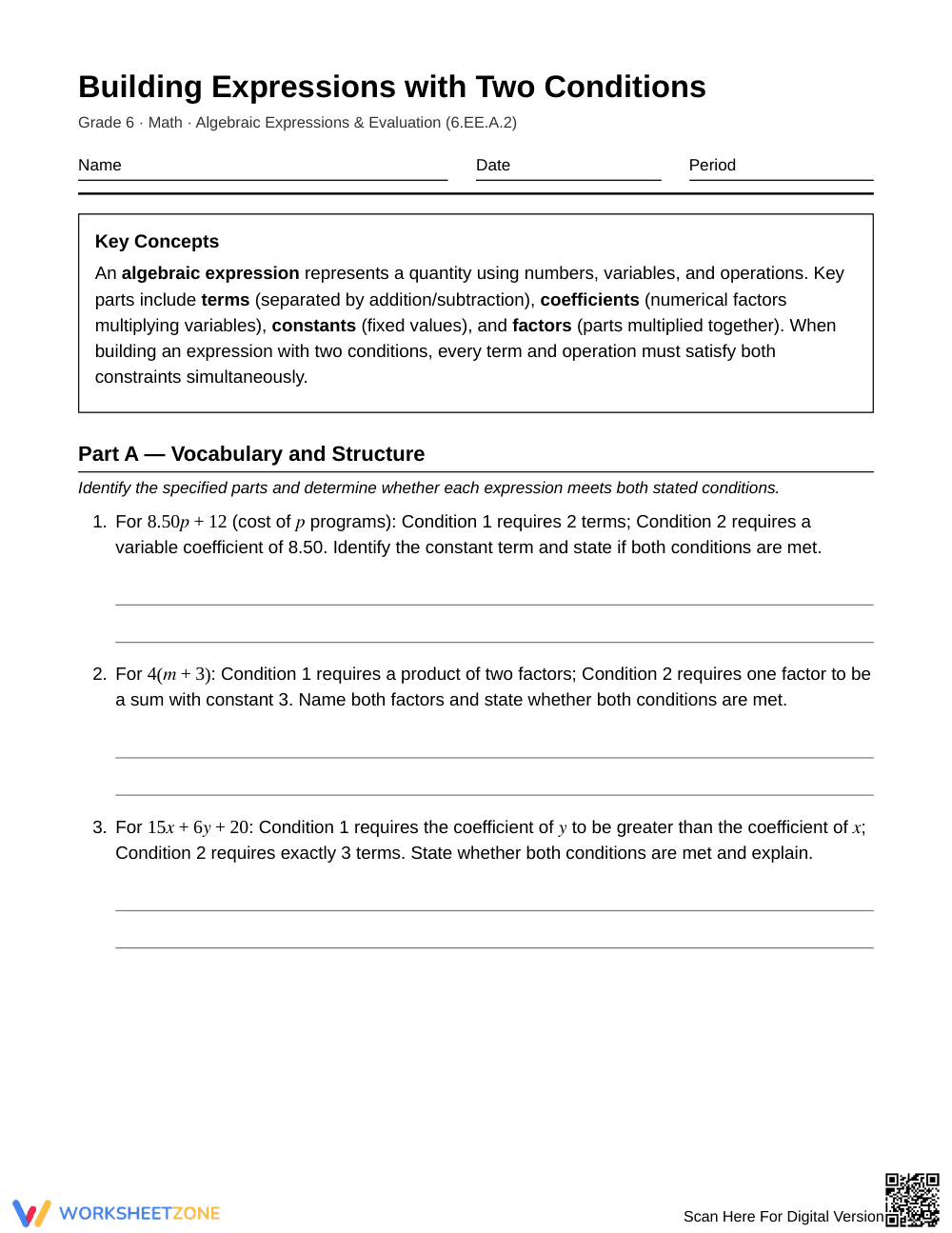
This Grade 6 algebra worksheet trains students to write, analyze, and evaluate algebraic expressions that satisfy two simultaneous mathematical constraints. Learners identify coefficients, terms, and constants before building expressions from contextual word problems. Through 18 targeted tasks, students solidify their structural understanding of variables to achieve algebraic fluency.
At a Glance
- Grade: 6 · Subject: Math
- Standard:
6.EE.A.2— Write, read, and evaluate expressions in which letters stand for numbers- Skill Focus: Constructing expressions meeting two simultaneous mathematical conditions
- Format: 5 pages · 18 problems · Complete 2-page answer key included · PDF
- Best For: Post-instruction practice and skill reinforcement
- Time: 40–50 minutes total completion time
What's Inside
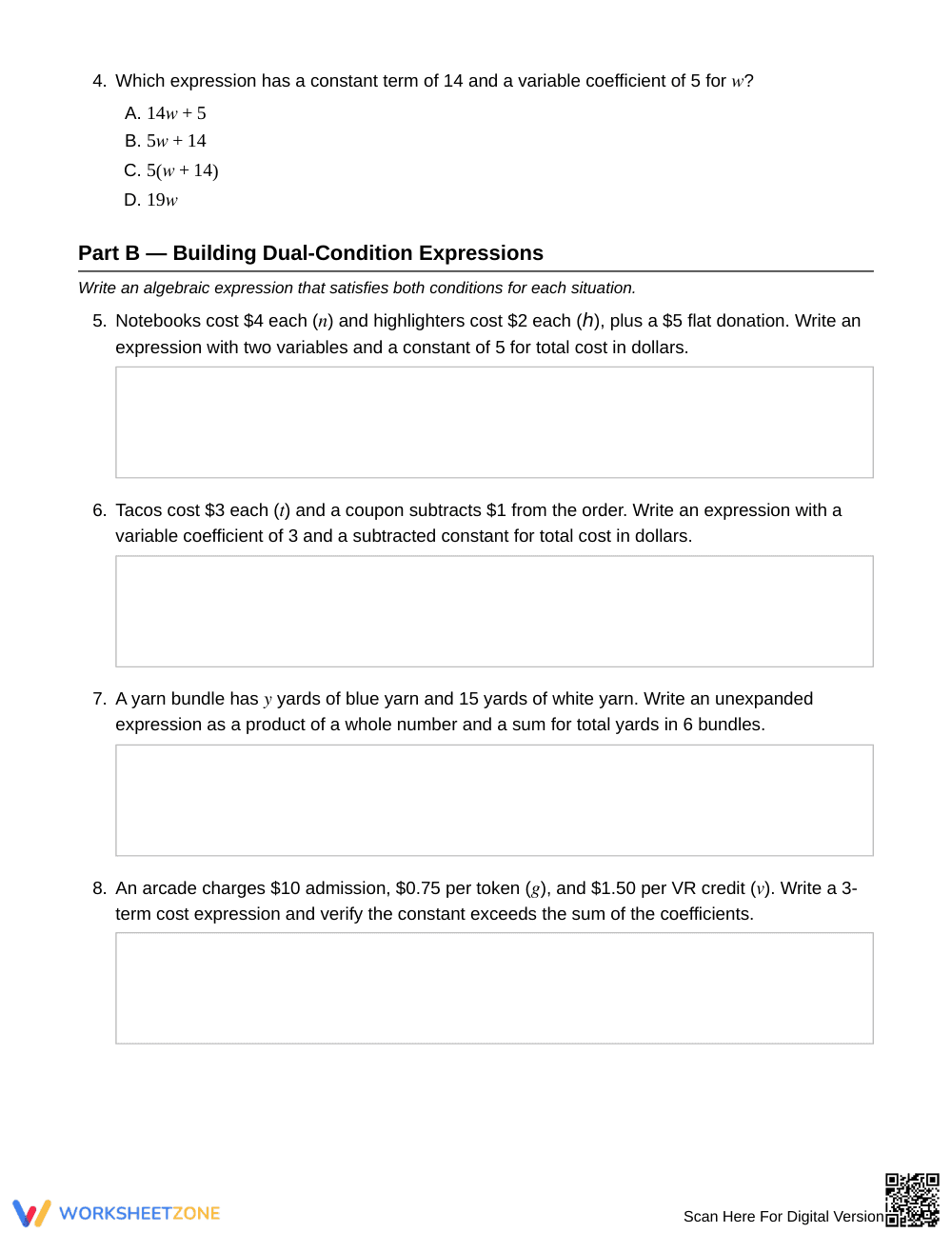
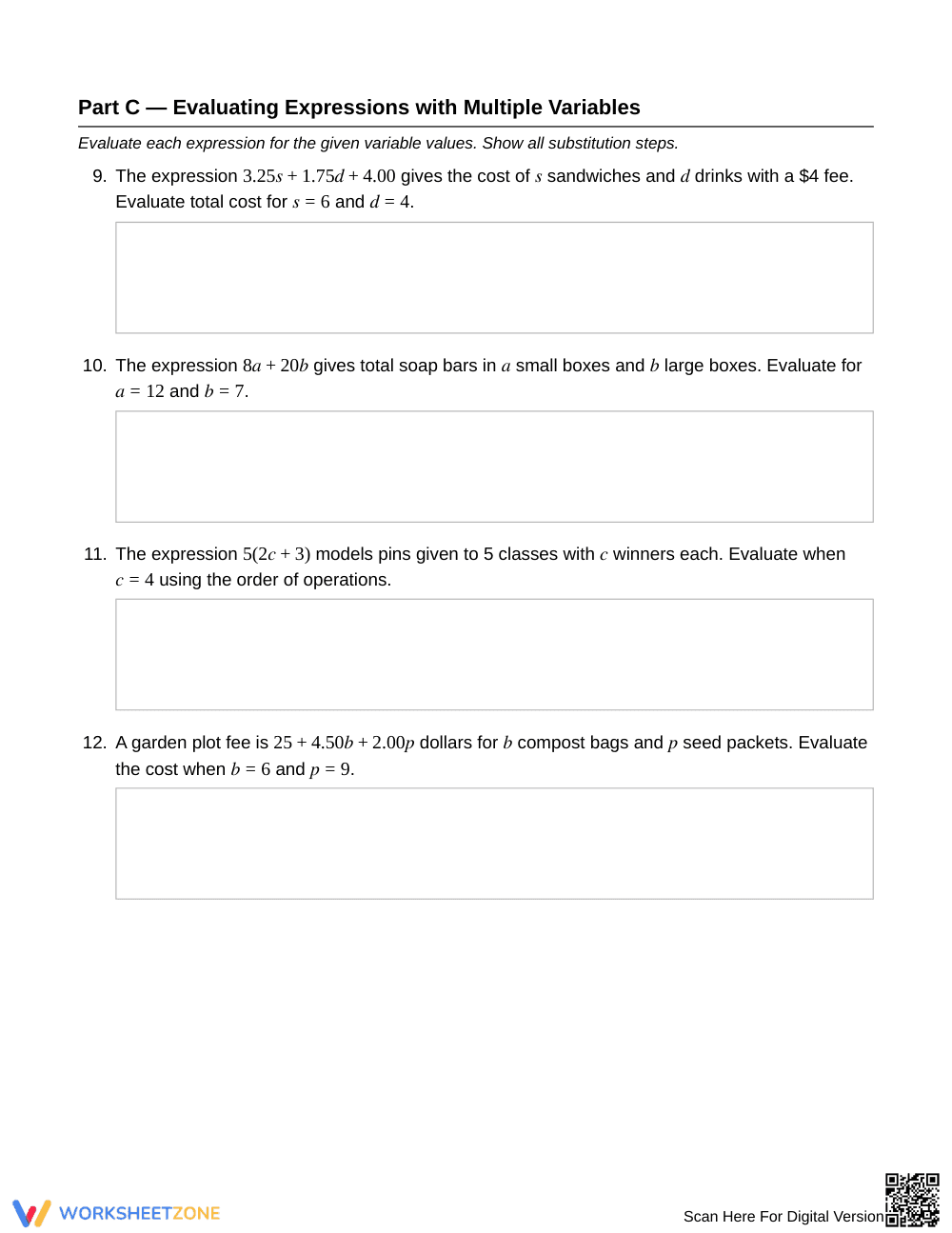
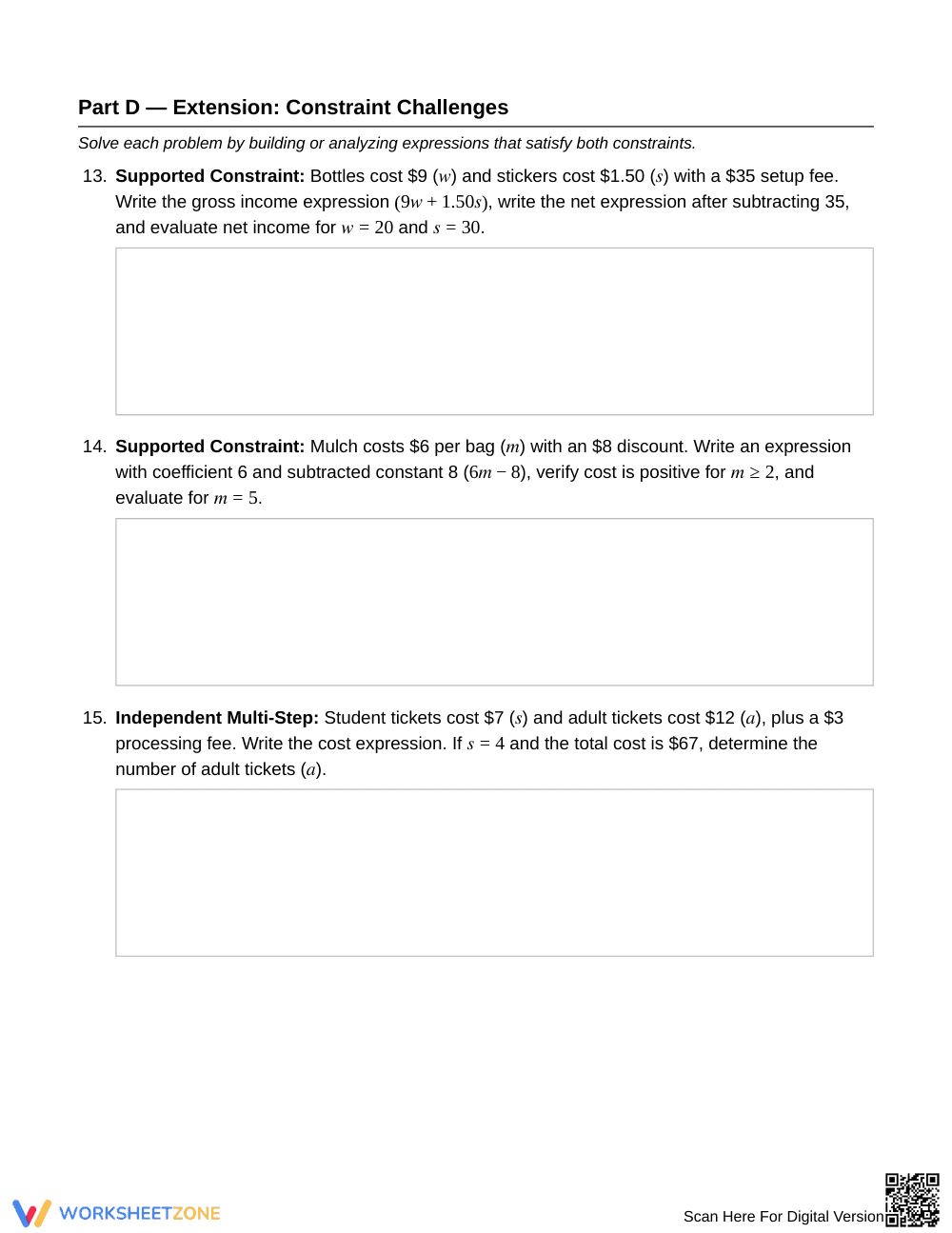
This 5-page packet features 18 structured problems across four sections, plus a 2-page answer key. An opening reference box reviews terms, coefficients, constants, and factors. Students identify components, construct contextual expressions from word problems, evaluate multi-variable scenarios, and solve non-routine constraint tasks.
Skill Progression
- Guided practice (Part A, 4 problems): Students identify parts of expressions and verify two given conditions.
- Supported practice (Parts B & C, 8 problems): Learners write dual-condition expressions from word problems and evaluate multi-variable expressions.
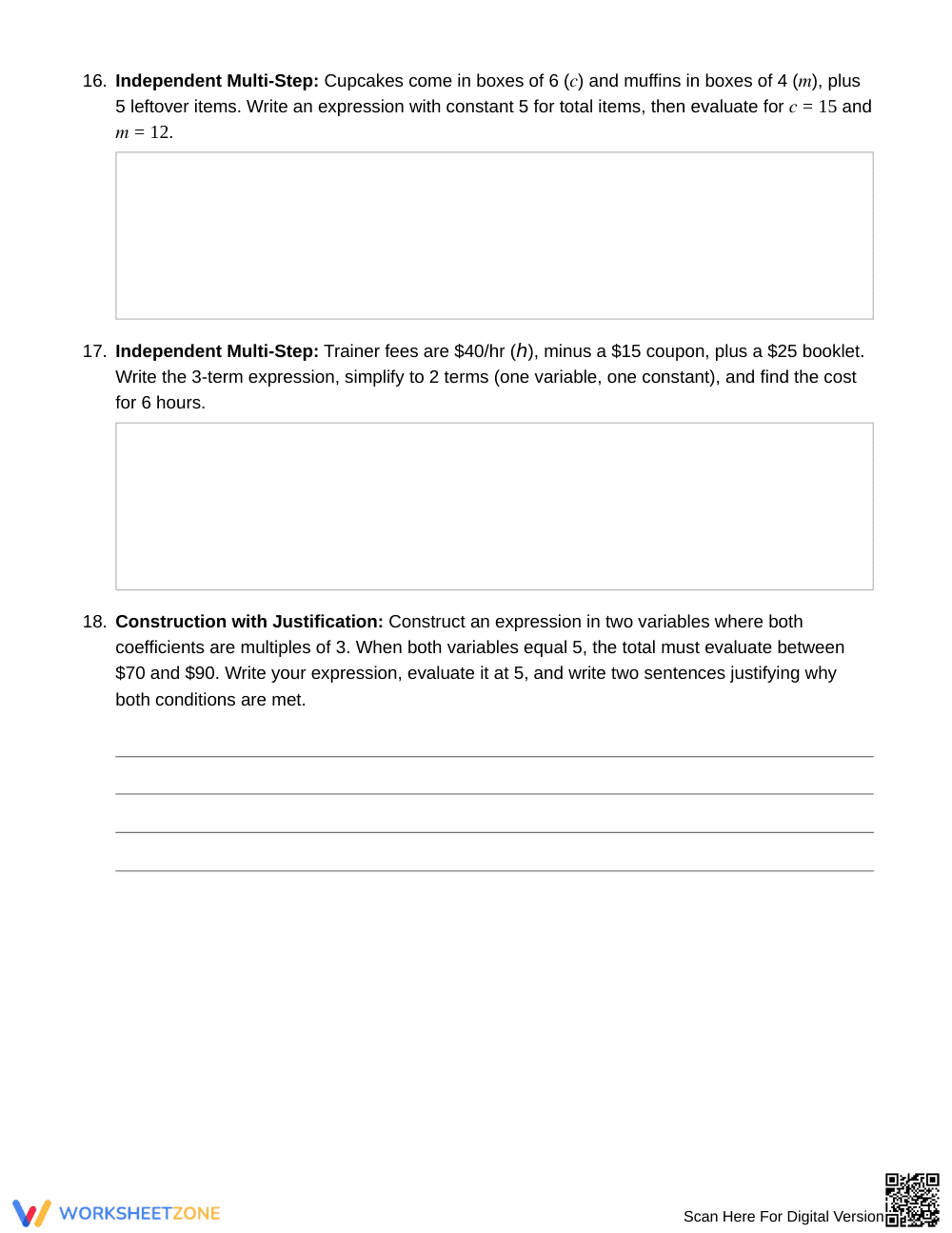
- Independent practice (Part D, 6 problems): Students solve multi-step constraint challenges and construct original justified expressions.
This sequence implements the gradual-release framework, guiding students from structural analysis to independent modeling.
Standards Alignment
This worksheet aligns to 6.EE.A.2: Write, read, and evaluate expressions in which letters stand for numbers. Modeling tasks also reinforce supporting standard 6.EE.B.6 by using variables to represent quantities in real-world contexts. Both standard codes can be copied directly into lesson plans, IEP goals, or district curriculum mapping tools.
How to Use It
Assign this resource during class practice after direct instruction on algebraic terms, or use Parts C and D as an independent formative check. During Part B, check whether students correctly distinguish subtracted constants from negative coefficients. The 18 problems require 40 to 50 minutes to finish.
Who It's For
Designed for Grade 6 math classrooms, this resource also supports Grade 5 enrichment and Grade 7 intervention. Structural prompts assist emerging bilingual students and striving learners, while Part D provides rigorous extensions. Pair this worksheet with an algebraic vocabulary anchor chart during initial instruction.
According to research on explicit instruction by Fisher & Frey (2014), structured practice that moves systematically from foundational vocabulary analysis to open-ended mathematical modeling substantially improves conceptual retention for middle school mathematics students. This Grade 6 worksheet directly supports standard 6.EE.A.2 by guiding learners to write, interpret, and evaluate algebraic expressions under two simultaneous mathematical constraints. By requiring students to identify coefficients, constant terms, and factors within real-world contexts, the material bridges concrete arithmetic with formal algebraic reasoning. Students verify multi-condition rules through guided structural tasks, substitute rational values to evaluate multi-variable expressions, and construct original expressions requiring written mathematical justification. The sequenced gradual-release architecture ensures students build procedural fluency while developing precise mathematical communication. Consequently, educators can reliably integrate this 18-problem practice set to diagnose misconceptions, reinforce variable notation, and measure student progress toward rigorous algebraic standards during regular instruction or targeted intervention blocks.


