




























Views
Downloads


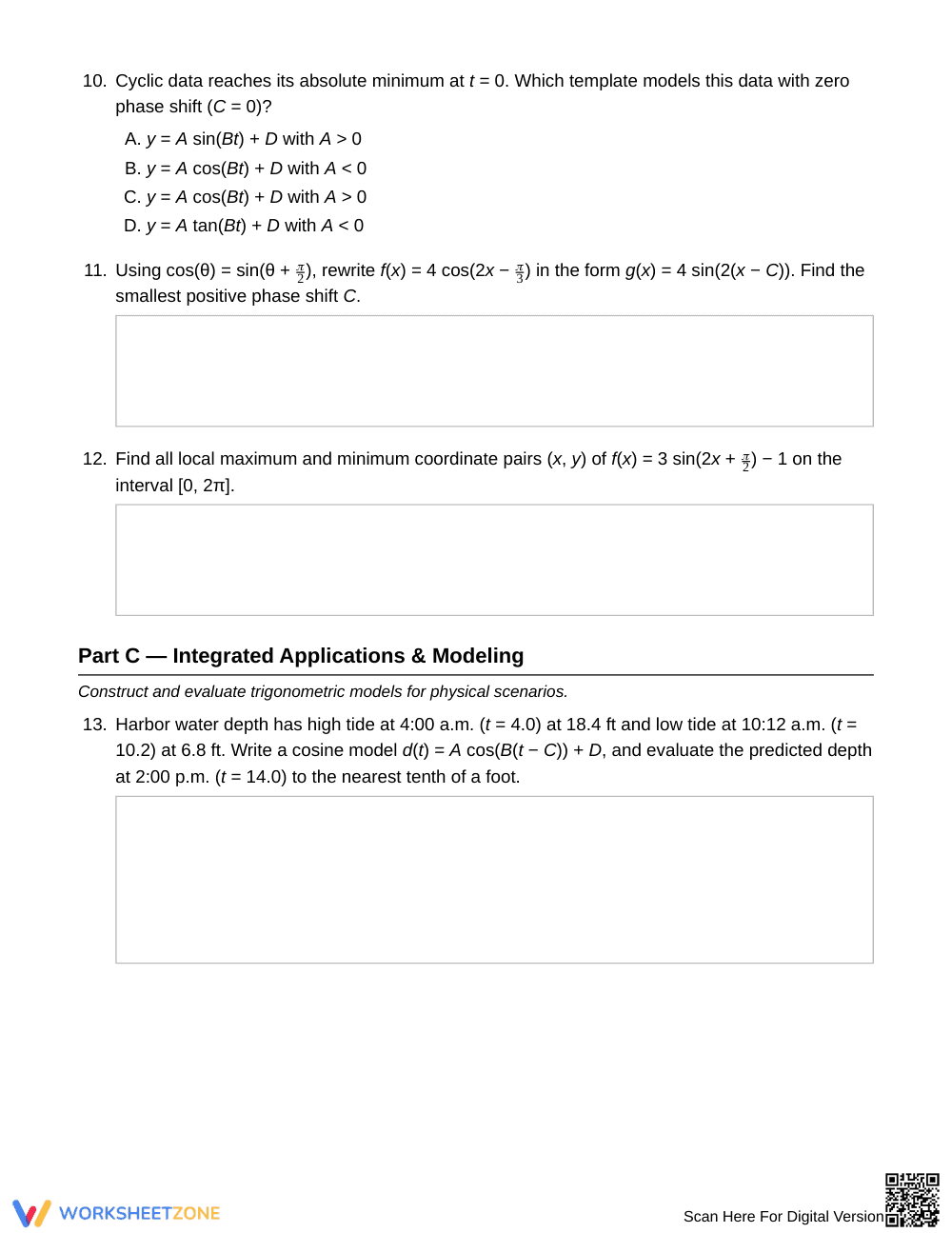


Complete Trig Graphs Worksheet | Grade 12 Precalculus

Paste this activity's link or code into your existing LMS (Google Classroom, Canvas, Teams, Schoology, Moodle, etc.).
Students can open and work on the activity right away, with no student login required.
You'll still be able to track student progress and results from your teacher account.
Mastering transformed trigonometric functions requires analyzing periodic behaviors across multiple representations. This worksheet provides high school seniors with rigorous analytical practice, guiding them from identifying amplitude, period, midline, and asymptotes to formulating algebraic models for cyclical phenomena like tidal shifts and rotating beacons.
At a Glance
- Grade: 12 · Subject: Precalculus
- Standard: Model periodic phenomena and graph transformed trigonometric functions
- Skill Focus: Mix Sine, Cosine, and Tangent Features
- Format: 5 pages · 16 problems · Answer key included · PDF
- Best For: Periodic modeling and graph analysis
- Time: 60–75 minutes
Across five pages, this resource delivers 16 multi-step problems organized by cognitive demand. A concise parameter box introduces formulas for sinusoidal and tangent functions. Students work through graphical interpretation, multiple-choice prompts, argument factorization, and contextual modeling, supported by a full two-page answer key with exact radian solutions.
Skill Progression:
- Guided practice (Part A, Problems 1–4): Feature identification using parameter formulas to find amplitude, period, phase shifts, and vertical asymptotes.
- Supported practice (Part B, Problems 5–12): Transformation analysis requiring argument factorization, phase-shift comparisons, domain-range determination, and dual curve fitting.
- Independent practice (Part C, Problems 13–16): Contextual modeling tasks where students construct and evaluate cosine and tangent models for physical systems.
This sequence reinforces independence through a gradual-release model moving from procedural identification to autonomous application.
Standards Alignment:
This worksheet aligns directly with high school standards requiring students to graph trigonometric functions showing period, midline, and amplitude, and model periodic phenomena with specified trigonometric parameters. Both standard descriptions can be copied directly into lesson plans, IEP goals, or district curriculum mapping tools.
How to Use It:
Assign this activity after direct instruction on horizontal scaling and tangent asymptotes. Complete Part A together, assign Part B for partner practice, and reserve Part C for summative assessment. Formatively check whether students factor the frequency parameter before identifying horizontal phase shifts. Completion takes 60 to 75 minutes.
Who It's For:
This resource serves Grade 12 Precalculus students preparing for calculus. For differentiation, have struggling students highlight midlines and amplitude bounds before calculating periods, while advanced learners construct alternate equations. Pair this worksheet with dynamic graphing software to visualize parameter shifts in real time.
According to research on effective instructional design by Fisher & Frey (2014), purposeful scaffolding through guided, collaborative, and independent phases significantly increases student retention and fluency in complex multi-step mathematical procedures. By moving systematically from foundational parameter extraction to open-ended physical modeling, this 16-problem precalculus resource exemplifies gradual-release architecture. Students analyze transformed trigonometric graphs, calculate precise periods and vertical asymptotes, and construct functional equations representing real-world periodic phenomena such as harbor tides, Ferris wheel heights, and rotational sweeps. The deliberate progression from reference-aided parameter identification to unassisted modeling ensures that Grade 12 learners develop rigorous conceptual understanding alongside analytical calculation skills. Consequently, this five-page instructional worksheet bridges abstract trigonometric function transformations with applied calculus readiness, providing secondary math educators with reliable evidence of student mastery in graphing and interpreting periodic functions across diverse contexts.


