


























Views
Downloads
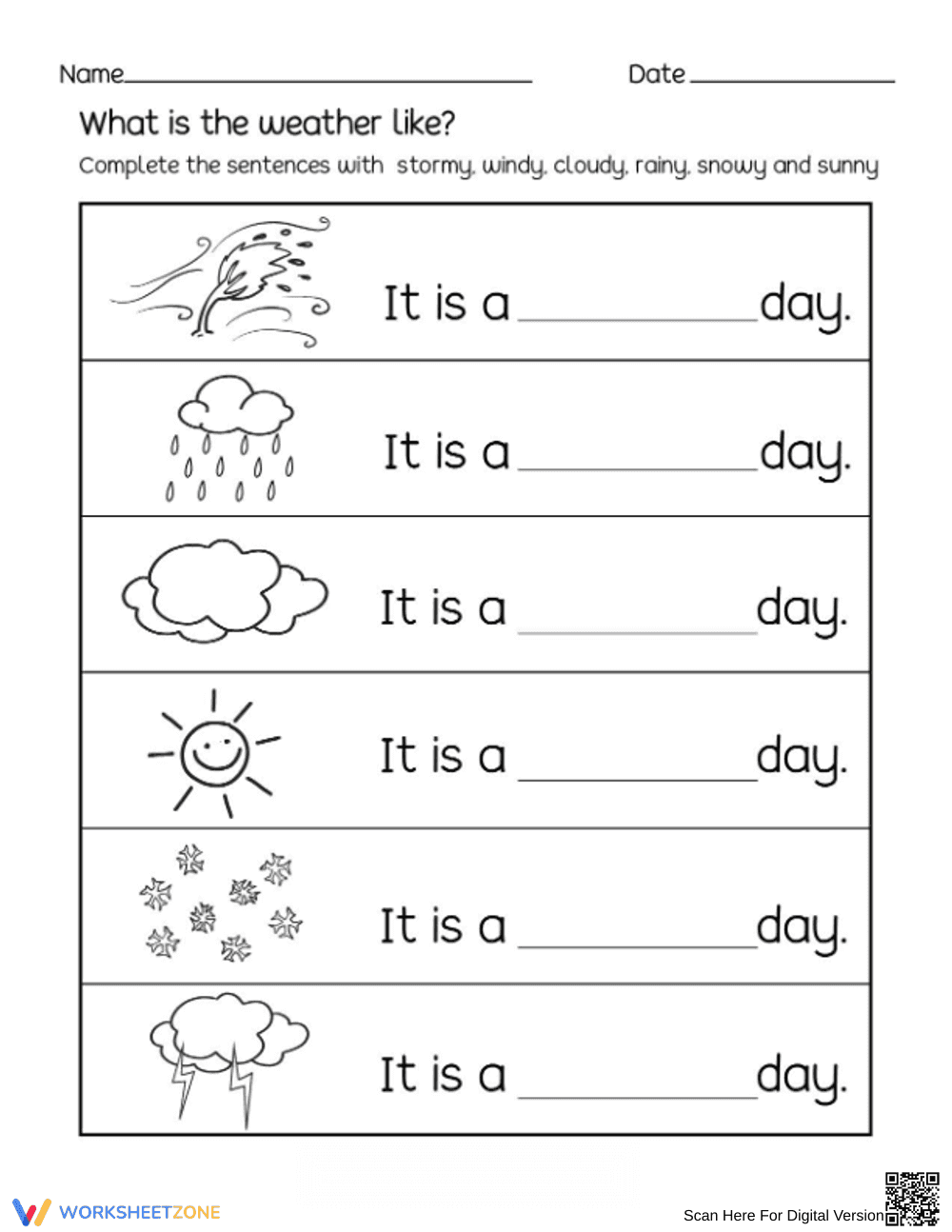

Essential Kindergarten Weather Worksheet | Printable PDF
Paste this activity's link or code into your existing LMS (Google Classroom, Canvas, Teams, Schoology, Moodle, etc.).
Students can open and work on the activity right away, with no student login required.
You'll still be able to track student progress and results from your teacher account.
This Kindergarten science worksheet helps early learners identify and describe different weather patterns using visual cues and vocabulary. By matching weather icons to descriptive sentences, students develop the foundational observational skills required to understand their environment. This activity provides a structured way for children to express their daily observations of the world around them.
At a Glance
- Grade: Kindergarten · Subject: Science
- Standard:
K-ESS2-1— Use observations of local weather conditions to describe patterns over time- Skill Focus: Weather vocabulary and visual identification
- Format: 1 page · 6 problems · Answer key included · PDF
- Best For: Daily weather observation and vocabulary practice
- Time: 5–10 minutes
Inside this resource, you will find a single-page worksheet featuring six distinct weather scenarios. Each task includes a clear, recognizable icon—such as a sun, snow clouds, or a lightning bolt—paired with a simple sentence starter: "It is a ________ day." Students utilize the provided word bank containing terms like stormy, windy, cloudy, rainy, snowy, and sunny to complete each sentence accurately.
The zero-prep workflow for this resource allows teachers to integrate science into their busy schedules effortlessly. First, print the required number of copies for your class in approximately 30 seconds. Second, distribute the worksheets during your morning meeting or science block; the clear layout ensures students can begin working with minimal verbal instruction. Finally, review the answers as a group to reinforce phonetic sounds and weather concepts in under 2 minutes.
This resource is directly aligned to the Next Generation Science Standard K-ESS2-1, which requires students to use and share observations of local weather conditions to describe patterns. By identifying specific weather types like rain, snow, and sun, students practice the descriptive language necessary for more complex atmospheric observations. This standard code can be copied directly into lesson plans, IEP goals, or district curriculum mapping tools.
Use this worksheet as a formative assessment after a group discussion about the morning's weather. Alternatively, it serves as an excellent independent center activity where students can practice handwriting while reinforcing scientific terminology. A quick observation tip: watch for students who can correctly identify the symbols but struggle with the vocabulary spelling, as this indicates a need for targeted literacy support.
This resource is designed for Kindergarten students but is also appropriate for Pre-K learners or English Language Learners (ELL) who need visual support to master basic environmental adjectives. It pairs naturally with a daily weather anchor chart or a read-aloud session featuring weather-themed informational texts to provide a comprehensive learning experience.
According to the RAND AIRS 2024 analysis, providing early learners with structured visual scaffolds significantly improves their retention of domain-specific vocabulary in the natural sciences. This worksheet implements those findings by pairing high-contrast weather icons with simple, repetitive sentence frames that reduce cognitive load while maximizing engagement. By focusing on the K-ESS2-1 standard, the activity ensures that students are not just memorizing words but are learning to observe and describe weather patterns in a scientifically relevant manner. The use of clear icons for stormy, windy, and sunny conditions allows for immediate visual processing, which is crucial for developing the observational habits required for future inquiry-based learning. Educators can rely on this resource as a consistent tool for building foundational literacy within the science curriculum, ensuring all students have the linguistic tools to describe the world they see every day.


