




























Views
Downloads
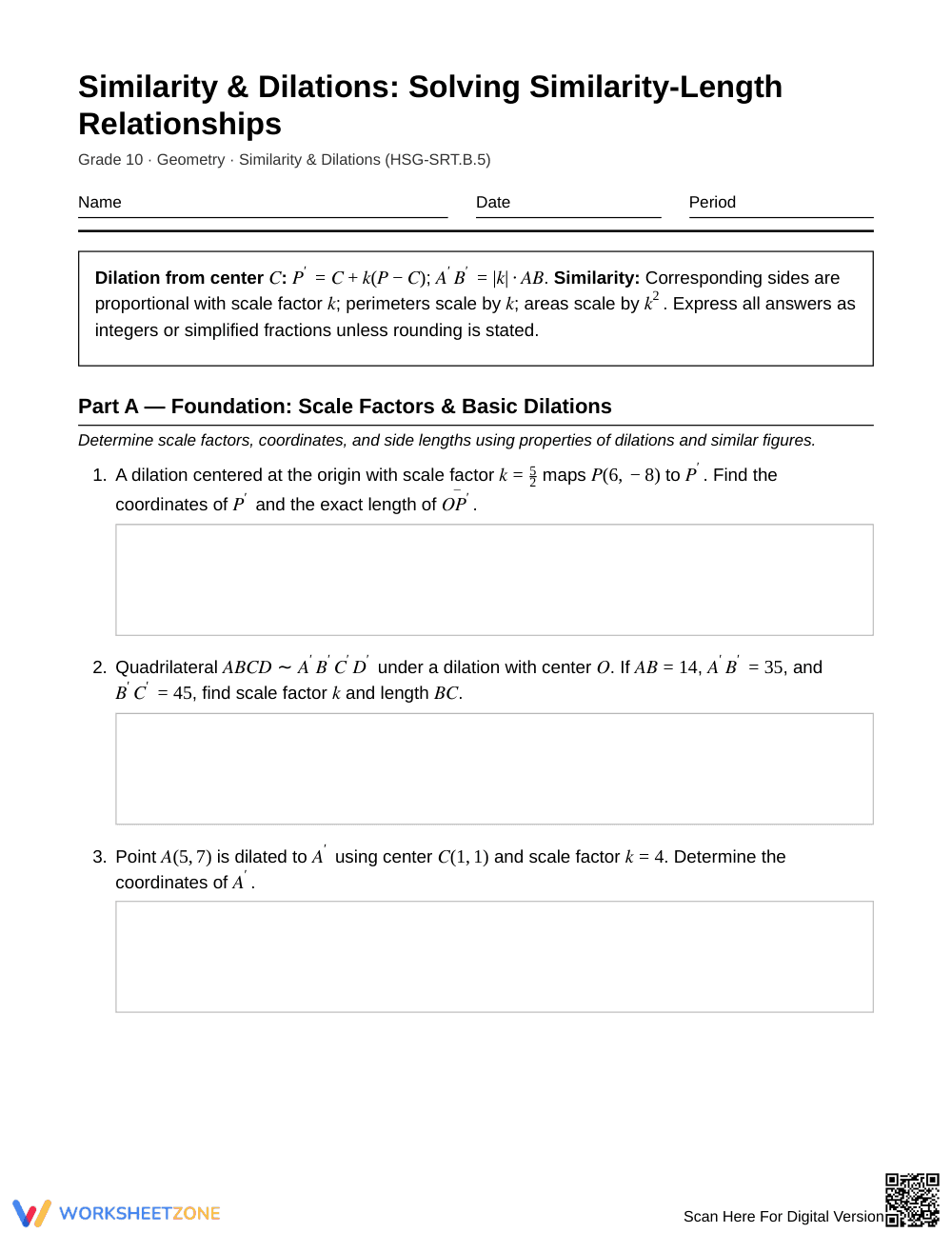
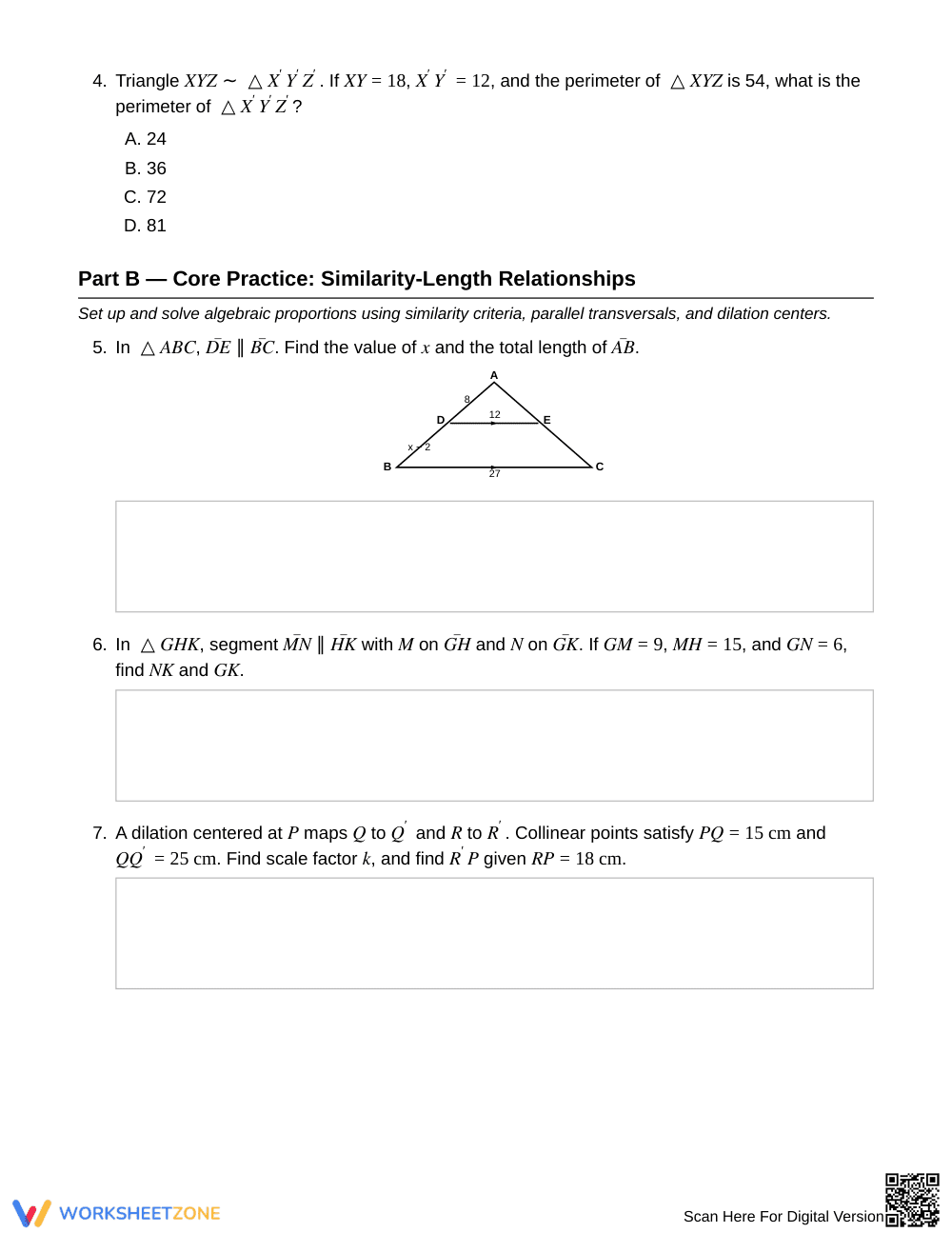
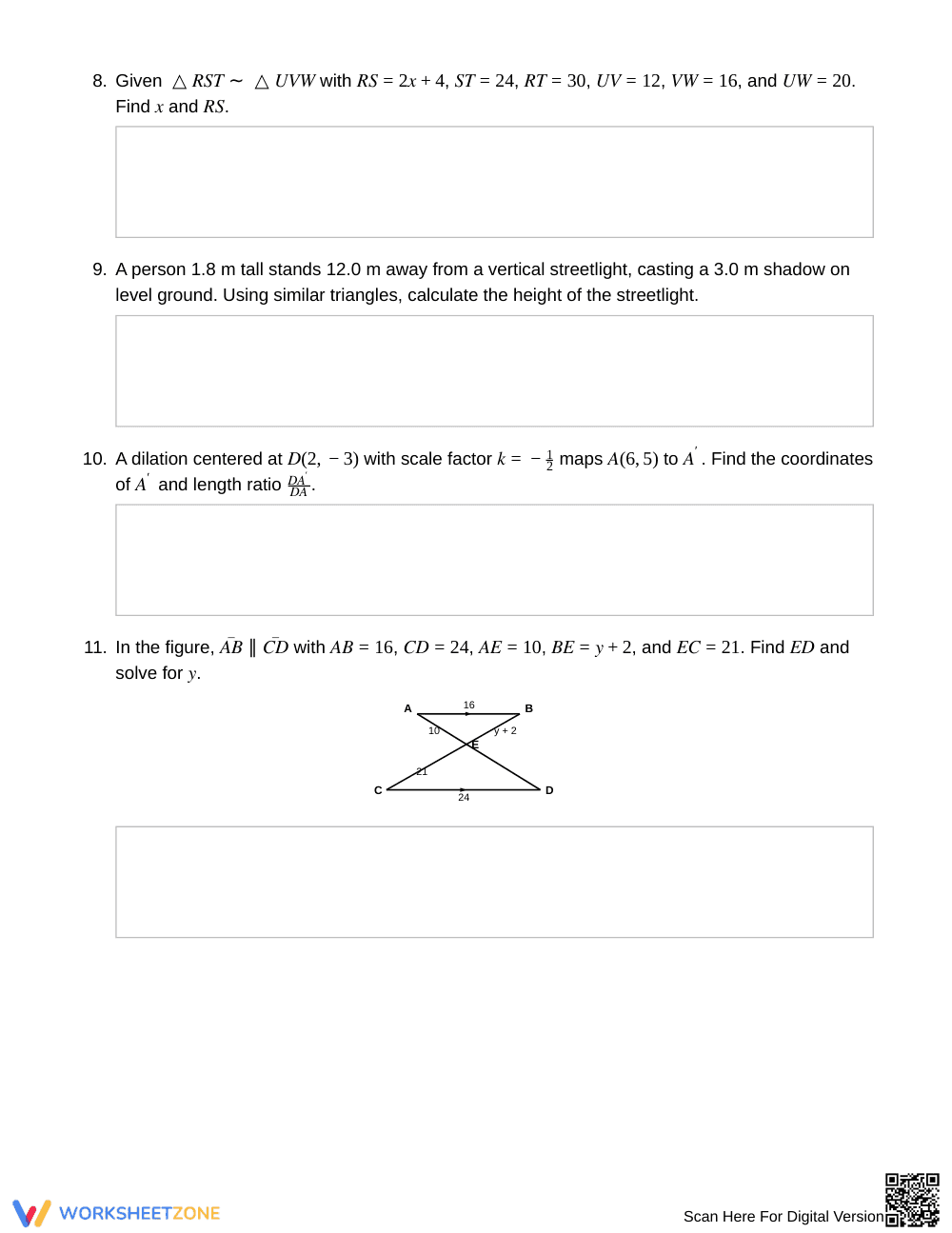
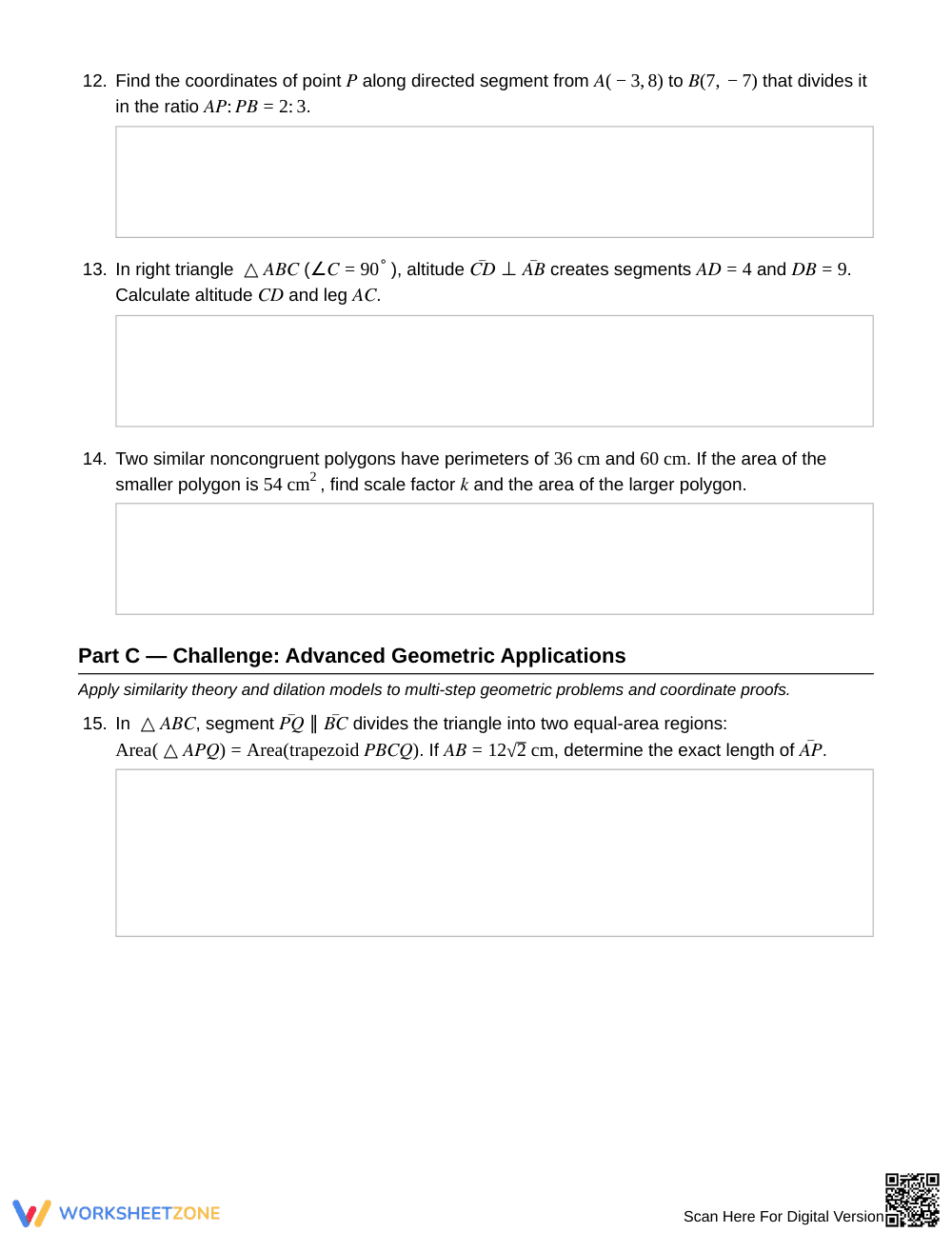

Complete Similarity-Length Worksheet | Grade 10 Geometry

Paste this activity's link or code into your existing LMS (Google Classroom, Canvas, Teams, Schoology, Moodle, etc.).
Students can open and work on the activity right away, with no student login required.
You'll still be able to track student progress and results from your teacher account.
This Grade 10 geometry worksheet strengthens geometric reasoning by guiding students to calculate unknown segment lengths using similarity ratios and dilation scale factors. High school learners apply algebraic proportions to parallel transversals, coordinate dilations, and right-triangle altitudes, establishing fluency with scale factors and proportional reasoning across 18 rigorous problems.
At a Glance
- Grade: 10 · Subject: High School Geometry
- Standard:
HSG-SRT.B.5— Use congruence and similarity criteria to solve problems and prove relationships in geometric figures- Skill Focus: Solving Similarity-Length Relationships and Dilation Proportions
- Format: 5 pages · 18 structured problems · 3-page complete answer key included · PDF
- Best For: Geometry skill reinforcement, intervention, and assessment prep
- Time: 45–60 minutes
What's Inside
Spanning five pages, this resource features a reference formula box, 18 mathematical tasks, and a complete three-page answer key. Students examine origin-centered and arbitrary dilation centers, parallel transversals, right-triangle altitude proportions, and perimeter-to-area scaling. Built-in scaffolds include coordinate notation reminders and geometric diagrams depicting parallel lines and intersecting segments.
Skill Progression
- Guided practice (Part A, Problems 1–4): Establishes basic dilation formulas, coordinate mapping, and perimeter ratios with constant scale factors and direct computational prompts.
- Supported practice (Part B, Problems 5–14): Introduces intermediate geometric proportions, such as side-splitter theorems, shadow measurements, right-triangle altitude relations, and directed segment partitions.
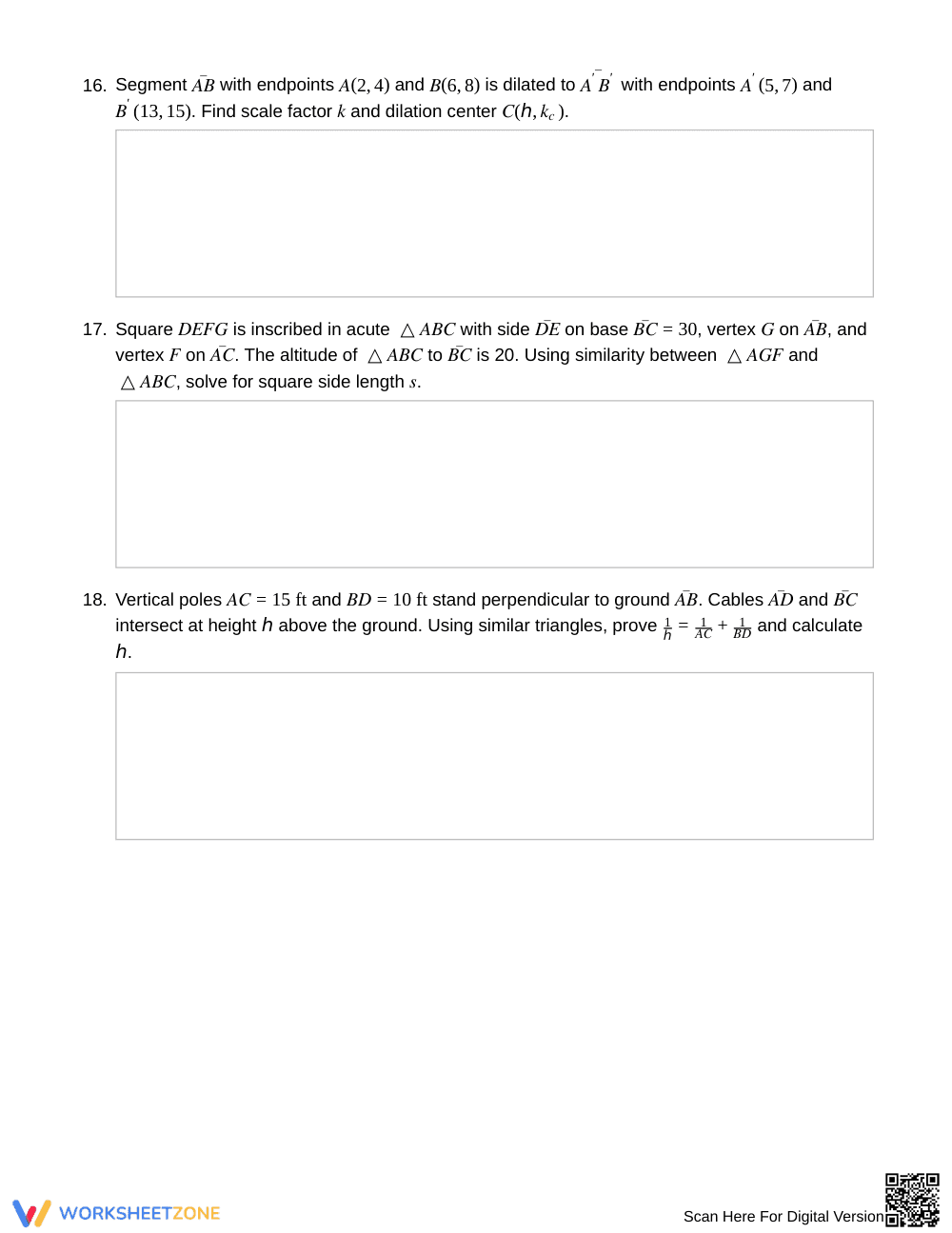
- Independent practice (Part C, Problems 15–18): Demands rigorous multi-step reasoning, requiring students to solve area bisectors, inscribed polygon side lengths, and algebraic proofs of intersecting cable heights.
This sequential design reflects the gradual-release model, moving students smoothly from initial procedural understanding to autonomous geometric problem-solving.
Standards Alignment
The primary focus of this worksheet aligns with HSG-SRT.B.5: "Use congruence and similarity criteria for triangles to solve problems and to prove relationships in geometric figures." Students additionally draw upon supporting standard HSG-SRT.A.2 by verifying geometric similarity through dilations and establishing proportionality among corresponding sides. Both standard codes can be copied directly into lesson plans, IEP goals, or district curriculum mapping tools.
How to Use It
Assign this worksheet following direct instruction on similarity criteria and dilation equations. Use Part A for guided warm-up practice, Part B for partner problem sets, and Part C for extension. During practice, monitor whether students correctly square the scale factor when calculating polygon areas. High school classes typically complete the 18 exercises within 45 to 60 minutes.
Who It's For
This resource is designed for Grade 10 Geometry students learning similarity proofs and dilation coordinates. Its tiered structure supports standard classes, honors extension, and intervention for students needing practice with algebraic proportions. Pair this worksheet with a coordinate dilation anchor chart to reinforce foundational formulas.
According to instructional research on structured cognitive progression by Fisher & Frey (2014), student mastery of abstract geometric reasoning accelerates when analytical tasks scaffold systematically from direct procedural execution to complex multi-step modeling. This Grade 10 geometry resource operationalizes that evidence-based architecture across 18 rigorously sequenced problems aligned to Common Core standard HSG-SRT.B.5. By guiding learners through similarity-length relationships, the worksheet builds essential fluency in applying similarity criteria, dilation scale factors, and geometric mean theorems to solve proportional lengths in intersecting figures and similar triangles. High school students transition from straightforward coordinate mapping to sophisticated algebraic proofs involving inscribed polygons, perimeter scaling, and area ratios, solidifying foundational geometric competencies. Secondary teachers gain an authentic, research-backed instructional tool that promotes conceptual understanding, strengthens spatial visualization, and prepares diverse learners for advanced trigonometry and standardized mathematics assessments.


