




























Views
Downloads




Complete Similarity Criteria Worksheet | Grade 10 Geometry

Paste this activity's link or code into your existing LMS (Google Classroom, Canvas, Teams, Schoology, Moodle, etc.).
Students can open and work on the activity right away, with no student login required.
You'll still be able to track student progress and results from your teacher account.
Mastering triangle similarity criteria and dilations is essential for high school geometry. This 16-problem worksheet guides Grade 10 students through identifying AA, SAS, and SSS similarity, calculating scale factors, and solving coordinate and geometric application problems. Students build procedural fluency and geometric justification across three structured sections.
At a Glance
- Grade: 10 · Subject: Geometry
- Standard:
HSG-SRT.B.5— Use similarity criteria for triangles to solve problems and prove geometric relationships- Skill Focus: Similarity criteria and scale factor reasoning
- Format: 5 pages · 16 problems · Answer key included · PDF
- Best For: Mid-unit practice or test review
- Time: 45–60 minutes
What's Inside
This 5-page resource features 16 geometry problems across three scaffolded sections, supported by a reference box with dilation formulas and similarity theorems. Tasks progress from ratio statements to non-origin coordinate dilations and indirect measurement. A complete 2-page answer key provides step-by-step calculations and visual justifications for rapid grading.
Skill Progression
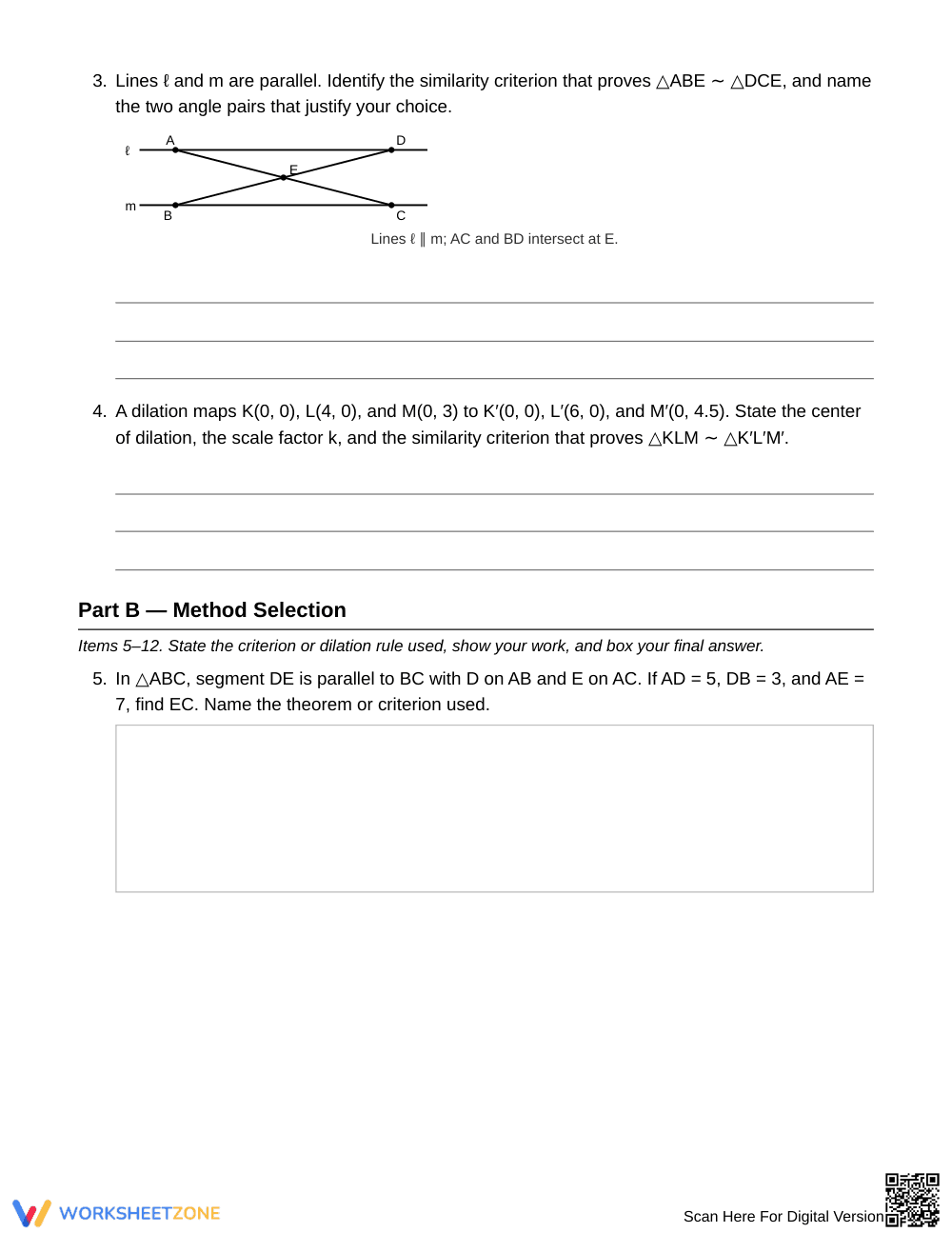
- Guided practice (Items 1–4): Foundation tasks establish similarity statements, scale factor identification from segments, parallel line angle proofs, and origin dilations.
- Supported practice (Items 5–12): Method selection problems require students to apply AA, SAS, or SSS criteria, find non-origin dilation coordinates, and relate area ratios to linear scale factors.
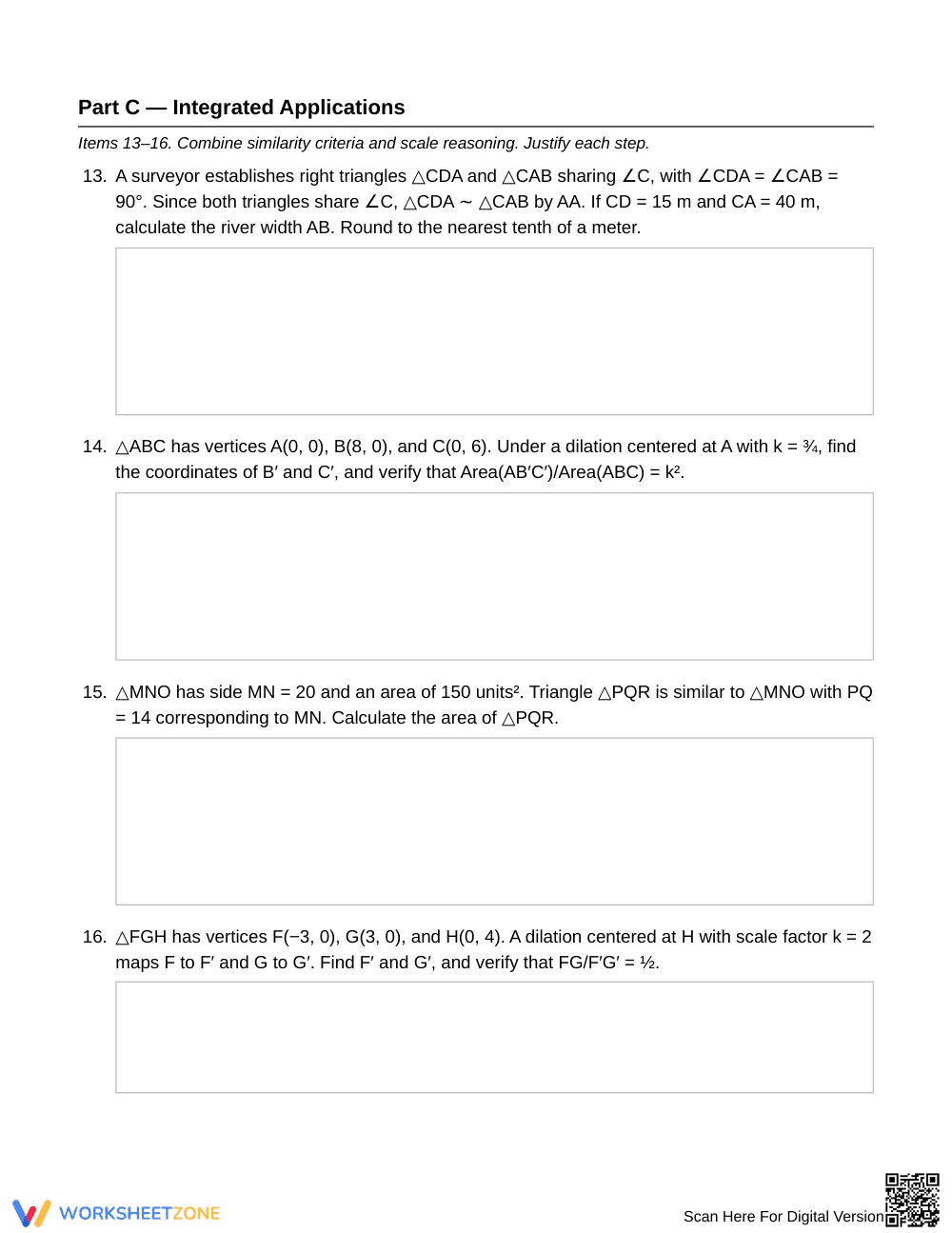
- Independent practice (Items 13–16): Integrated applications challenge learners to model surveyor indirect measurements, calculate scaled coordinates, and verify area ratios algebraically.
This sequence implements gradual release, moving learners smoothly from basic recall to multi-step proof.
Standards Alignment
Primary alignment is to `HSG-SRT.B.5`: Use congruence and similarity criteria for triangles to solve problems and prove relationships in geometric figures. Supporting standard `HSG-SRT.A.2` connects dilation definitions to similarity transformations. Both standard codes can be copied directly into lesson plans, IEP goals, or district curriculum mapping tools.
How to Use It
Implement this worksheet after direct instruction on triangle similarity as partner practice, or assign it before a unit exam. While circulating, check whether students square scale factors when solving area problems in Items 11 and 15, as conflating linear and two-dimensional scaling is a common misconception. Expected completion time is 45 to 60 minutes.
Who It's For
Designed for Grade 10 Geometry students, this worksheet supports developing learners through built-in reference conventions while challenging advanced thinkers with non-origin dilations. Pair this resource with dynamic geometry software or a similarity anchor chart for optimal engagement.
According to Fisher & Frey (2014), structured instructional frameworks that transition students from foundational schema building to autonomous problem solving significantly improve mastery in complex secondary mathematics. This Grade 10 Geometry worksheet directly targets standard HSG-SRT.B.5, guiding students through using triangle similarity criteria and scale factor reasoning to solve geometric problems and verify geometric relationships. By organizing practice into 16 carefully sequenced items—advancing from basic ratio statements and parallel line angle criteria to coordinate dilations with arbitrary centers and quadratic area relationships—the resource supports cognitive load management. Teachers gain targeted diagnostic evidence of student understanding across linear and area proportions, while learners develop the formal justification habits demanded by high-stakes assessments. The rigorous inclusion of coordinate geometry and real-world surveyor applications ensures students bridge the gap between abstract proportionality definitions and applied mathematical modeling.


