


























Views
Downloads
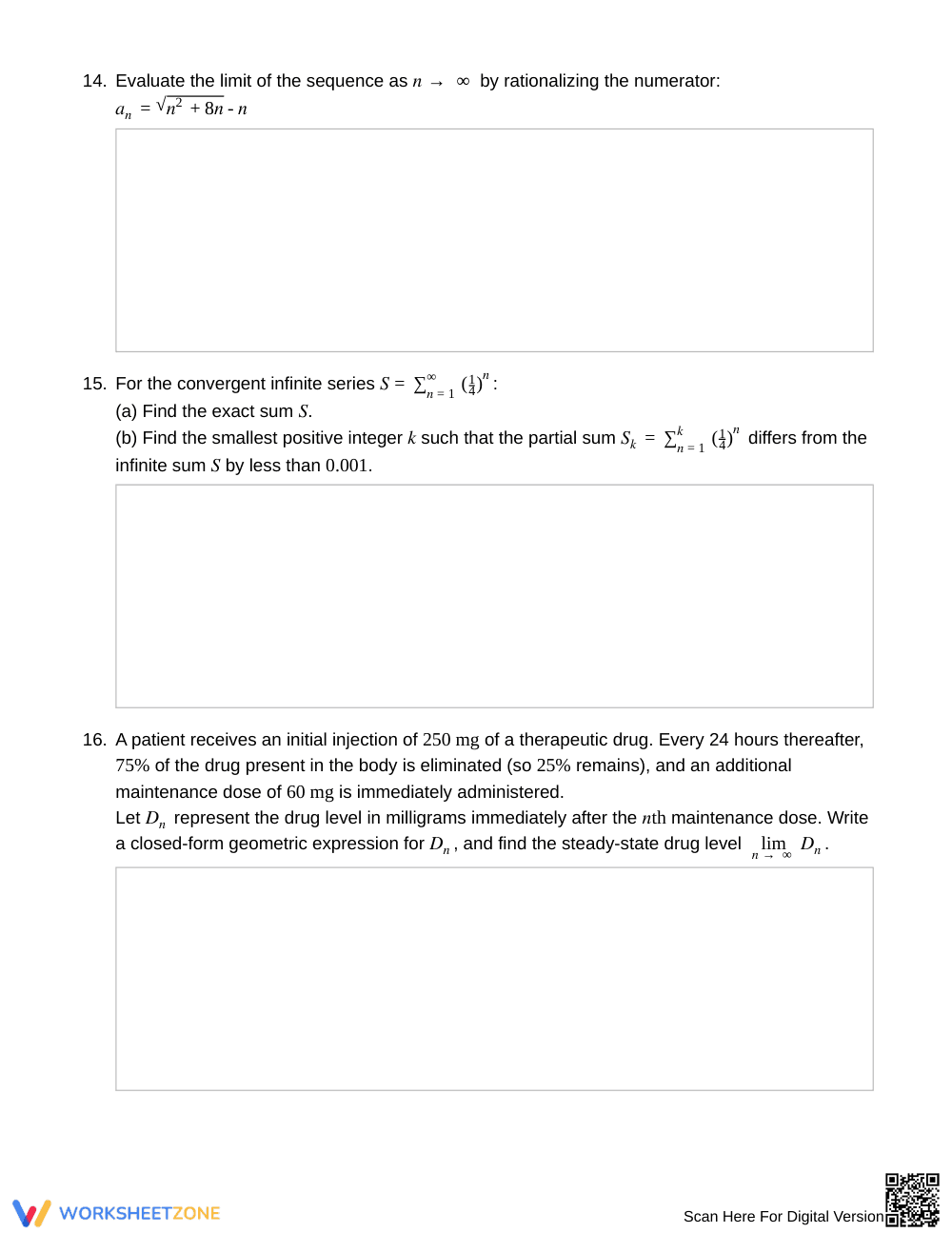

Complete Sequence Limits Worksheet | Grade 12 Precalculus
Paste this activity's link or code into your existing LMS (Google Classroom, Canvas, Teams, Schoology, Moodle, etc.).
Students can open and work on the activity right away, with no student login required.
You'll still be able to track student progress and results from your teacher account.
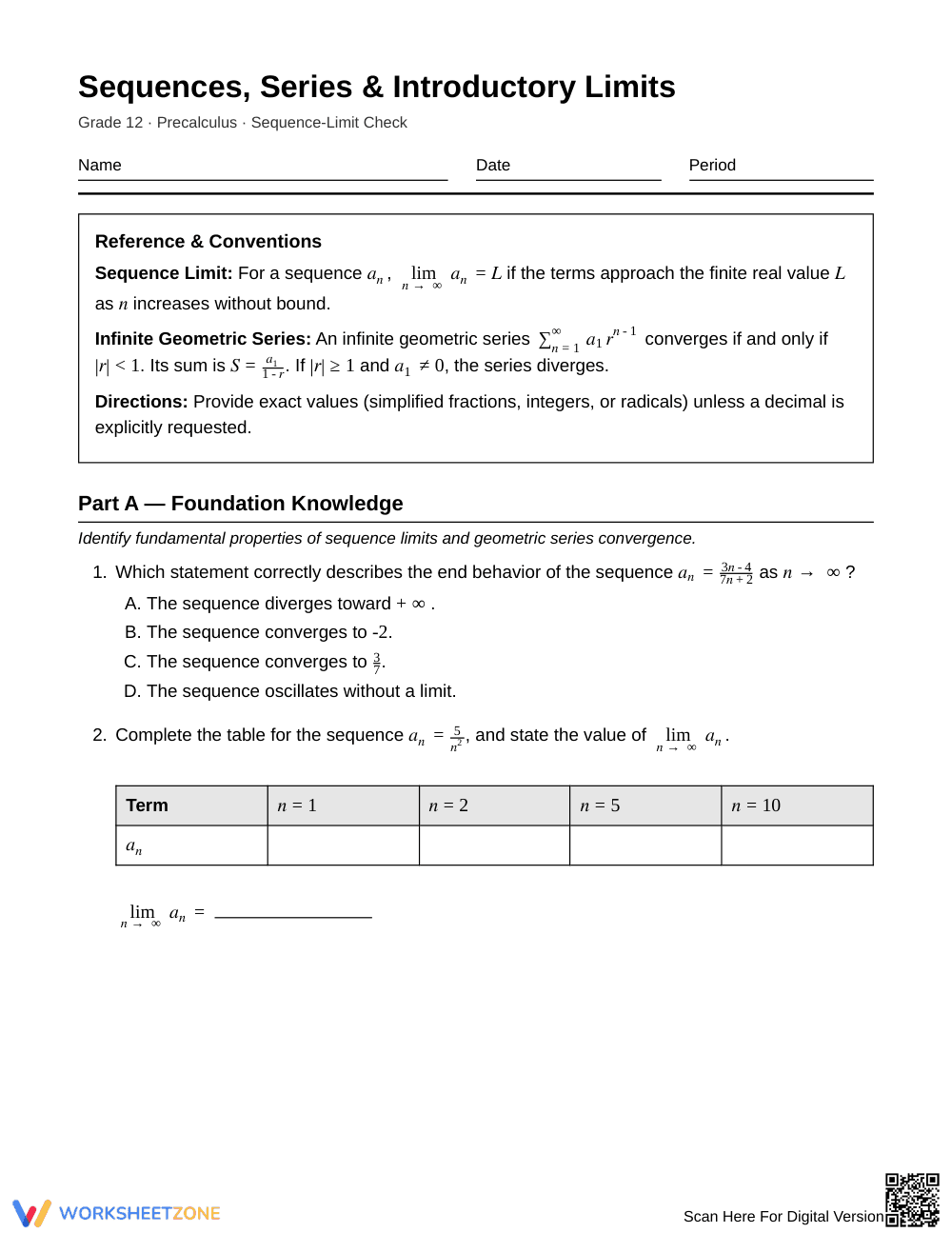
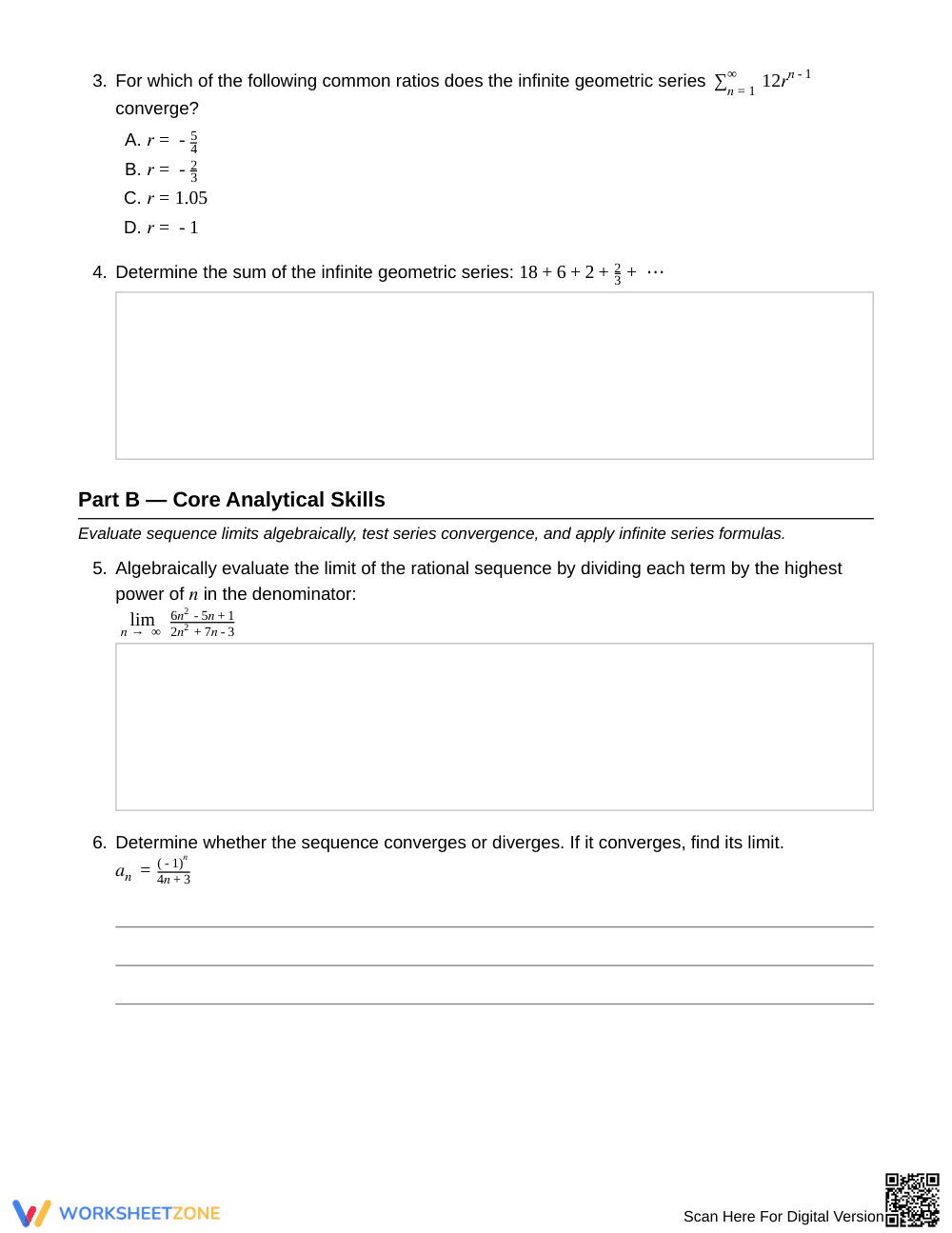
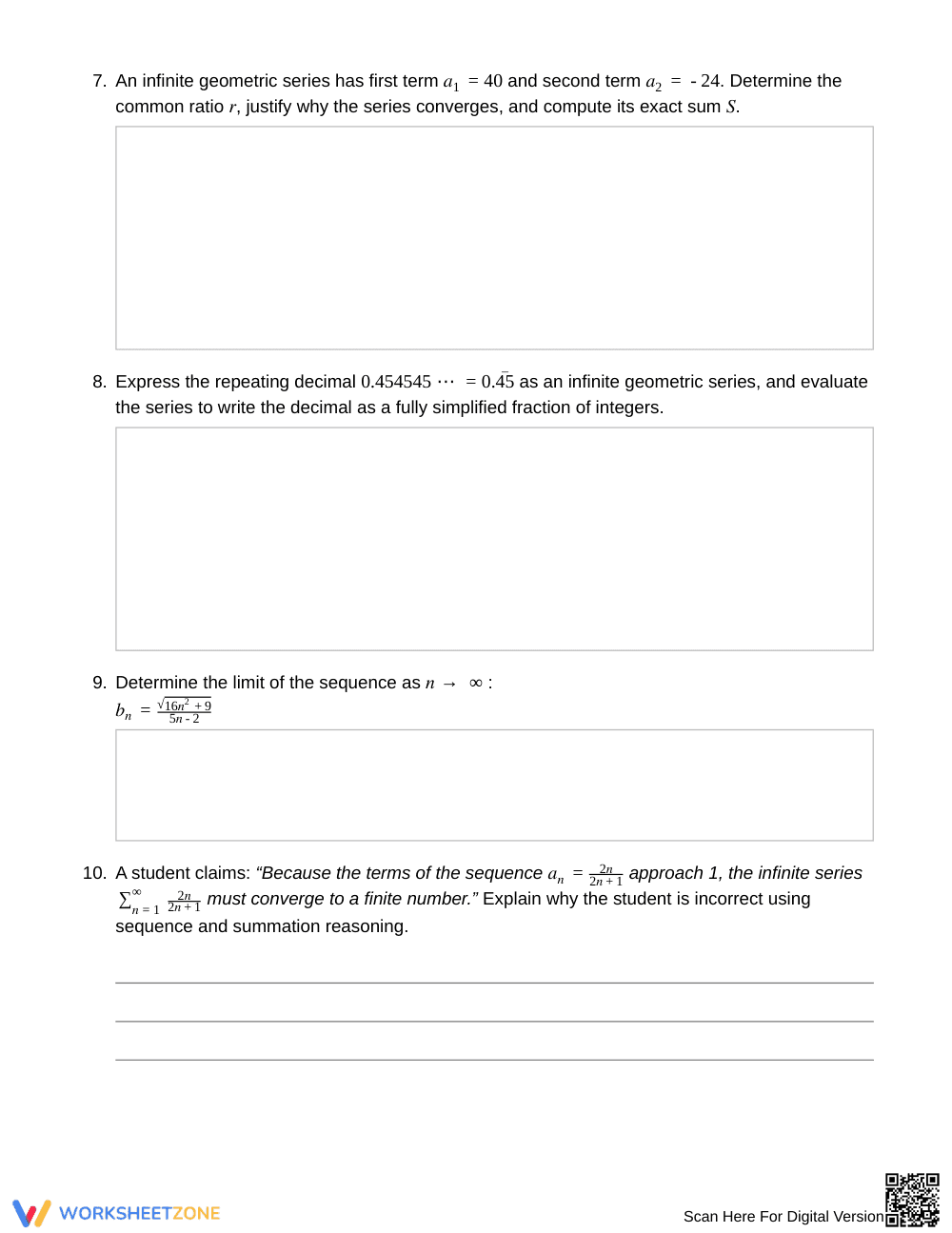
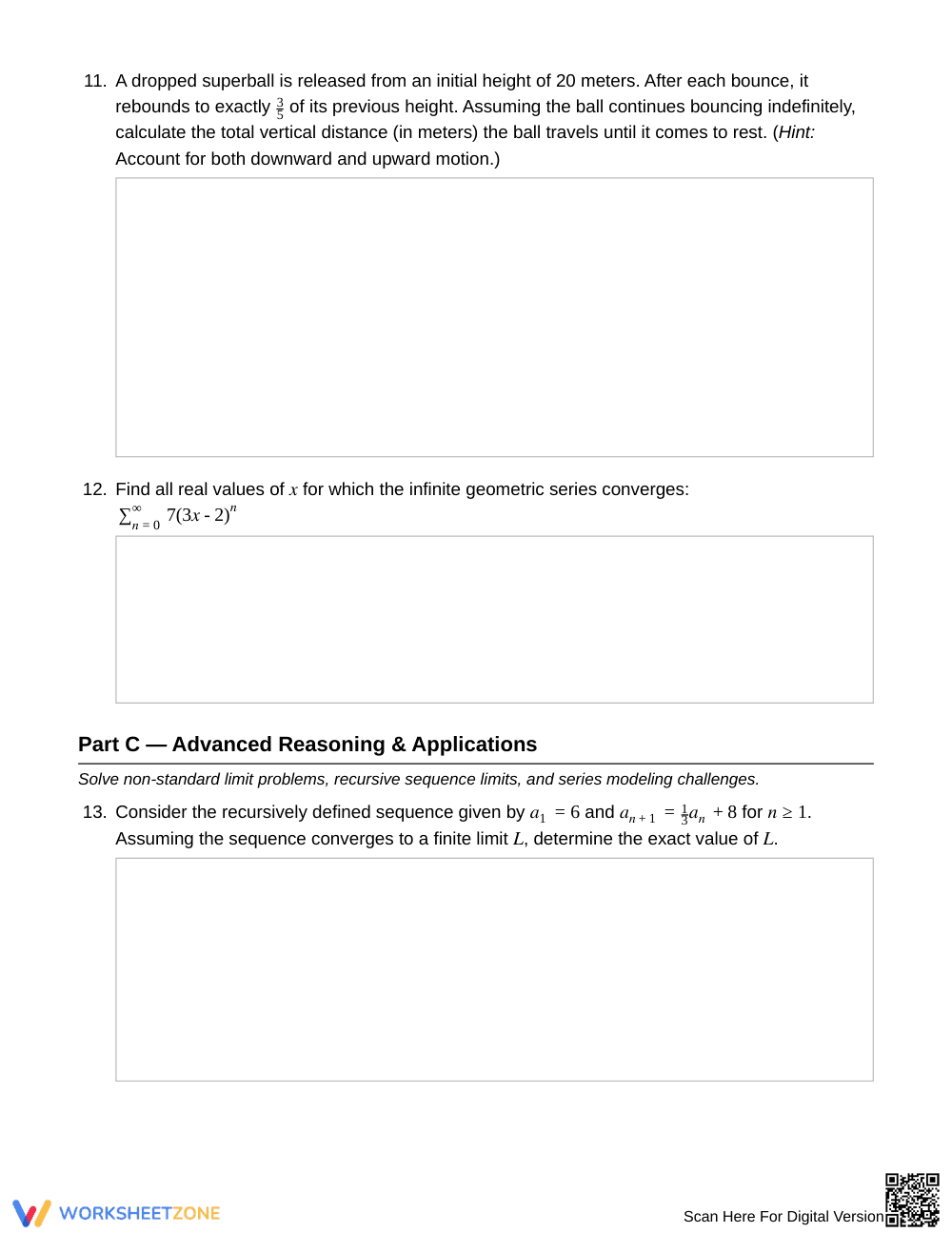
This Grade 12 Precalculus worksheet strengthens student understanding of sequence limits and infinite geometric series convergence across 16 rigorous analytical problems. Students evaluate end behavior, apply algebraic limit techniques, calculate infinite sums, and model real-world decay systems, establishing foundational fluency for introductory calculus.
At a Glance
- Grade: 12 · Subject: Precalculus
- Standard: Advanced Mathematics — Determine limits of sequences and evaluate convergence of infinite geometric series
- Skill Focus: Sequence Limits and Infinite Series Convergence
- Format: 5 pages · 16 problems · Answer key included · PDF
- Best For: Calculus readiness and comprehensive unit review
- Time: 45–60 minutes
What's Inside
The 5-page worksheet includes a reference formula box covering limit definitions and geometric series convergence tests before providing 16 varied tasks. Students encounter conceptual checks, numerical tables, algebraic rationalizations, repeating decimals, and contextual modeling problems. A full 4-page answer key provides complete algebraic solutions.
Skill Progression
- Guided practice (Part A, Problems 1–4): Foundation tasks evaluate end behavior, tabular trends, and series convergence conditions.
- Supported practice (Part B, Problems 5–12): Core analytical problems require evaluating rational and radical limits, converting repeating decimals, and calculating bouncing ball distances.
- Independent practice (Part C, Problems 13–16): Advanced tasks demand recursive limit analysis, numerator rationalization, error bound calculations, and drug elimination modeling.
This gradual-release structure moves students from foundational recognition to autonomous mathematical reasoning.
Standards Alignment
This resource aligns with advanced high school mathematics standards governing discrete limits and series analysis. Students determine sequence convergence, compute limits algebraically, and evaluate infinite series within real-world contexts. Both standard objectives can be copied directly into lesson plans, IEP goals, or district curriculum mapping tools.
How to Use It
Use this worksheet after direct instruction on sequence limits and geometric series. Assign Parts A and B during class to observe student rationalization steps on Problem 9 before assigning Part C. Expected completion time is 45 to 60 minutes.
Who It's For
Designed for Grade 12 Precalculus students preparing for calculus, this resource supports differentiated practice. Assign Parts A and B for targeted computation, reserving Part C for advanced learners. Pair with an anchor chart detailing convergence criteria.
According to research synthesized by Fisher & Frey (2014) on effective instructional scaffolding, sustained mathematical proficiency requires a deliberate transition from conceptual recognition to rigorous independent application. This 16-problem precalculus worksheet operationalizes that pedagogical architecture by guiding Grade 12 students through sequence limits and infinite geometric series convergence. Beginning with foundational table analysis and explicit convergence checks, the structured progression advances learners toward complex algebraic manipulation, including radical rationalization and recursive sequence modeling. By systematically bridging procedural execution with deep analytical reasoning, the resource reinforces conceptual stability across rational functions, bouncing ball vertical distance models, and steady-state pharmacokinetic applications. Such structured practice aligns directly with instructional frameworks necessary for post-secondary calculus readiness, enabling educators to diagnose misconceptions early and support students in developing lasting quantitative problem-solving habits across advanced discrete mathematics and introductory analysis topics.


