


























Views
Downloads




Complete Right-Triangle Trig Worksheet | Grade 10 Geometry
Paste this activity's link or code into your existing LMS (Google Classroom, Canvas, Teams, Schoology, Moodle, etc.).
Students can open and work on the activity right away, with no student login required.
You'll still be able to track student progress and results from your teacher account.
This comprehensive geometry practice packet equips Grade 10 students to master right-triangle trigonometry, angle calculations, and multi-step geometric modeling. Learners progress systematically from calculating primary trigonometric ratios to resolving complex real-world applications involving angles of elevation, depression, and regular polygons with precision.
At a Glance
- Grade: 10 · Subject: Geometry
- Standard:
HSG-SRT.C.8— Use trigonometric ratios and the Pythagorean Theorem to solve right triangles in applied problems- Skill Focus: Right-triangle trigonometry, inverse ratios, and modeling
- Format: 5 pages · 16 problems · Answer key included · PDF
- Best For: Geometry unit review and summative practice
- Time: 45–60 minutes
What's Inside
This 5-page practice set features 16 rigorous math tasks organized into three distinct tiers of complexity. It begins with fundamental ratio evaluations and inverse trigonometric angle calculations, transitions into applied single-triangle modeling problems, and concludes with advanced composite geometric figures. A comprehensive 2-page answer key provides step-by-step solutions and exact numerical rounding.
Skill Progression
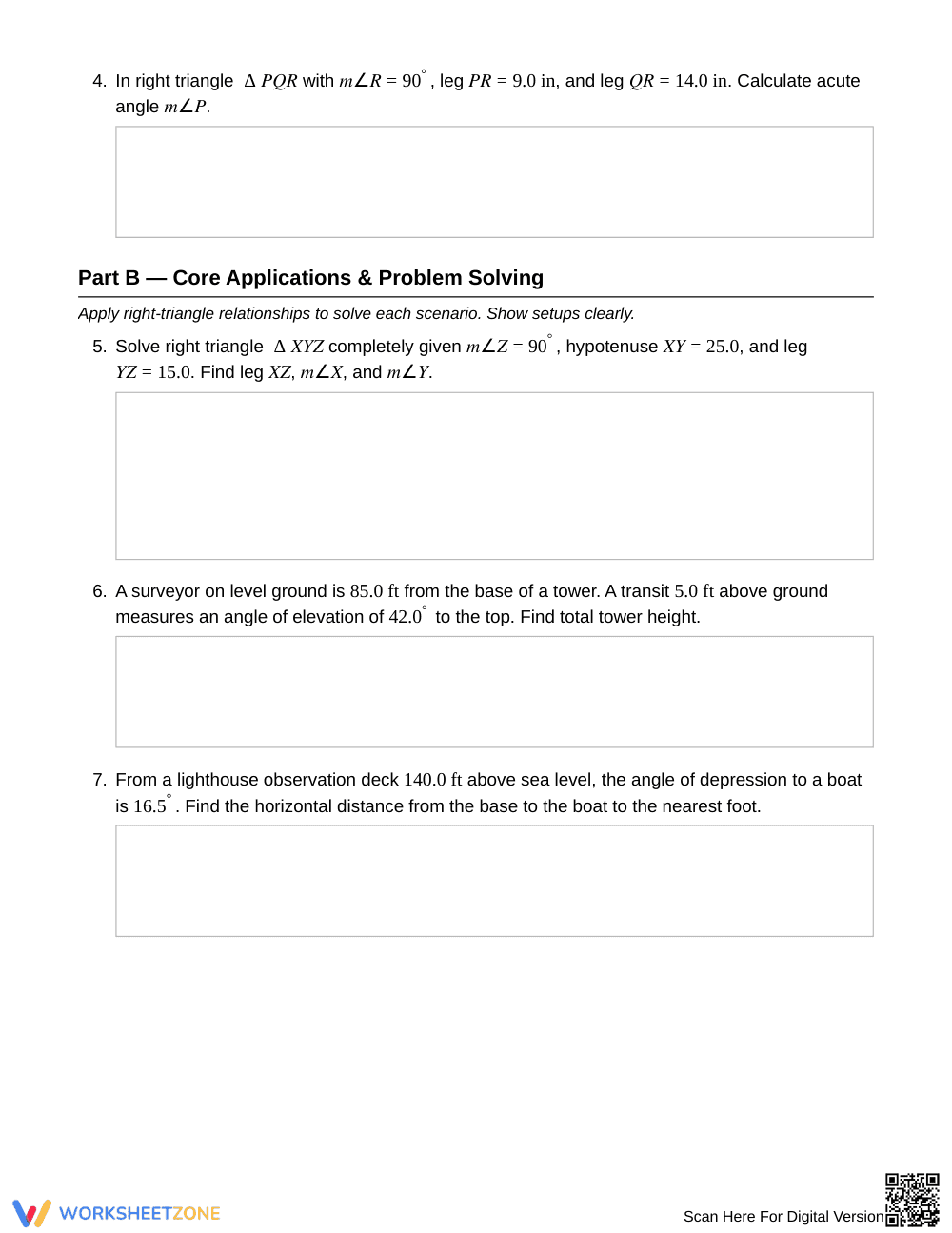
- Guided Practice (Part A, 4 problems): Foundation exercises focusing on calculating sine, cosine, and tangent ratios, setting up direct equations, and determining unknown side lengths or acute angles.
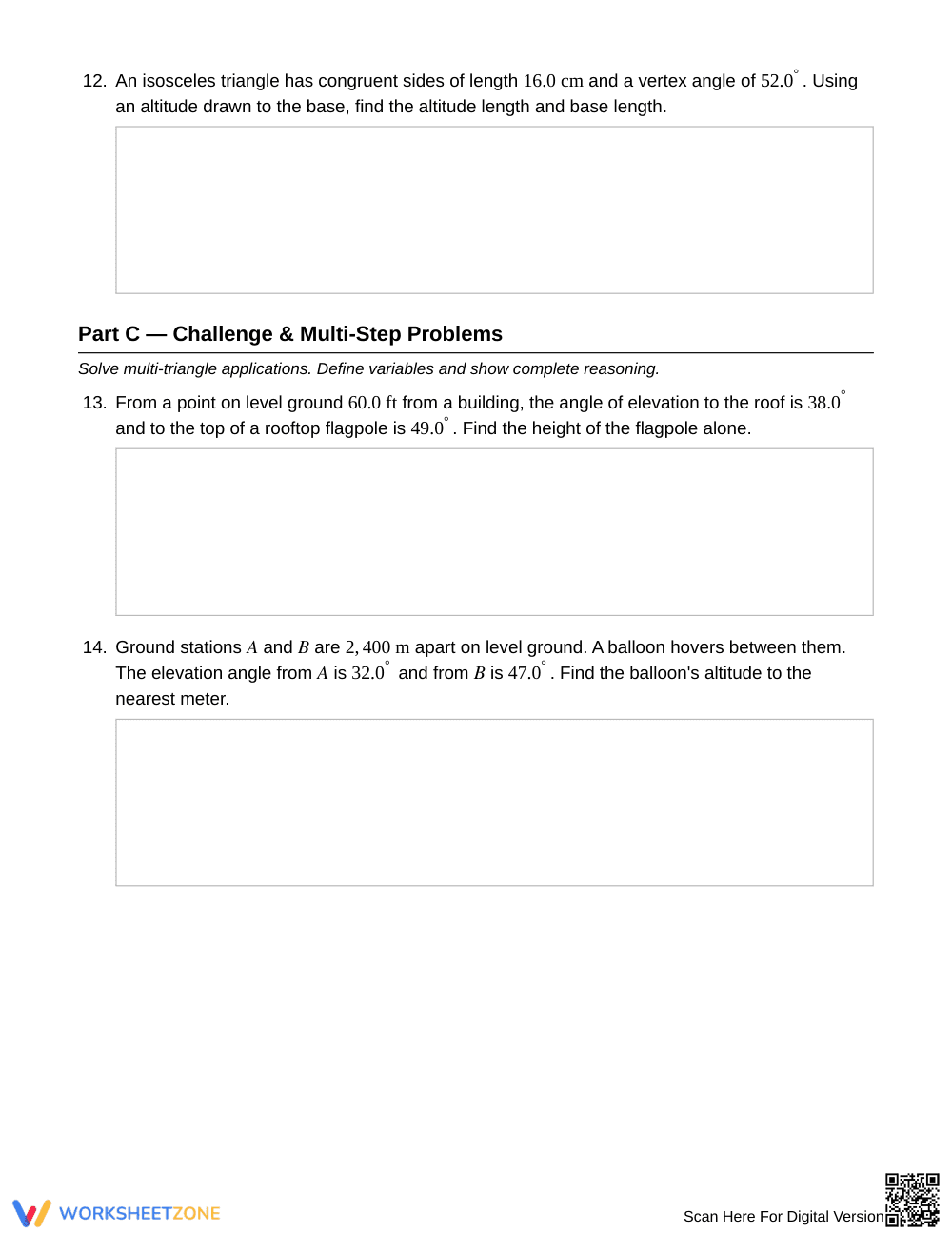
- Supported Practice (Part B, 8 problems): Applied word problems incorporating transit surveying, lighthouse observation lines, algebraic side expressions, ladder positions, wheelchair ramps, and isosceles triangle altitudes.
- Independent Practice (Part C, 4 problems): Multi-step challenge scenarios requiring system setups, including dual-angle flagpole sightings, two-station balloon tracking, trapezoid dimensions, and regular nonagon area calculations.
This tiered structure supports the gradual release of responsibility model, moving students from basic algorithmic setups to autonomous geometric synthesis.
Standards Alignment
This resource aligns directly with standard `HSG-SRT.C.8`: "Use trigonometric ratios and the Pythagorean Theorem to solve right triangles in applied problems." It also reinforces foundational work with complementary angle identities and trigonometric definitions. Both standard codes can be copied directly into lesson plans, IEP goals, or district curriculum mapping tools.
How to Use It
Deploy this packet after direct instruction on sine, cosine, and tangent definitions as an in-class summative assessment or multi-day review station. During work time, observe whether students correctly identify adjacent versus opposite legs when setting up inverse trigonometric equations. The complete 16-problem sequence is designed for a focused 45 to 60-minute instructional block.
Who It's For
This resource is tailored for Grade 10 Geometry students, honors math tracks, and students preparing for standardized state assessments. Scaffolded prompts support emerging learners, while composite challenge tasks stretch advanced thinkers. Pair this worksheet directly with visual right-triangle reference charts and scientific calculator orientation guides.
Grade 10 mathematics standards require students to apply trigonometric definitions and the Pythagorean Theorem to solve authentic geometric scenarios under standard HSG-SRT.C.8. This 16-task worksheet targets right-triangle trigonometry by building fluency across primary ratio setups, inverse angle computations, and multi-step composite spatial models. By integrating real-world contexts such as surveying transits, navigation angles, and regular polygon decompositions, students transition from rote arithmetic toward robust spatial analysis. According to Fisher & Frey (2014), instructional frameworks that scaffold mathematical tasks through guided, collaborative, and independent phases significantly enhance student conceptual retention and problem-solving autonomy. Incorporating systematic problem sets with full answer keys ensures teachers can identify persistent misconceptions regarding side labeling and degree-mode calculator operations rapidly during formative assessment checks.


