


























Views
Downloads



Complete Quadratic Features Worksheet | Grade 9 Algebra I
Paste this activity's link or code into your existing LMS (Google Classroom, Canvas, Teams, Schoology, Moodle, etc.).
Students can open and work on the activity right away, with no student login required.
You'll still be able to track student progress and results from your teacher account.
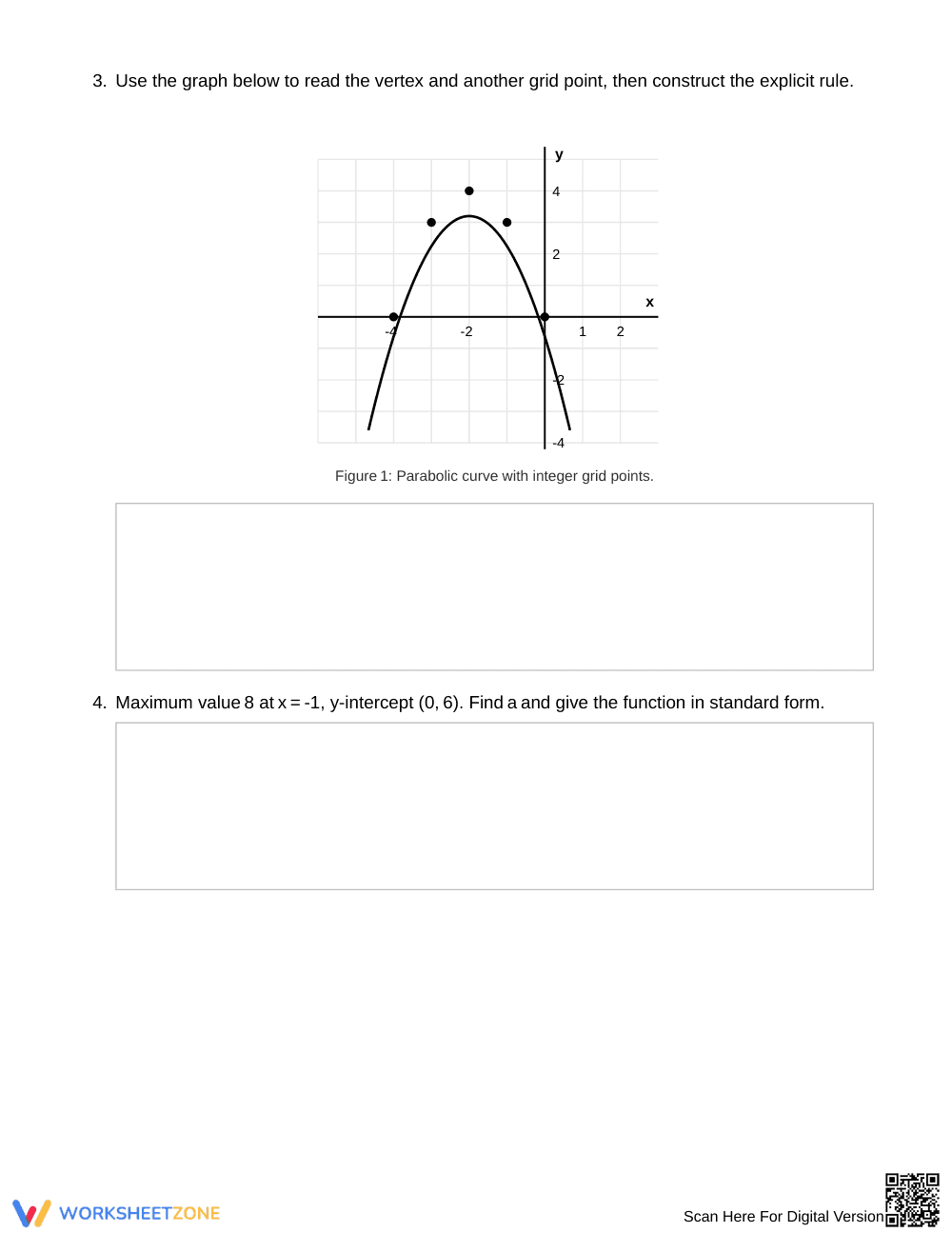
This 5-page Algebra I worksheet provides targeted practice in constructing quadratic functions from graph features and constraints. Grade 9 students analyze vertices, intercepts, and rates of change to build algebraic equations in vertex, factored, and standard forms across 14 rigorous modeling problems.
At a Glance
- Grade: 9 · Subject: Algebra I
- Standard:
HSF-BF.A.1— Write a quadratic function describing a relationship between two quantities.- Skill Focus: Constructing Quadratic Functions from Given Features
- Format: 5 pages · 14 problems · Answer key included · PDF
- Best For: Guided practice and skill mastery
- Time: 45–60 minutes
The worksheet provides a reference formula box displaying vertex, factored, and standard forms. Practice is organized across three sections: parameter determination from graphs and coordinates, contextual modeling with projectile and arch problems, and multi-constraint construction challenges. A complete two-page answer key provides step-by-step solutions.
Skill Progression
- Guided Practice (Part A, Problems 1–4): Students select optimal quadratic forms to determine parameters from given vertices, intercepts, or plotted curves.
- Supported Practice (Part B, Problems 5–8): Applied scenarios require students to model physical heights, break-even profits, and projectile trajectories.
- Independent Practice (Part C, Problems 9–14): Multi-constraint tasks require students to integrate axis conditions, ranges, and rates of change into complete algebraic rules.
This structured progression reflects the gradual-release model, moving students from guided calculation to independent mathematical modeling.
Standards Alignment
This worksheet aligns directly to primary standard HSF-BF.A.1: Write a function that describes a relationship between two quantities. It also supports standard HSF-IF.C.8.a by requiring conversion between vertex, factored, and standard forms. Both standard codes can be copied directly into lesson plans, IEP goals, or district curriculum mapping tools.
How to Use It
Use Part A during direct instruction for paired practice, or assign Parts B and C as independent practice or homework. As a formative check, observe whether students identify the most efficient form immediately or struggle by setting up unnecessary systems of equations. Expect students to complete the assignment in 45 to 60 minutes.
Who It's For
This resource supports Grade 9 Algebra I students learning quadratic functions, as well as older students reviewing for standardized algebra exams. Coordinate diagrams assist visual learners, while multi-constraint proofs challenge advanced thinkers. Pair this worksheet with an instructional anchor chart on quadratic forms for best results.
High school algebra instruction demands intentional alignment between algebraic manipulation and geometric interpretation. Under Common Core standard HSF-BF.A.1, students must construct quadratic functions from graph features, a skill central to algebraic modeling. Research by Fisher & Frey (2014) emphasizes that purposeful gradual-release architectures—progressing from focused parameter identification to open-ended applied modeling—prevent cognitive overload when students encounter multi-step functions. This worksheet operationalizes that framework by moving learners across 14 scaffolded tasks: identifying parameters from graphical vertices, applying quadratic formulas to physical projectile trajectories, and synthesizing complex boundary constraints. By linking factored, vertex, and standard forms within authentic scenarios like bridge engineering and trajectory analysis, the resource secures conceptual fluency alongside computational rigor. Teachers can rely on this document to evaluate functional reasoning, identify algebraic misconceptions, and prepare high school learners for advanced polynomial analysis.


