




























Views
Downloads



Complete Pricing Models Worksheet | Grade 9 Algebra I

Paste this activity's link or code into your existing LMS (Google Classroom, Canvas, Teams, Schoology, Moodle, etc.).
Students can open and work on the activity right away, with no student login required.
You'll still be able to track student progress and results from your teacher account.
This linear functions worksheet equips Grade 9 Algebra I students to evaluate competing pricing options through mathematical modeling. Learners solve ten structured problems to identify crossover thresholds, apply realistic budget constraints, and determine cost-effective solutions.
At a Glance
- Grade: 9 · Subject: Algebra I
- Standard:
HSA-CED.A.3— Represent constraints with equations or systems and interpret solutions as viable options- Skill Focus: Choose Between Two Pricing Models
- Format: 5 pages · 10 problems · Answer key included · PDF
- Best For: Linear systems and modeling practice
- Time: 45–60 minutes
What's Inside
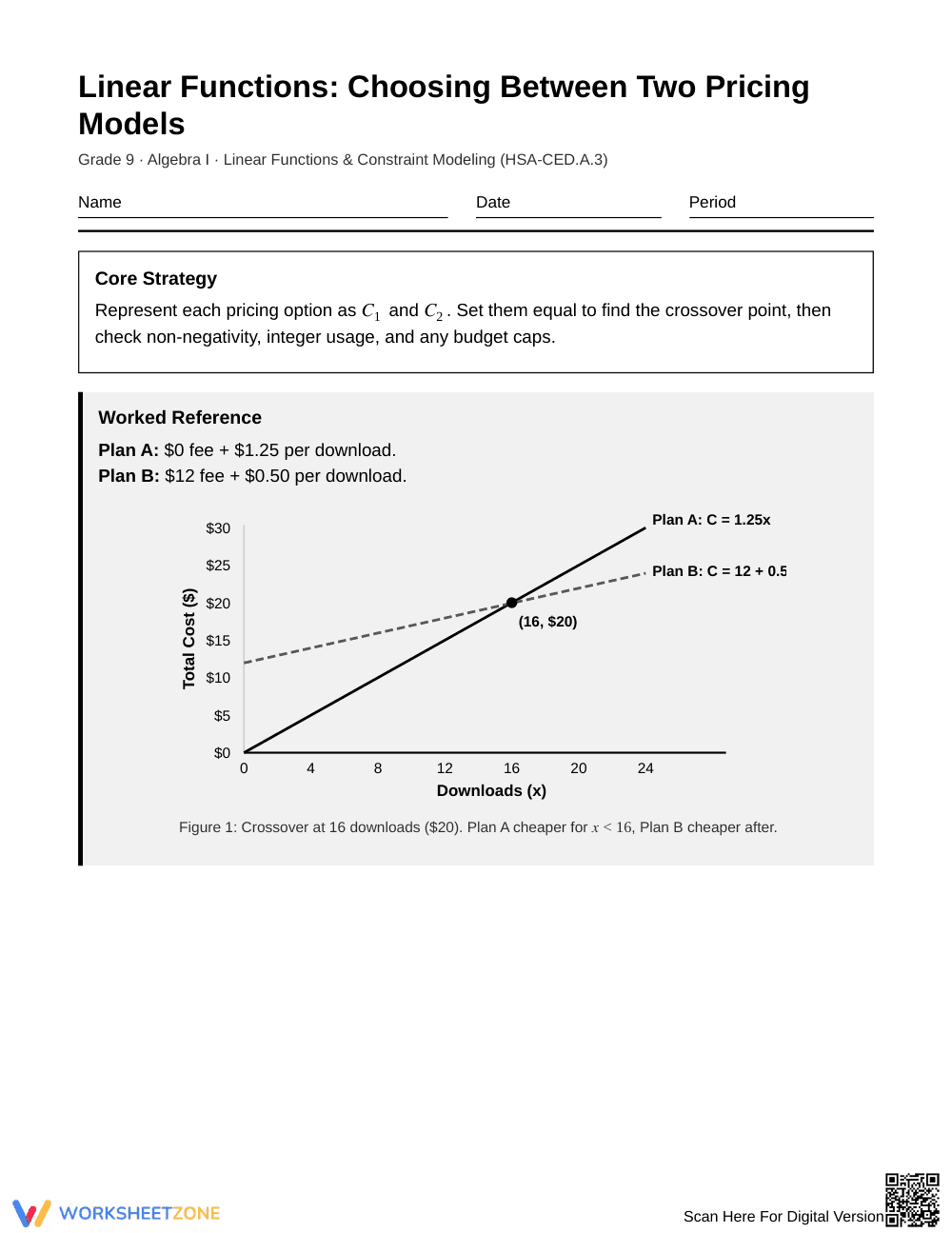
The 5-page student packet includes a core strategy reference box and an annotated break-even graph. Students write linear function pairs, calculate crossover points, and evaluate piecewise options across ten applied problems. The complete 2-page answer key provides step-by-step algebraic setups and solutions.
Skill Progression
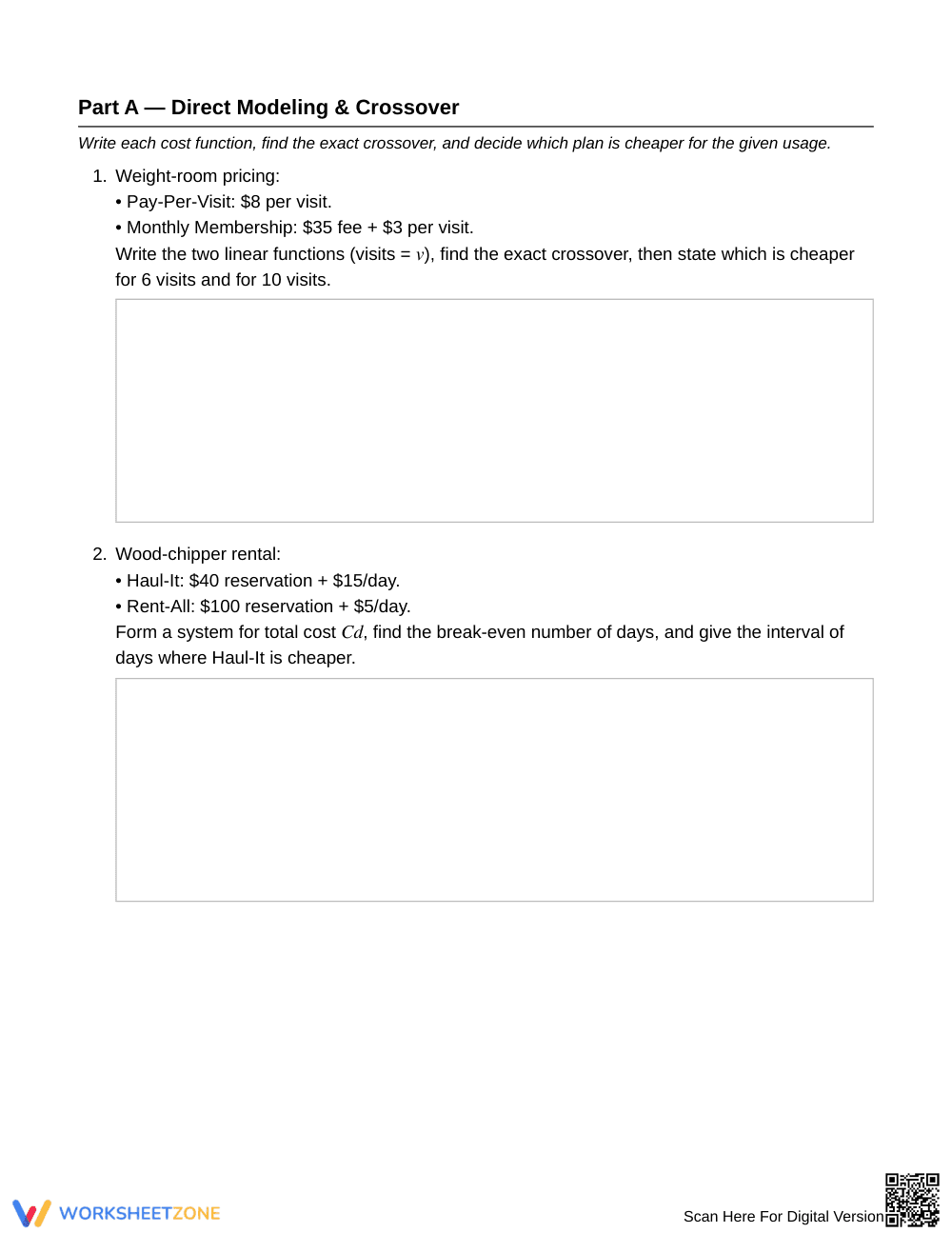
- Guided practice (Part A, 2 problems): Students write cost functions from clear scenarios and calculate exact break-even values with visual support.
- Supported practice (Part B, 6 problems): Learners solve multi-step problems involving setup fees, flat rates, and seasonal limits to maximize savings.
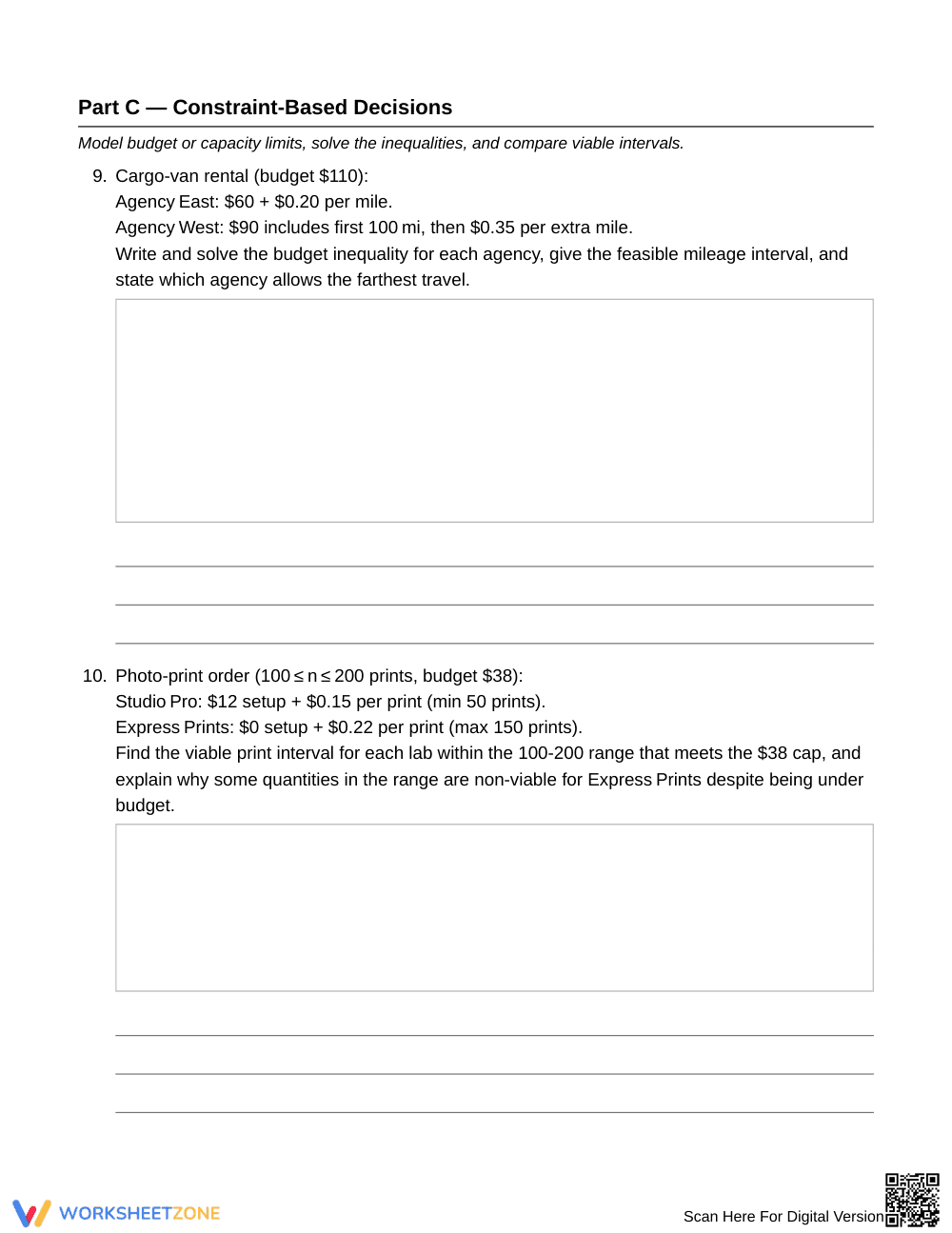
- Independent practice (Part C, 2 problems): Students solve system inequalities and determine viable domain intervals under strict budget caps.
This gradual-release progression moves students smoothly from basic crossover points to complex constraint analysis.
Standards Alignment
This resource aligns directly with `HSA-CED.A.3`: Represent constraints by equations or inequalities, and interpret solutions as viable or non-viable options in a modeling context. It also reinforces HSA-REI.C.6 by solving linear systems algebraically in applied contexts. Both standard codes can be copied directly into lesson plans, IEP goals, or district curriculum mapping tools.
How to Use It
Use this worksheet following direct instruction on linear systems. During partner work, check whether students equate expressions algebraically or rely on trial and error; redirect students to isolate variables. Alternatively, assign Part C as an exit ticket or summative check. Typical completion time is 45 to 60 minutes.
Who It's For
This practice is designed for Grade 9 Algebra I students learning constraint modeling, as well as high schoolers needing applied systems review. Provide struggling learners with a graphic organizer for fixed and variable rates. Pair this activity with a coordinate plane anchor chart showing break-even intersections.
According to EdReports 2024, high-quality secondary mathematics instruction requires authentic modeling tasks where students interpret algebraic solutions within authentic contextual constraints. This worksheet directly supports standard HSA-CED.A.3 by challenging Grade 9 students to choose between two pricing models through linear equations and system inequalities. Rather than practicing isolated procedural calculations, learners must translate complex verbal parameters into mathematical functions, locate algebraic crossover points, and assess non-viable domain intervals under strict budget limits. Research syntheses highlighted by EdReports 2024 demonstrate that connecting symbolic systems to real-world financial decision-making deepens conceptual retention, supports mathematical discourse, and improves student performance on standardized modeling assessments. By combining structured visual scaffolds with rigorous multi-step problem solving, this comprehensive instructional resource ensures that secondary learners build both procedural fluency and durable quantitative literacy across diverse high school classroom settings.


