


























Views
Downloads

Complete pH & Concentration Worksheet | Grade 11 Chemistry
Paste this activity's link or code into your existing LMS (Google Classroom, Canvas, Teams, Schoology, Moodle, etc.).
Students can open and work on the activity right away, with no student login required.
You'll still be able to track student progress and results from your teacher account.
Mastering aqueous equilibria requires distinguishing between solute concentration and acid strength. This Grade 11 chemistry worksheet provides 10 analytical problems where students evaluate laboratory records, calculate hydronium concentrations, analyze percent ionization, and determine neutralization stoichiometry across strong and weak monoprotic systems.
At a Glance
- Grade: 11 · Subject: Chemistry
- Standard: State Chemistry Standards — Analyze aqueous equilibrium, concentration, and pH data to evaluate chemical shifts
- Skill Focus: Interpret Concentration-and-pH Records
- Format: 5 pages · 10 problems · Answer key included · PDF
- Best For: Quantitative acid-base practice and review
- Time: 45–60 minutes
What's Inside
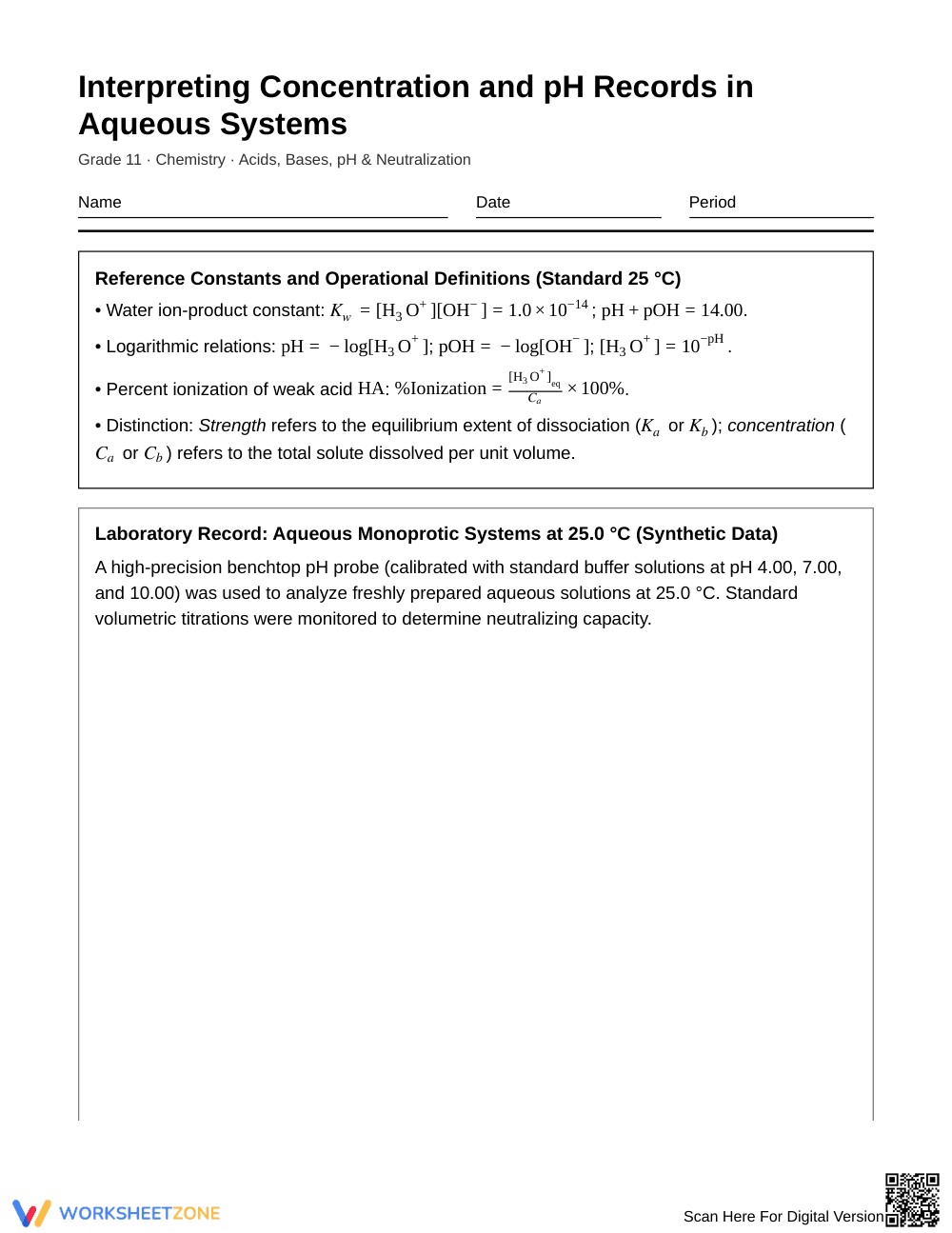
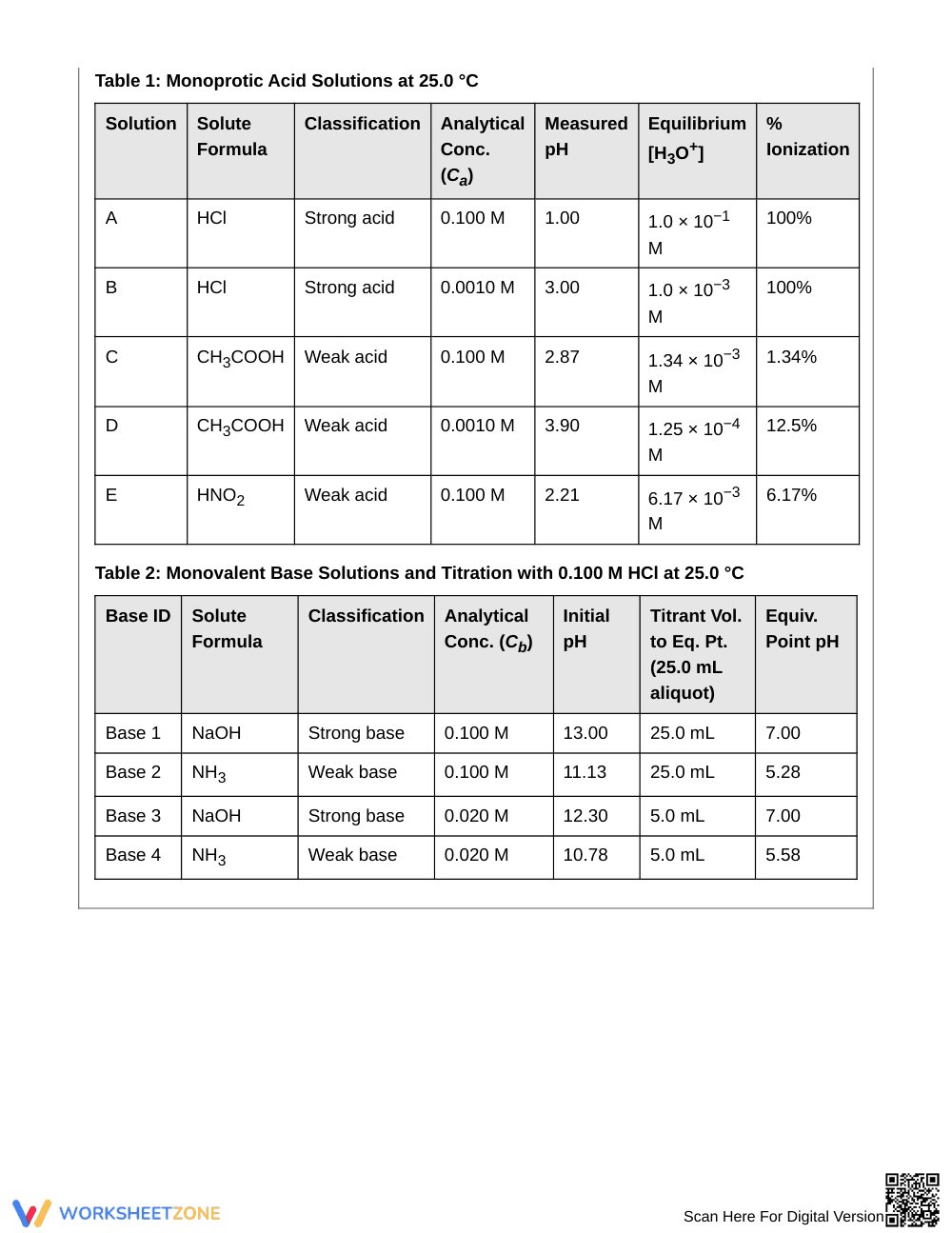
This 5-page worksheet provides two reference tables of experimental pH, hydronium concentrations, and titration data. It includes a reference definition box, 10 structured analytical problems spanning three difficulty tiers, and a 4-page answer key containing complete mathematical solutions.
Skill Progression
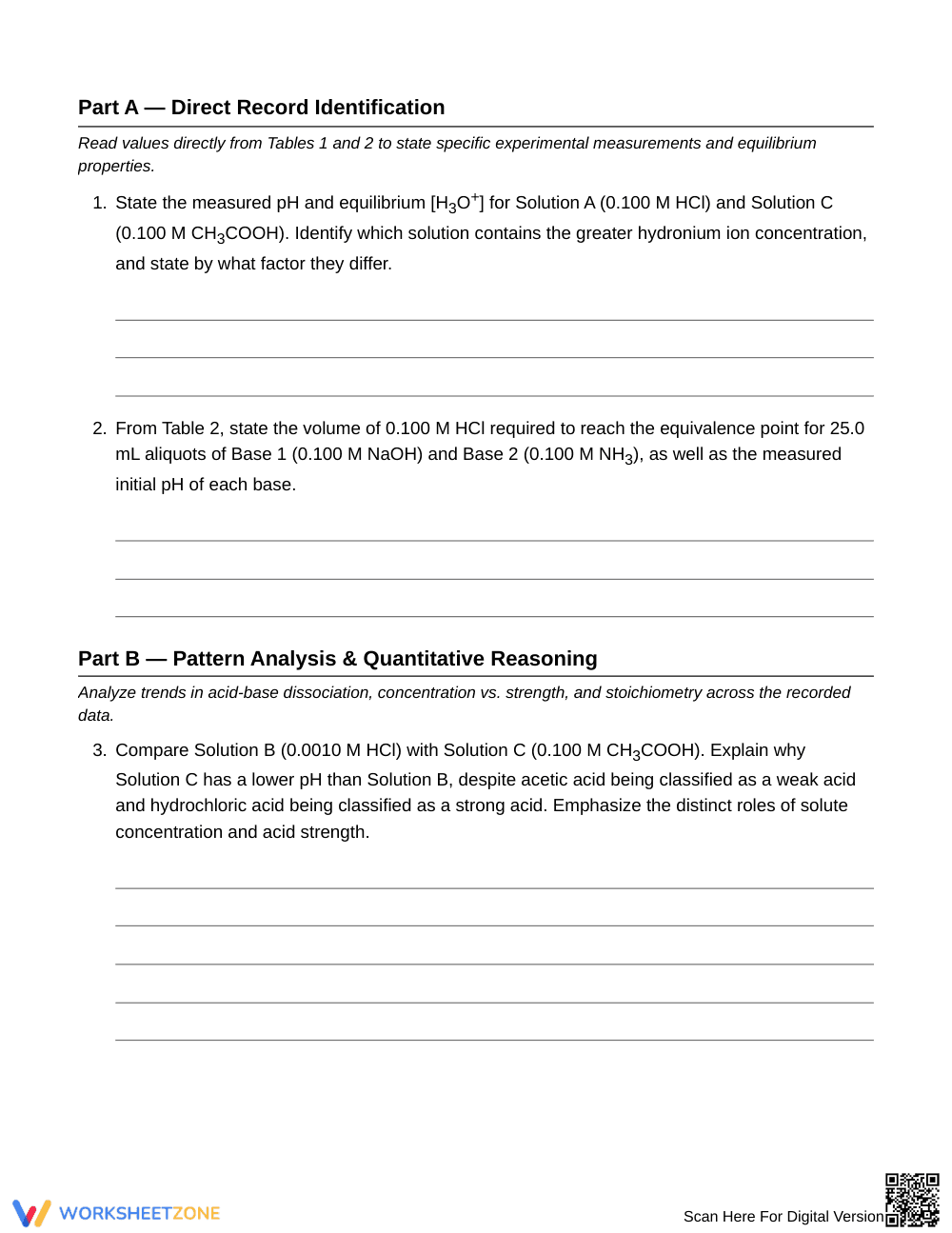
- Guided Practice (Part A, 2 tasks): Direct data extraction from tables to compare hydronium concentrations and stoichiometric titration volumes.
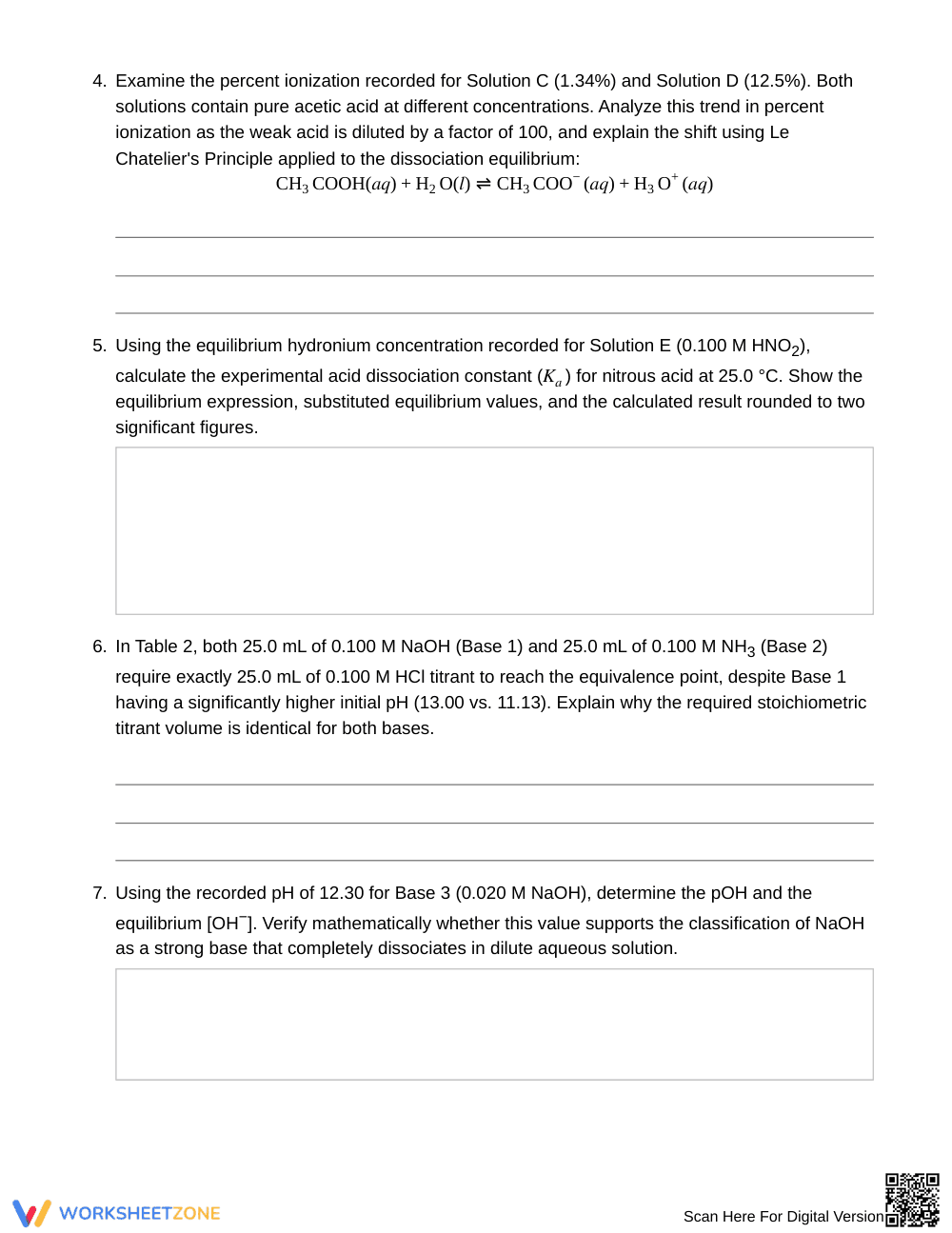
- Supported Practice (Part B, 6 tasks): Quantitative analysis calculating Ka values, modeling dilution shifts via Le Chatelier's principle, and writing hydrolysis reactions.
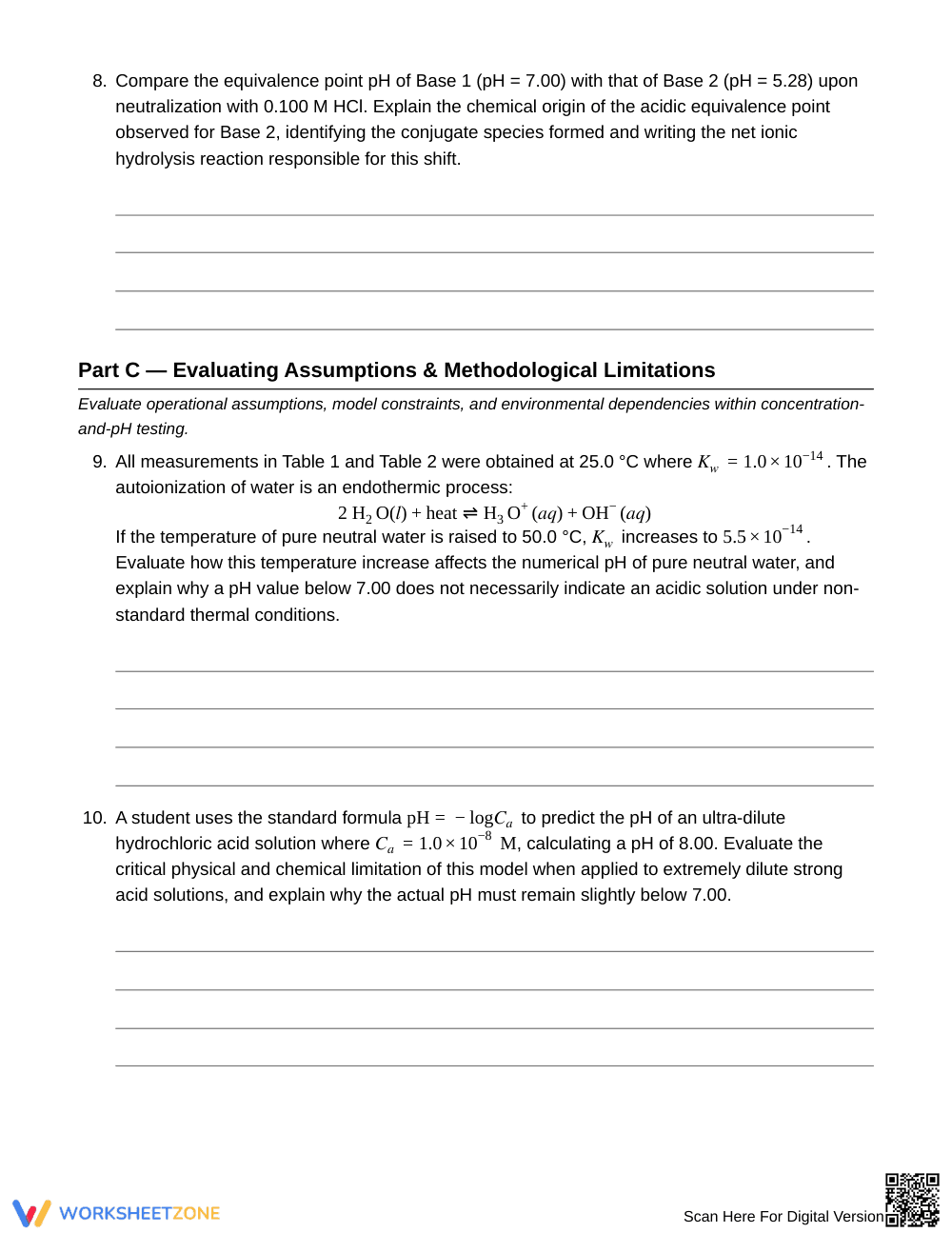
- Independent Practice (Part C, 2 tasks): Methodological evaluation assessing temperature effects on Kw and model limitations in ultra-dilute acid solutions.
This sequence follows a gradual-release model, transitioning students from foundational table reading to advanced thermodynamic evaluation.
Standards Alignment
This resource aligns with high school chemistry standards for aqueous equilibrium and chemical reactions. Students evaluate acid dissociation, apply Le Chatelier's principle, and calculate pH. Supporting standards address titration stoichiometry and mathematical modeling of equilibrium systems. Both standard codes can be copied directly into lesson plans, IEP goals, or district curriculum mapping tools.
How to Use It
Use this worksheet after direct instruction on acid-base dissociation constants and pH. Implement it during class as a collaborative laboratory analysis activity or assign it as comprehensive test prep. Formative tip: verify that students distinguish between acid strength and solute concentration when analyzing Solution B and C. Expected completion time is 45 to 60 minutes.
Who It's For
Designed for Grade 11 Chemistry, Honors, and AP Chemistry students. Tiered tasks support struggling learners with formula reference boxes while challenging advanced students with equilibrium model critique. Pair with an acid-base titration lab or equilibrium anchor chart.
According to Fisher & Frey (2014), structured data analysis tasks that bridge conceptual understanding and quantitative modeling accelerate higher-order reasoning in secondary science education. This Grade 11 chemistry resource targets interpreting concentration-and-pH records across aqueous monoprotic acid and base systems. By examining authentic laboratory records, students confront common misconceptions surrounding the critical distinction between analytical solute concentration and acid-base dissociation strength. Learners progress from basic data extraction and hydronium concentration factor comparisons to calculating experimental dissociation constants (Ka), justifying dilution-driven percent ionization shifts using Le Chatelier's principle, and formulating net ionic hydrolysis equations for weak base neutralization. Furthermore, evaluating thermodynamic shifts in Kw at raised temperatures and examining the failure of standard logarithmic models in ultra-dilute regimes reinforces methodological critique. This systematic instructional approach ensures students achieve measurable mastery in quantitative chemical equilibrium analysis.


