




























Views
Downloads



Complete Order of Operations Worksheet | Grade 6 Math

Paste this activity's link or code into your existing LMS (Google Classroom, Canvas, Teams, Schoology, Moodle, etc.).
Students can open and work on the activity right away, with no student login required.
You'll still be able to track student progress and results from your teacher account.
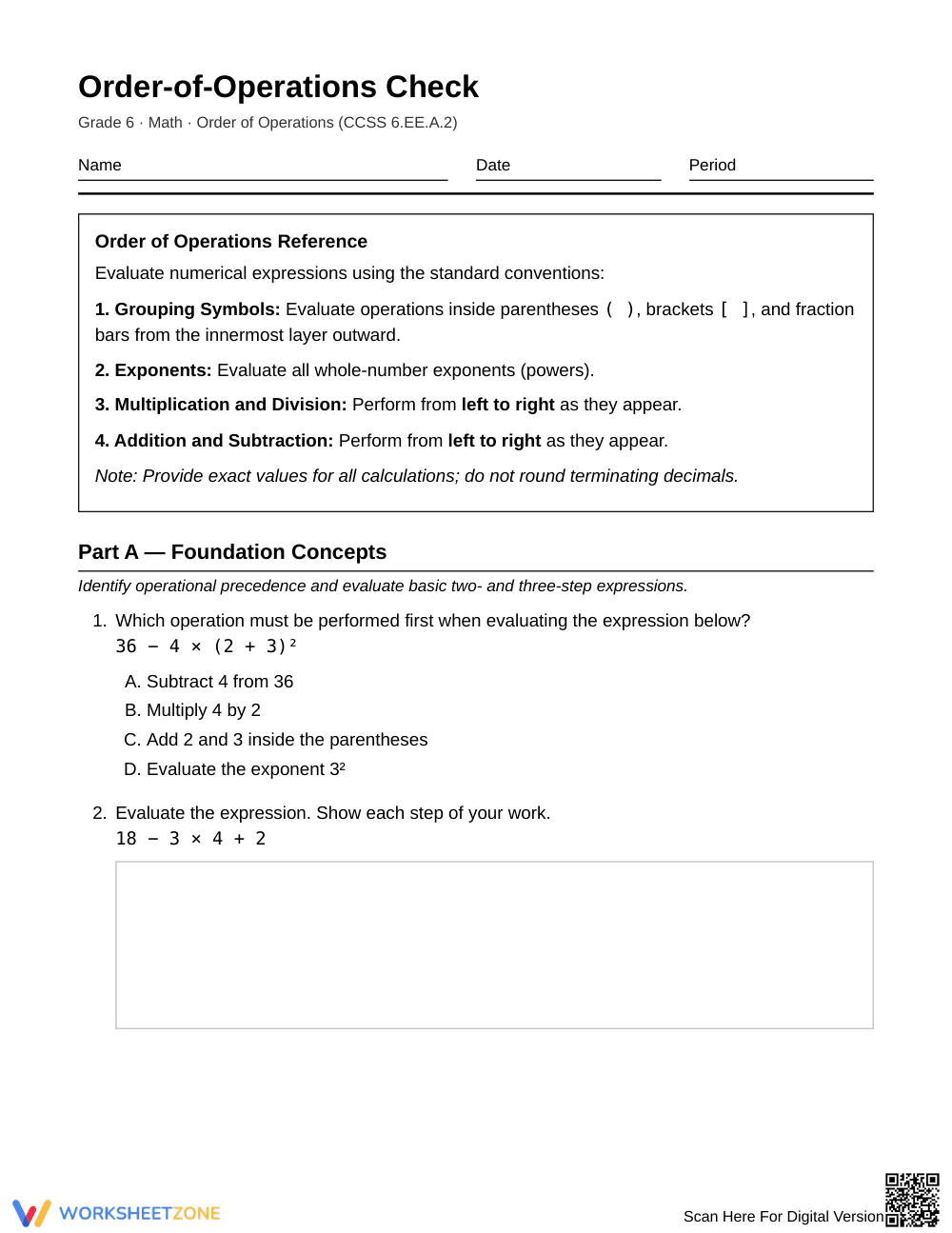
Master evaluating complex numerical expressions with this comprehensive 5-page practice resource. Designed for sixth-grade mathematics, this worksheet guides students through operational precedence, exponents, parentheses, nested brackets, and multi-step calculations with whole numbers and decimals. Students build computational precision, identify common algebraic misconceptions, and justify mathematical reasoning across 16 rigorous problems.
At a Glance
- Grade: 6 · Subject: Math
- Standard:
6.EE.A.1— Write and evaluate numerical expressions involving whole-number exponents- Skill Focus: Order of operations with exponents and brackets
- Format: 5 pages · 16 problems · Answer key included · PDF
- Best For: Independent practice, targeted intervention, review
- Time: 35–45 minutes
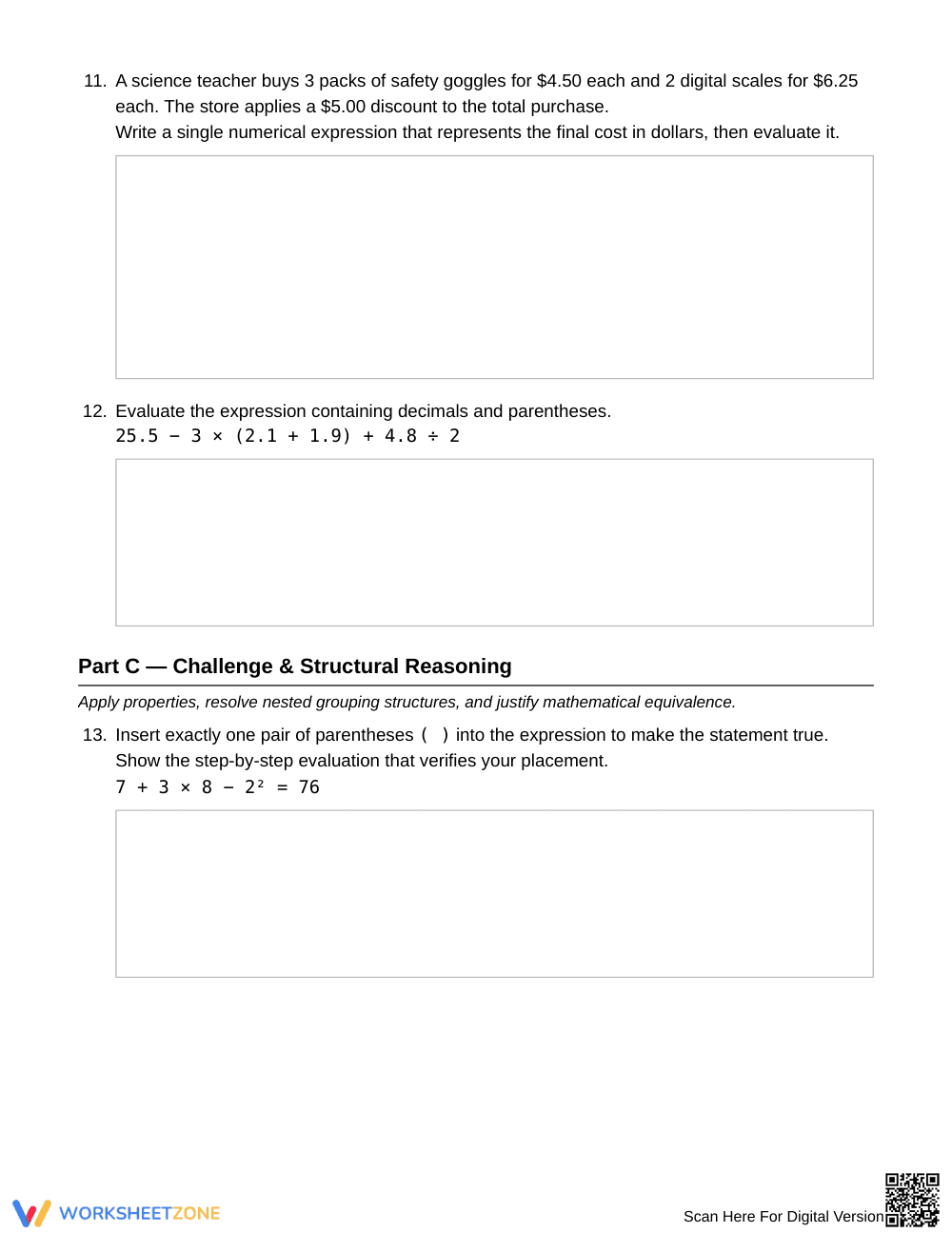
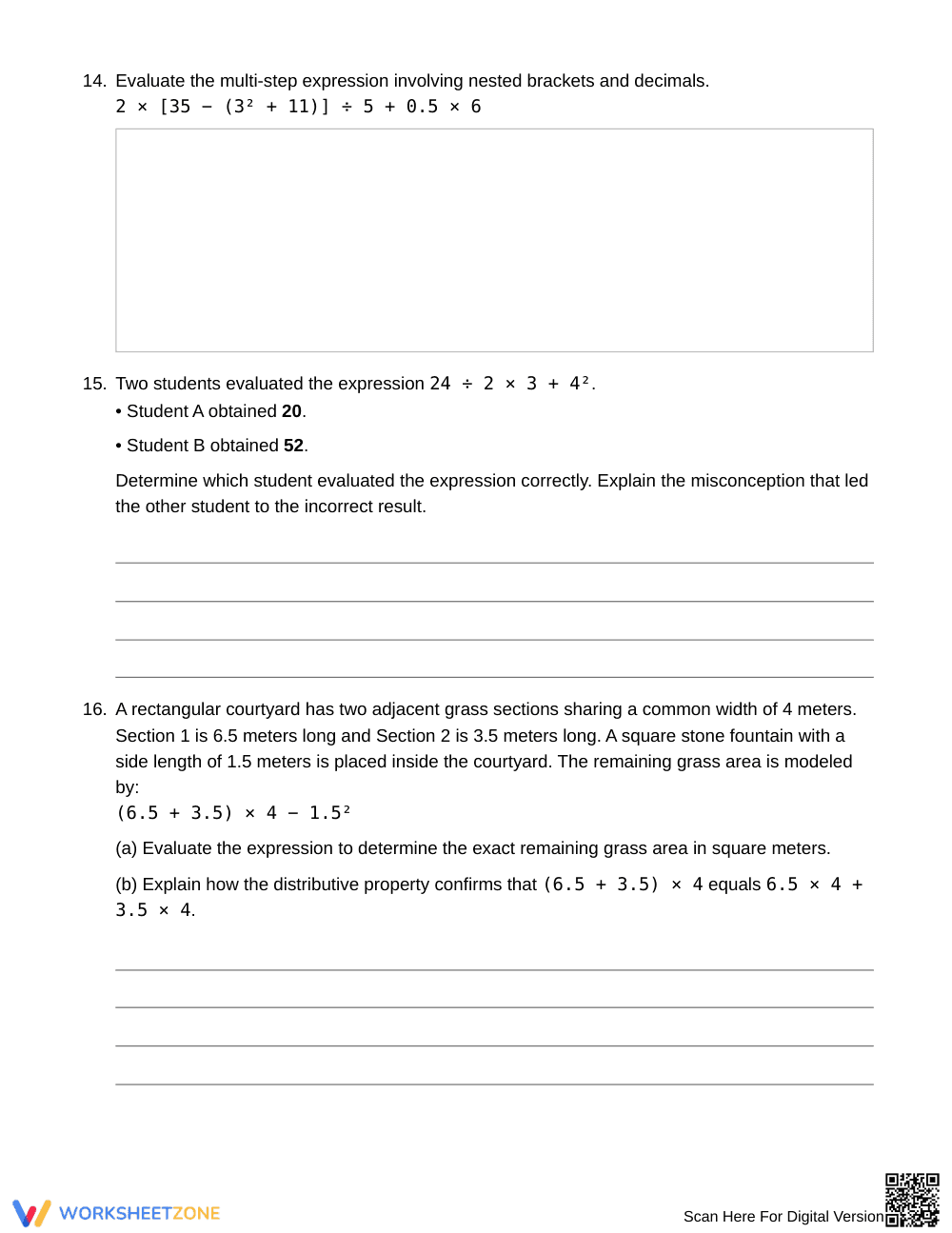
This 5-page print-and-go worksheet contains 16 varied problems structured around an opening reference guide outlining standard operational hierarchy. It features basic multi-step evaluation, decimal computations, comparative inequality analysis, contextual word problems, and error-analysis tasks where students diagnose common calculation mistakes. A thorough 4-page answer key provides step-by-step solutions to streamline grading and support self-checking.
Skill Progression
- Guided practice (Part A): 4 foundational items establish operational precedence, requiring students to identify first operations and evaluate two- to three-step expressions with exponents and simple grouping symbols.
- Supported practice (Part B): 8 core application tasks expand into decimal values, comparative statements, multi-step word problems, and targeted error-analysis prompts that challenge procedural oversights.
- Independent practice (Part C): 4 non-routine challenge problems require students to insert grouping symbols to reach target values, simplify nested brackets, resolve student misconceptions, and connect expressions to geometric area models.
This sequence follows a gradual-release instructional model, transitioning students from fundamental recall to deep conceptual analysis.
Standards Alignment
This worksheet directly aligns with 6.EE.A.1: Write and evaluate numerical expressions involving whole-number exponents. It also reinforces foundational work within CCSS.MATH.CONTENT.6.EE.A.2 by requiring students to identify parts of an expression and evaluate terms accurately. Both standard codes can be copied directly into lesson plans, IEP goals, or district curriculum mapping tools.
How to Use It
Deploy this worksheet during the independent practice phase following direct instruction on operational conventions, or assign it as a targeted mid-unit review station. While students work, formatively observe whether they calculate multiplication and division strictly from left to right rather than prioritizing multiplication arbitrarily. Typical completion time spans 35 to 45 minutes.
Who It's For
This resource serves general education sixth-grade math students, accelerated fifth graders, and seventh-grade intervention groups needing remediation in pre-algebraic structures. Pair this activity naturally with a classroom order-of-operations anchor chart or a short teacher-led modeling lesson on handling nested brackets and exponents.
According to research by Fisher & Frey (2014) on structured instructional frameworks, moving students systematically through scaffolded tiers of guided, collaborative, and independent problem-solving solidifies conceptual retention and procedural fluency. This 16-problem mathematics resource targets standard 6.EE.A.1 by reinforcing operational hierarchy, whole-number powers, and grouping boundaries. Students actively evaluate multi-step numerical expressions, resolve nested brackets, manipulate decimal values, and engage in constructive error analysis. By challenging learners to detect procedural flaws in sample work and justify operations through geometric area models, the resource cultivates higher-order mathematical reasoning. The inclusion of structured reference supports alongside rigorous evaluation tasks ensures equitable access while driving mastery of algebraic fundamentals. Teachers can confidently utilize this resource to evaluate student understanding and address common operational misconceptions.


